SSS.6.209 - Stealth Additive Works Tisha and the MK18 5.56x45mm Short Barrel Automatic AR15 Rifle (Free Version)
/Stealth Additive Works Tisha on the MK18 5.56x45mm AR15 with 10.3-in Barrel
The name "Tisha" is derived from the Russian word Тише (Tiše), phonetically: TEE-sheh, which translates to "quieter" and is commonly used as a colloquial command for "hush" or "be quiet."
The Tisha is designed and manufactured by Stealth Additive Works. It is a .223 caliber centerfire rifle silencer, optimized to suppress the 5.56x45mm NATO cartridge. It has a variable external diameter; the proximal diameter is almost 2.1 inches, while the distal diameter is 1.8 inches. With no mount installed, the silencer is 4.13 inches long. The rear of the silencer is threaded 1.375-24tpi to accommodate “HUB” compatible mounting systems; the direct-thread mount used in testing increased the total system length to 4.56 inches. The Tisha is entirely 3D-printed from Gr. 5 ELI titanium. The core of the silencer weighs 8.9 ounces and the 1/2-28tpi direct-thread mount weighs 2.1 ounces, for a total system weight of 11 ounces, as tested. The retail version of the silencer includes a Q Plan-B-compatible HUB mount and brake muzzle device. The Tisha can be obtained directly from Stealth Additive Works.
Silencer Hazard Map:
The predicted personnel hazards generated by the tested weapon system in this report, in the free field, are shown in the adjacent Silencer Hazard Map. Click or tap the Map to enlarge. Please reference Silencer Hazard Map Brief 8.1.7 for further details. The PEW-SOFT HD Blast Hazard Prediction Tool and Hazard Mapper is presented in Report 8.1.1.
Stealth Additive Works Tisha 10.3-in MK18 AR-15 Free Field Hazard Map Produced by PEW-SOFT HD Blast Hazard Prediction Tool using PEW Science Test Data
PEW Science is an independent private testing laboratory and also hosts the world’s only independent public suppressed small arms research cooperative. Testing, data analysis, and reporting is generated with funding provided by PEW Science members. Any test data that is generated with any portion of private funding contains this disclosure. The testing and analysis production for this Sound Signature Review was funded in part by PEW Science Project PEW-SAW-134-001-25. Therefore, data pertaining to the Tisha in this Sound Signature Review is published with the express written permission of Stealth Additive Works.
The testing and analysis presented in this Sound Signature Review is of the Stealth Additive Works Tisha mounted with a direct-thread mount on the MK18 Automatic AR15 rifle rifle, chambered in 5.56x45mm NATO with a 10.3-inch barrel. Federal XM193 55gr ammunition was used in the test. The standard PEW Science MK18 test host weapon system is described in Public Research Supplement 6.51.
Report Table of Contents:
Section 6.209.1 contains a Stealth Additive Works (SAW) Tisha Performance Summary and Generational Hybrid Design Technology Comparison (SAW vs. CAT SURGE BYPASS vs. KAC PRT)
Section 6.209.2 contains Stealth Additive Works Tisha test results and analysis on the standard untuned MK18.
Section 6.209.3 contains overall Suppression Rating comparisons of the Stealth Additive Works Tisha with dedicated 223 and 30 caliber silencers on the current market, including the CAT CACM 556, CAT KK, FOR Systems Monarch Recce, Engaged Industries Operator 5.56, Q Southpaw, Centurion Arms Maximus-L, Otter Creek Labs Infinity, PTR VENT Spiritus 556i, LMT AT ION LT, HUXWRX FLOW 556 Ti, Off Grid Operator Ti, Surefire SOCOM556-MINI2, KAC QDC/CRS-PRT, KAC QDC/MCQ-PRT, Surefire SOCOM556-RC3, Otter Creek Labs Polonium-30, AAC M4-2000 Mod 08, PTR VENT 3, SilencerCo Velos LBP, BOSS Guillotine, CAT WB, PWS BDE 556, CAT ODB, Aero Precision Lahar-30L, Lahar-30, HUXWRX FLOW 762 Ti, Maxim Defense DSX, Thunder Beast Dominus, KAC 5.56 QDC, CGS SCI-SIX, Dead Air Nomad-30, YHM Turbo T2, Dead Air Sandman-S, HUXWRX FLOW 556k, Energetic Armament ARX, KAC QDSS-NT4, Rugged Razor556, Otter Creek Labs Polonium and Polonium-K, Surefire SOCOM556-RC2, HUXWRX HX-QD 556 and HX-QD 556k, Q Trash Panda, CGS Helios QD, SilencerCo Saker 556, Rugged Razor762, and others.
Section 6.209.4 contains an article summary and PEW Science laboratory staff opinions.
Summary: When paired with the 10.3-in barrel MK18 and fired with Federal XM193, the Stealth Additive Works Tisha with a direct-thread mount achieved a composite Suppression Rating™ of 49.6 in PEW Science testing.
As with all weapon systems, the user is encouraged to examine both muzzle and ear Suppression Ratings.
Relative Suppression Rating Performance is Summarized in SSS.7 - PEW Science Rankings.
6.209.1 Stealth Additive Works Tisha Performance Summary and Generational Hybrid Design Technology Comparison
The PEW Science Silencer Sound Standard includes the 5.56x45mm NATO suppression evaluation of a variety of different rifle silencer technologies. Of the technologies proliferating in the current market, hybrid designs provide the greatest performance potentials while balancing operator and bystander protection and weapon system reliability and longevity. Specifically, these types of silencers use early venting and different pressure stages to relieve stagnation and increase suppression efficiency in a given design envelope, while also significantly reducing back pressure. Hybrid designs are not Flow Through silencers, and misclassification is commonplace in the silencer industry; no Flow Through silencers exist other than those manufactured by HUXWRX (formerly OSS). For more details, performance evaluations, and in-depth signature comparisons of hybrid and conventional designs, the reader may examine analysis that is previously published in:
Member Research Supplement 6.103 (supersonic 5.56 NATO)
Member Research Supplement 6.115 (supersonic 7.62 NATO)
Member Research Supplement 6.124 (subsonic 300 BLK)
Member Research Supplement 6.169 (supersonic 5.56 NATO), and recently
Member Research Supplement 6.184 (subsonic 9mm).
The subject report presents an evaluation of the Stealth Additive Works Tisha rifle silencer that implements what PEW Science classifies as next generation hybrid technology. While some advanced hybrid silencers evaluated by PEW Science incorporate several of the above features in their designs, no other hybrids combine all these performance traits with superior pressure stage and vent timing. More specific details of the Tisha design are highlighted in the next section of this report.
In the previous Combat Application Technologies CAT CACM556 MK18 technical report (6.203), a concerted effort was made to highlight hybrid silencer design evolution, performance scaling with size, and efficiency differentials that vary across technologies. That effort continues in this report, and the Stealth Additive Works Tisha provides the public with an excellent case study of the following design factors:
Aforementioned superior pressure stage and venting timing.
The augmenting of annular (coaxial) elements with patent-pending TPMS structures (reference adjacent recent research).
To be clear, it is not the addition of a single design element that produces high performance from a small arm weapon system silencer. It is the combination and purposefully engineered integration of multiple design elements that give way to high holistic system performance. At the time of this report publication, the Stealth Additive Works Tisha represents the most advanced and complete performance example of hybrid design rifle silencer technology evaluated by the PEW Science Laboratory.
There are three significant geometric traits of the Tisha that are important to highlight, with nuanced emphasis:
The Tisha is only 4.13 inches long without a mount. Though the tested direct-thread mount increased the system length to 4.56 inches, it is postulated that using a shorter direct-thread mount would not appreciably influence system performance. The silencer is already one of the shortest models evaluated on this system, with the highest performance, and it could be even shorter.
The bore of the tested silencer is dedicated for 5.56 mm (.223) projectile use. The silencer test specimen evaluated in this program is not a 6 mm (.243) rifle silencer. This information is provided for practical utility and to highlight the fact that system back pressure is not high with the Tisha, despite the “tighter” bore aperture than possessed by some competing designs. On the contrary, in combination with the short dwell time of the standard untuned MK18, the Stealth Additive Works Tisha is shown not to exacerbate adverse ejection port blast hazards and produces the highest shooter’s ear Suppression Rating on a reciprocating 5.56 weapon system in the Rankings, to date. Early-time flow rate and vent characteristics are discussed further in this report. The operator risk with the Tisha on this platform, in the free field, is on par with the tuned MK18 example presented in the Maxim Defense SURG study (6.111). This is unprecedented. [Research Caution - extrapolation of this performance trait to other AR-15 platforms with different gas port sizes and dwell times will produce spurious results. Weapon system tuning will be required to achieve this level of free field operator risk reduction on most platforms.]
The external diameter of the silencer is stepped; it is larger at the blast entrance and smaller at the blast exit. Gross increases in volumetric expansion due to diameter increases are not the sole reason for the performance increases produced by the Tisha silencer or by most high performance silencers, in general. It is the utilization of volumetric “real estate” that enables design efficiency. Expansion, turbulence generation, gross heat transfer, and other mechanisms combine to greatly enhance total performance. When all design principles are used simultaneously, the highest levels of performance can be achieved.
Repeating the comparative example from report 6.203, and adding the next generation Stealth Additive Works Tisha, we produce the following:
The CAT CACM 556 and CAT KK (6.197) silencers represent some of the most mature examples of CAT SURGE BYPASS, as previously examined in other CAT rifle silencers such as the WB (6.129), ODB (6.120), and TSWIF (6.193). This is one of the state-of-the-art silencer technologies on the current market that balances performance with form factor. Other examples of hybrid design technologies, applied to different form factors on the same weapon platforms, exist in the research pedigree and have been evaluated in-depth. A relatively well known example is from KAC; their Pressure Reduction Technology (PRT) is a hybrid design class in which early time flow rate is significantly elevated when compared to legacy KAC QDC silencer designs and advanced blast dynamics are used to reduce first-round-pop (FRP) propagation. An exhaustive evaluation of this technology is presented in KAC Report 6.156 with 16 tests.
The raw performance of the Tisha, regardless of form factor, is illustrated in Figure 1, below. “Large” and “small” silencers from the two other hybrid technology example families are compared with the next generation Stealth Additive Works Tisha: two CAT SURGE BYPASS units (CACM 556 and KK) and two KAC PRT units (556-QDC/CRS-PRT and 556-QDC/MCQ-PRT). The host weapon system is kept constant, and metrics shown are in terms of PEW Science Suppression Rating, which is a human risk metric calculated from raw free field blast overpressure test data. The calculated risk metrics for the unsuppressed case are also presented.
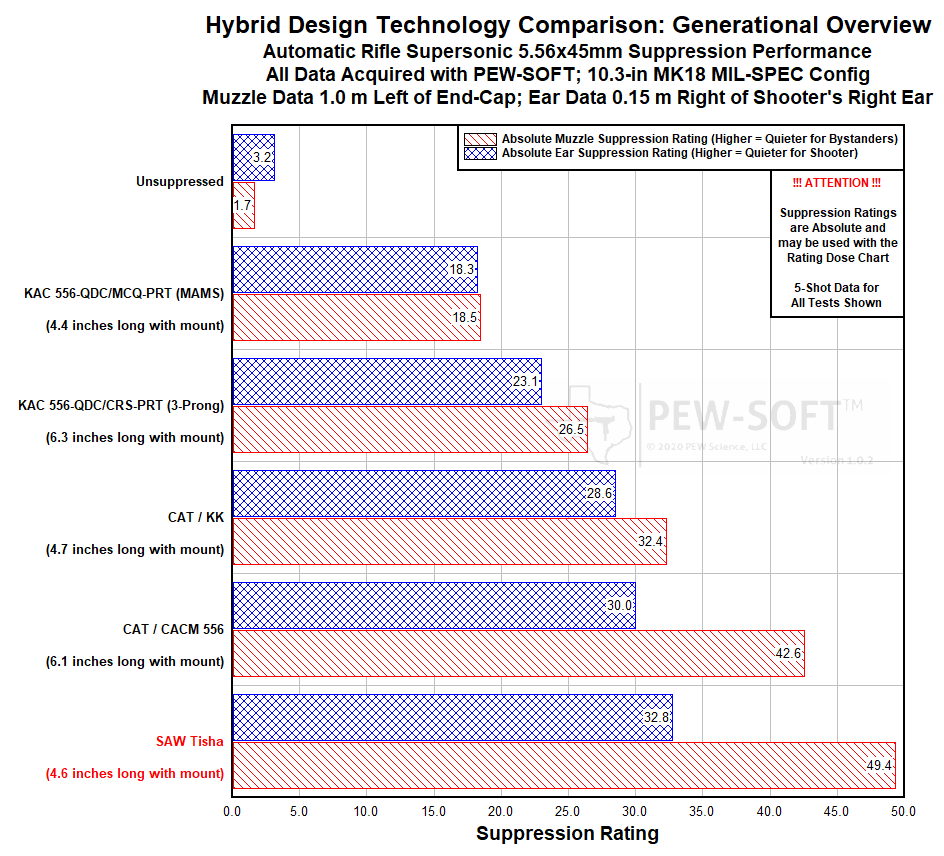
Figure 1. Suppression Rating Comparisons of Stealth Additive Works, CAT SURGE BYPASS, and KAC PRT Technologies Using PEW-SOFT 5.56x45mm Supersonic MK18 Test Data and PEW Science Analysis
From the above data, it is clear that rifle silencer suppression technology continues to advance at a rapid pace. The KAC PRT hybrid technology is relatively recent (developed in the past decade); the silencers are engineered, the designs optimized, and the manufacturing methods to produce them are advanced. The CAT SURGE BYPASS hybrid technology is also relatively recent (portions developed in the past half decade); these systems are also optimized and produced with advanced manufacturing. The Stealth Additive Works Tisha is next generation technology. Not only does it outperform the above silencers, it does so with a drastic length differential.
Additive manufacturing is required in order to implement the engineering solutions present in many of the most advanced silencers, including the Tisha. However, it is not only purposeful design and advanced manufacturing that can contribute to high performance for the end user. Some designs perform better than others, even in the same size classes; there are clear behavioral differences that are showcased with real measured test data and engineering analysis. The performance differentials may be nontrivial, even between new technologies released today. The above metrics are calculated from test data generated on a standard untuned host; weapon system tuning may raise performance potentials, as has been demonstrated in previous public research.
Detailed Stealth Additive Works Tisha test data and analysis follows.
6.209.2 Stealth Additive Works Tisha Sound Signature Test Results
A summary of the principal Silencer Sound Standard performance metrics of the Stealth Additive Works Tisha is shown in Table 1. The data acquired 1.0 m (39.4 in) left of the muzzle is available for viewing to all. The data acquired 0.15 m (6 in) right of the shooter’s ear is only available to membership supporters of PEW Science and the Silencer Sound Standard. You can support public PEW Science testing, research, and development with a membership, here. State-of-the-art public firearm sound signature testing and research conducted by PEW Science is supported by readers like you.
Table 1. Stealth Additive Works Tisha Sound Metric Summary
6.209.2.1 SOUND SIGNATURES AT THE MUZZLE
Real sound pressure histories from a 6-shot test acquired with PEW-SOFT™ are shown below. Six cartridges were loaded into the magazine, the fire control group positioned to single-shot, and the weapon was fired until the magazine was empty and the bolt locked back on the follower of the empty magazine. Only five shots are considered in the analysis. The signatures of Shot 6 are displayed in the data presentation but are not included in the analysis to maintain consistency with the overall PEW Science public dataset and bolt-closing signatures. The waveforms are not averaged, decimated, or filtered. The data acquisition rate used in all PEW Science laboratory sound signature testing is 1.0 MS/s (1 MHz). The peaks, shape, and time phasing (when the peaks occur in relation to absolute time and to each other) of these raw waveforms are the most accurate of any firearm silencer testing publicly available. PEW-SOFT data is acquired by PEW Science independent laboratory testing; the recognized industry leader in silencer sound research. For more information, please consult the Silencer Sound Standard.
The primary sound signature pressure histories for all 6 shots with the Stealth Additive Works Tisha are shown in Figure 2a. The sound signatures of Shot 1 and Shot 2 are shown in Figure 12b, in early time. The real sound impulse (momentum transfer potential) histories from the same 6-shot test are shown in Figure 3a. In Figure 3b, a shorter timescale is shown comparing the impulse of Shot 1 to that of Shots 2 and 3.
Fig 2a. Stealth Additive Works Tisha 5.56x45mm NATO MK18 Automatic Rifle Muzzle Sound Pressure Signature
Fig 2b. Stealth Additive Works Tisha 5.56x45mm NATO MK18 Automatic Rifle Sound Pressure Signature
Figure 3a. Stealth Additive Works Tisha 5.56x45mm NATO MK18 Automatic Rifle Muzzle Sound Impulse Signature
Figure 3b. Stealth Additive Works Tisha 5.56x45mm NATO MK18 Automatic Rifle Muzzle Sound Impulse Signature
The Stealth Additive Works Tisha is a highly advanced next generation hybrid design silencer. The Tisha design incorporates all hybrid design principles in an extremely compact form factor. With no mount, the silencer is 4.13 inches long. Its internal design includes:
Generous HUB-compatible first expansion (blast) chamber with immediate venting and purposeful flow shaping control.
Multistage first annular path with highly efficient surface area for heat transfer (the system employs patent-pending TPMS arrays throughout its annular passages; the reader is encouraged to review larger-scale TPMS adoption in other recent reports).
Multistage pressure balancing through both medial venting, second-stage annular utilization, and second-stage distal venting (the Tisha vents blast loads at the middle and end of the core).
While some advanced hybrid silencers evaluated by PEW Science incorporate some of the above features, no other hybrids combine all three feature families, let alone employ them in a complete high efficiency staged design. The combination of executed design principles in the Stealth Additive Works Tisha represent the current high blast input pressure suppression state-of-the-art, in accordance with all PEW Science laboratory research conducted, to date. There exist no other silencers, of which PEW Science is aware, that are able to produce the suppression performance of the Tisha on the standard untuned 5.56x45mm MK18 automatic rifle. When this performance fact is combined with the silencer’s size, it can confidently be concluded that the Tisha’s performance is unprecedented.
PEW Science Research Note 1: The Stealth Additive Works Tisha’s behavior is exemplified by high early time flow rate, low late time flow rate, and superior pressure staging control through its internal combustion propagation cycle. When the combustion byproducts are expelled from the system and propagate externally, the following observations are made from the above test data:
Unusually low free field blast overpressure amplitude through the entire time regime with relatively late time bolt carrier group (BCG) return to battery (Fig. 2a).
Unique early-time blast pressure propagation sequence; bullet shock and coupled initial jetting present as typical in all shots. However, the primary jet pulse (pseudo shock with slight rise time, Fig. 2b) in each shot begins to show signs of divergence (Fig. 3b). Immediately upon completion of the primary pulse jet’s negative phase, controlled venting begins. This is smooth and immediate after jet rarefaction (Fig. 2b). The controlled venting then progresses at low amplitude.
The aforementioned divergence signs in the primary jet pulse are only the beginning of a more global, key performance indicator of the Tisha design. Blast momentum transfer potential (free field blast impulse) accumulation increases in rate, from shot to shot (Fig. 3a). Maximum blast impulse is reached earlier in time with each subsequent shot. This is a direct result of heat transfer efficiency in the silencer, postulated to be driven partially by the annular TPMS arrays (see note, Fig. 3b). The silencer expels more momentum as it is heated. However, the gross signature and hazard severity increase throughout the shot string is minimal. This is extremely significant.
As stated above, this performance is unprecedented (not only for the size of the silencer, but in general, on the MK18). The performance gap between the Tisha and other high performance competitors is relatively nontrivial. The “jump” in pure suppression performance, with accompanying balanced flow rate on an untuned weapon system is significant. Nonetheless, notable “runner-up” competitors with extremely balanced performance on this system are:
CAT CACM 556 (6.203) - 1.28 inches longer, extremely high and balanced performance, but outclassed in pure suppression.
PTR VENT 3 (6.135) - 3.5 inches longer, high gross performance, but unable to completely mask FRP on this platform.
HUXWRX FLOW 556 Ti (6.167) - distal flow rate may induce undesirable blast load reflections near surfaces.
Centurion Arms Maximus-L (6.180) - strong performance, but lacks advanced FRP control and consistency.
PTR VENT Spiritus 556i (6.175) - excellent performance example, but it is surpassed in distal blast propagation control.
CAT ODB (6.120) - over-bored and longer (a 7.62 silencer).
The Stealth Additive Works Tisha is in a different class than the above six silencers. This is due to the way it incorporates the aforementioned three primary hybrid design principles. The closest competitor in hybrid design technology is CAT SURGE BYPASS. The technologies are compared below. Note: to protect intellectual property, some physical behavioral traits of these technologies are omitted. The gross performance descriptions hold.
PEW Science Research Note 2: Like the Tisha design, several CAT silencers are multistage hybrids. Input blast loads are vented early, routed to various expansion regions for pressure balance, and flow control is managed through multiple stages of the core(s). Distal venting is purposefully managed. These are principle design features of not only CAT SURGE BYPASS, but several hybrid designs, such as those from PTR, Otter Creek Labs (Infinity), and others. It is important to note that each technology is different, and some are more advanced than others. The Stealth Additive Works Tisha design, at a high level, differs from most designs in two primary (and important) ways:
The “short time” design principle is applied immediately. Gas expansion is given an efficient travel path and annular elements are given extremely efficient heat transfer capability. This is patent-pending TPMS driven. A competitor analogy or example of this part of the design would be enhancement of a SURGE BYPASS silencer’s annular utilization and efficiency at a local level by applying recently evaluated Battle Born Supply Co. principles that were applied at a global level. Can you do the most work in the time allotted?
Pressure staging is done in a balanced and segregated way. This allows blast load venting to be utilized with a true multiphase approach. A competitor example of this part of the design would be enhancement of radial vent arrays incorporated in Purposely Induced Porosity (PIP) silencers by segregating vent sources. This example is more abstract than presented in (1) and represents a potential complete departure in how the currently available PIP silencers are designed. For a silencer currently utilizing PIP to accomplish this design method, drastic pressure stage timing changes would be required. If you are going to vent blast loads, can you do so with the optimal initial conditions at free vent?
To summarize the above two high level design differences in plain English: Stealth Additive Works has squeezed an extreme amount of efficiency out of a short length, and done so by almost perfecting expansion and vent timing, as well as heat transfer. It is objectively impressive.
PEW Science Research Note 3: It is extremely important to note that the increased proximal diameter of the Tisha does allow for some of the expressed design choices to work properly; to operate with such high efficiency. However, it even more important to note that diameter (and volume) increases, alone, will not guarantee performance increases. It is not pure expansion volume that drives high blast input pressure suppression performance at the most advanced echelons of silencer technology. It is the utilization of the volume envelope that determines how a design will perform.
PEW Science Research Note 4: At the time of writing, the measured performance of the Stealth Additive Works Tisha places it at the top of the overall MK18 PEW Science Rankings, and over half a Suppression Rating category above the larger CAT CACM 556. With regard to free field operator protection, the Tisha on the untuned MK18 is on par with that of the large high back pressure Maxim Defense DSX on a tuned SURG system (6.111). This is highly unusual, and is a consequence of the Tisha’s ultra-high pure suppression performance with its relatively high flow rate. The Tisha is the highest performing 5.56 silencer in PEW Science research, currently, regardless of size. For further context regarding both performance and size balance, the reader is encouraged to use the Suppression Rating Parametric Visualization Tool (Members Only) for further independent study.
PEW Science Research Note 5: It is extremely important for the reader to understand the Suppression Ratings are computed with free field test data, and are therefore universal when translating the weapon and operator to different environments without reflections. However, when the environment becomes complex with many reflecting surfaces, performance translation of different systems is not yet possible; sound field shapes and particle velocities result in varied blast wave time-of-arrivals, as well as changes of blast load angles of incidence; these variations change amplitude and phase waveform components. As a result of these inevitable environmental complexities, user impressions will vary, as both the shooter and bystander. Nonetheless, hazard reduction efficacy in the free field, as characterized by the Suppression Rating, holds. The Suppression Rating comparisons are the current state-of-the-art, and the most “apples to apples” sound suppression performance comparisons that currently exist. Further research is ongoing. The reader should note that shooting a Tisha indoors and a HUXWRX FLOW silencer indoors may result in significantly different blast overpressure risk profiles.
PEW Science Research Note 6: As in all semiautomatic AR15 weapon testing, a second pressure pulse originates from the ejection-port signature of the weapon and it occurs early enough in time such that its waves coalesce with that of the muzzle signature. However, in late time (at approximately 93 ms in Figure 1a) the mechanical noise of the bolt closing is observed. The pressure signature of Shot 6 does not display this event due to the bolt remaining open after the sixth and final round is fired from the magazine.
PEW Science Research Note 7: The closing time of the AR-15 bolt is directly related to the flow restriction of a silencer for a given weapon system. PEW Science has determined bolt closing time variation from the unsuppressed state to be a reliable indicator of silencer back pressure, with strong correlation with the PEW Science Back Pressure Metric, Omega and the alpha parameter. However, PEW Science has also determined that the indicator is unreliable upon upper receiver fouling. Sound signatures are not influenced by this fouling, as these kinematics occur in late time, after gas venting to atmosphere. Momentum transfer, weapon condition (upper receiver fouling), and other factors, can significantly influence bolt closing time. PEW Science urges the reader to exercise extreme caution if using the published bolt closing time to make determinations regarding silencer flow restriction (back pressure) or weapon system kinematics. This type of calculation may provide erroneous results, as the weapon condition at the time of each test is not published data. The time-scale duration showing bolt closing time is only published by PEW Science such that the signature data pedigree may be verified.
The shape, timing, and magnitudes of the early-time pressure pulses and overall shape of the impulse waveforms measured at the muzzle, from shot-to-shot, are relatively consistent. The consistency of the waveform amplitudes highlight the silencer’s overall sound performance consistency at the muzzle after the FRP, as well as the relative consistency of the tested automatic rifle firearm configuration.
As typically indicated, first-round sound signatures always differ from subsequent shots, as the atmosphere within the silencer changes. The FRP phenomenon cannot always be shown by viewing only the peak sound pressure. This is one of the reasons why The Silencer Sound Standard requires examining multiple sound signature metrics. Ammunition consistency can play a role in the determination of FRP, however, the close examination of measured pressure and impulse waveforms typically excludes ammunition from the possible factors influencing true FRP, due to the relative consistency of most high quality factory ammunition.
PEW Science Research Note 8: Note that the muzzle Suppression Rating of the Stealth Additive Works Tisha is 49.4 and the at-ear Suppression Rating is 32.8; different zones on the Suppression Rating Dose Chart, but both higher than typical on this weapon system. The lower back pressure of the Tisha, along with its highly advanced muzzle suppression, contributes to a less severe ejection port blast signature, which further decreases shooter hazard on the standard MK18 weapon system. The reader is encouraged to examine the Silencer Hazard Map at the top of this report as detailed in Silencer Hazard Map Brief 8.1.7. Weapon tuning will influence hazard reduction efficacy, and is outside the scope of this study.
The signatures measured at the shooter’s ear are presented in the full Member Version of this report.
Gross MK18 performance comparisons from the research follow.
6.209.3 Suppression Rating Comparison (5.56x45mm from the MK18)
Figure 6 presents a comparison of the PEW Science Suppression Rating of the Stealth Additive Works Tisha with that of several other silencers on the MK18 weapon system. The standard PEW Science MK18 test host weapon system is described in Public Research Supplement 6.51.
Figure 6. Suppression Rating Comparisons of the Stealth Additive Works Tisha and other rifle silencers, Using PEW-SOFT 5.56x45mm Supersonic Test Data and PEW Science Analysis
Figure 6 presents an overall summary of the postulated hazards to the operator and bystanders when fielding a variety of different silencers on the standard MK18 weapon system. The Stealth Additive Works Tisha from this test program is shown in red. Hazards are expressed with the Suppression Rating; a holistic parameter that captures human inner ear damage risk potential from a measured impulsive complex blast overpressure signature during the entire time regime of weapon operation, including combustion, complete blowdown, and all mechanical operation, including the carrier group returning to battery, in the true free field. The parameter may be used with the dose chart and Hazard Map at the beginning of this report. The PEW Science Suppression Rating is a damage risk criterion (DRC), a lower Suppression Rating indicates a higher personnel hazard in the free field - it is not a subjective quantity; it is an objective quantification of hearing damage risk potential. Due to its true free field test data origin and complete waveform analytical calculation basis, it is the only known universal suppressed weapon system signature comparison metric available. Analytically computed metrics are color-coded in the Rankings Table, in all Silencer Hazard Maps, and keyed to the dose chart for user interpretation.
The following gross conclusions can be made from the metrics presented in Figure 6, above:
The Stealth Additive Works Tisha produces free field bystander hazard reduction higher than any other tested system on the MK18. "Runner-ups” are the following silencers:
The free field operator (shooter) hazard reduction of the Stealth Additive Works Tisha with the standard untuned MK18 weapon system is higher than it is with several other designs due to its higher flow rate (lower back pressure) and extremely efficient muzzle suppression for its size. The MK18 operator protection with the Stealth Additive Works Tisha is on par with or exceeding that of the:
PEW Science Research Note 12: Without weapon system tuning, operator hazards from a suppressed MK18, in the free field, plateau at Suppression Ratings in the low 30s. This is due to ejection port blast loads. However, this does not mean that silencers with similar shooter’s ear Suppression Ratings will sound the same to the shooter, in the free field. On the contrary, what an operator hears through the entire time regime of a gun shot event and subsequent environmental reflections, and which acute hazards manifest, may be different. The reader is strongly encouraged to review the published Silencer Hazard Map at the top of this report and in Silencer Hazard Map Brief 8.1.7. Furthermore, to illustrate to extremes, the difference in spatial hazards from a Flow Through silencer and a high back pressure silencer are directly compared in Silencer Hazard Map Brief 8.1.5 (HUXWRX FLOW 556k vs. SilencerCo Saker 556).
The Stealth Additive Works Tisha exceeds the bystander hazard reduction performance of every silencer evaluated by PEW Science on the standard MK18, to date. Its operator Suppression Rating performance also exceeds that of all designs, on this weapon system.
As stated in Research Note 4, at the time of writing, the measured performance of the Stealth Additive Works Tisha places it at the top of the overall MK18 PEW Science Rankings, and over half a Suppression Rating category above the larger CAT CACM 556. With regard to free field operator protection, the Tisha on the untuned MK18 is on par with that of the large high back pressure Maxim Defense DSX on a tuned SURG system (6.111). This is highly unusual, and is a consequence of the Tisha’s ultra-high pure suppression performance with its relatively high flow rate. The Tisha is the highest performing 5.56 silencer in PEW Science research, currently, regardless of size. For further context regarding both performance and size balance, the reader is encouraged to use the Suppression Rating Parametric Visualization Tool (Members Only) for further independent study.
The Stealth Additive Works Tisha represents the next generation of hybrid silencer design. Hybrid designs continue to demonstrate significant performance with supersonic ammunition suppression, and silencers like the Tisha, and others, show that performance can be achieved in compact design envelopes. The performance of these next generation systems are significantly elevated when compared to that of highly prolific previous generation hybrids such as the Surefire SOCOM556-RC2 (6.52) and other newly released military silencer hybrids such as the KAC PRT family (6.156) on this weapon system. Designs like the Tisha challenge even the most modern advanced hybrids, outperforming technologies like SURGE BYPASS. Users now have additional high performance practical options to reduce weapon system length and maintain hazard reduction.
As detailed in this report, signature at the operator’s head is a function of both muzzle and ejection port signatures from the AR-15 weapon system. Specific weapon system parameters will dictate hazard reduction efficacy.
Small arm weapon system suppression performance is a spectrum. The PEW Science Suppression Rating and the Silencer Sound Standard help quantify this spectrum for end users and industry, objectively.
6.209.4 Review Summary: Stealth Additive Works Tisha on the MK18 5.56x45mm AR15 with 10.3-in Barrel
When paired with the 10.3-in barrel MK18 and fired with Federal XM193, the Stealth Additive Works Tisha with a direct-thread mount achieved a composite Suppression Rating™ of 49.6 in PEW Science testing.
As with all weapon systems, the user is encouraged to examine both muzzle and ear Suppression Ratings.
PEW Science Laboratory Staff Opinion:
The Stealth Additive Works Tisha is a compact titanium 5.56 rifle silencer with extreme suppression performance and balanced flow rate. The silencer uses next generation technology, is only 4.1 inches long without a mount, and is HUB-mount compatible. The Tisha is not only lightweight and smaller than most rifle silencers on the market, but it also outperforms all 5.56 suppression systems evaluated by the PEW Science Laboratory, as of the date of this report publication. Its performance is unprecedented, regardless of size, and it lives up to its namesake.
The Stealth Additive Works Tisha is a highly advanced next generation hybrid design silencer. The Tisha design incorporates all hybrid design principles in an extremely compact form factor. Its internal design includes a generous HUB-compatible first expansion (blast) chamber with immediate venting and purposeful flow shaping control, multistage first annular path with highly efficient surface area for heat transfer, and multistage pressure balancing through both medial venting, second-stage annular utilization, and second-stage distal venting (the Tisha vents blast loads at the middle and end of the core). While some advanced hybrid silencers evaluated by PEW Science incorporate some of the above features, no other hybrids combine all three feature families, let alone employ them in a complete high efficiency staged design. The combination of executed design principles in the Stealth Additive Works Tisha represent the current high blast input pressure suppression state-of-the-art, in accordance with all PEW Science laboratory research conducted, to date. There exist no other silencers, of which PEW Science is aware, that are able to produce the suppression performance of the Tisha on the standard untuned 5.56x45mm MK18 automatic rifle. When this performance fact is combined with the silencer’s size, it can confidently be concluded that the Tisha’s performance is unprecedented.
The Tisha is only 4.13 inches long without a mount. Though the tested direct-thread mount increased the system length to 4.56 inches, it is postulated that using a shorter direct-thread mount would not appreciably influence system performance. The silencer is already one of the shortest models evaluated on this system, with the highest performance, and it could be even shorter.
The bore of the tested silencer is dedicated for 5.56 mm (.223) projectile use. The silencer test specimen evaluated in this program is not a 6 mm (.243) rifle silencer. This information is provided for practical utility and to highlight the fact that system back pressure is not high with the Tisha, despite the “tighter” bore aperture than possessed by some competing designs. On the contrary, in combination with the short dwell time of the standard untuned MK18, the Stealth Additive Works Tisha is shown not to exacerbate adverse ejection port blast hazards and produces the highest shooter’s ear Suppression Rating on a reciprocating 5.56 weapon system in the Rankings, to date. The operator risk with the Tisha on this platform, in the free field, is on par with the tuned MK18 example presented in the Maxim Defense SURG study, which is unprecedented. Note that extrapolation of this performance trait to other AR-15 platforms with different gas port sizes and dwell times will produce spurious results. Weapon system tuning will be required to achieve this level of free field operator risk reduction on most platforms.
The external diameter of the silencer is stepped; it is larger at the blast entrance and smaller at the blast exit. Gross increases in volumetric expansion due to diameter increases are not the sole reason for the performance increases produced by the Tisha silencer or by most high performance silencers, in general. It is the utilization of volumetric “real estate” that enables design efficiency. Expansion, turbulence generation, gross heat transfer, and other mechanisms combine to greatly enhance total performance. When all design principles are used simultaneously, the highest levels of performance can be achieved.
The Tisha is titanium. The retail version of the silencer is shipped with a muzzle brake that can help protect the core of the silencer from direct blast jet impingement during heavy firing schedules. PEW Science has not evaluated the durability of the Tisha. As always, the user should remain cognizant of their personal firing schedules. The user should contact Stealth Additive Works to ensure compatibility for their use case.
In this review, the Stealth Additive Works Tisha performance metrics depend upon suppressing a supersonic centerfire rifle cartridge on a short barrel gas-operated rifle, which is an incredibly difficult task. PEW Science encourages the reader to remain vigilant with regard to all supersonic centerfire rifle suppression claims. The gas volume and combustion products created by the firing of the supersonic 5.56x45mm cartridge are significant; the measured pressure and impulse magnitudes, and their durations, illustrate this fact. Silencer performance on automatic (reciprocating) rifles depends on many factors. Weapon configuration may significantly influence total suppressed small arm system performance.
The hearing damage potential of supersonic centerfire rifle use is significant. PEW Science encourages the reader to consider the Suppression Rating when deciding on an appropriate silencer and host weapon combination for their desired use.