SSS.6.223 - Otter Creek Labs Universe-36 Review: Multi-Caliber Suppressor Tests (5.56, .308, & 9mm) (Free Version)
/Otter Creek Labs Universe-36 on 5.56 MK18 AR-15, .308 Bolt-Action, and 9mm HK MP5
The Universe-36 is designed by Otter Creek Labs. It is a .36 caliber “universal” or “multi-caliber” centerfire rifle silencer, intended to suppress any cartridge with projectiles appropriately sized to travel through the bore. It has a 1.5-in diameter and is 7 inches long with no mount installed. The rear of the silencer is threaded 1.375-24tpi to accommodate “HUB” compatible mounting systems; the tested direct-thread mounts increase the total system length to 7.47 inches. The core of the silencer is 3D-printed Inconel, whereas the removable and interchangeable end caps are machined stainless steel. The silencer includes one (1) vented 9mm end cap. Other end caps are available, including solid and vented variants in 9mm, 7.62mm, and 5.56mm. Solid variants in each of the respective calibers were used in this test program. The silencer weighs 14.6 ounces and the direct thread mounts weighs approximately 2 ounces, for a total system weight of approximately 16.6 ounces, as tested. The Universe-36 can be obtained from Silencer Shop.
System Suppression Ratings and Silencer Hazard Maps:
This report includes three (3) different tests of the Universe-36. Composite and Detailed Suppression Ratings, along with the predicted personnel hazards generated by the tested weapon systems in this report in the free field, are shown in the below graphics and Silencer Hazard Maps. Click or tap the Maps to enlarge. Please reference Silencer Hazard Map Brief 8.1.20 for further details. The PEW-SOFT HD Blast Hazard Prediction Tool and Hazard Mapper is presented in Report 8.1.1.
Otter Creek Labs Universe-36 10.3-in MK18 AR-15 Free Field Hazard Map Produced by PEW-SOFT HD Blast Hazard Prediction Tool using PEW Science Test Data
Otter Creek Labs Universe-36 20-in .308 Bolt-Action Free Field Hazard Map Produced by PEW-SOFT HD Blast Hazard Prediction Tool using PEW Science Test Data
Otter Creek Labs Universe-36 HK MP5 9mm Subsonic Free Field Hazard Map Produced by PEW-SOFT HD Blast Hazard Prediction Tool using PEW Science Test Data
PEW Science is an independent private testing laboratory and also hosts the world’s only independent public suppressed small arms research cooperative. Testing, data analysis, and reporting is generated with funding provided by PEW Science members. Any test data that is generated with any portion of private funding contains this disclosure. The testing and analysis production for this Sound Signature Review was funded in part by PEW Science Project PEW-OCL-132-001-25. Therefore, data pertaining to the Universe-36 in this Sound Signature Review is published with the express written permission of Otter Creek Labs.
The testing and analysis presented in this Sound Signature Review is of the Otter Creek Labs Universe-36 in the following configurations:
Direct-thread mounted on the MK18 Automatic AR15 rifle rifle, chambered in 5.56x45mm NATO with a 10.3-inch barrel. Federal XM193 55gr ammunition was used in the test. The standard PEW Science MK18 test host weapon system is described in Public Research Supplement 6.51.
Direct-thread mounted on the Savage Model 10 Precision Carbine rifle, chambered in .308WIN with a 20-inch barrel. Federal XM80 149gr ammunition was used in the test.
Direct-thread mounted on the semiautomatic Hecker and Koch SP5 submachine gun, chambered in 9x19mm NATO with a 8.9-inch barrel. Speer Lawman 147gr ammunition was used in the tests, in which its velocity was subsonic. The standard PEW Science HK SP5-A2 test host weapon system is described in Public Research Supplement 6.85.
Report Table of Contents:
Section 6.223.1 contains a Otter Creek Labs Universe-36 performance summary comparison from this test program.
Section 6.223.2 contains Universe-36 test results and analysis on the standard untuned 5.56 MK18.
Section 6.223.3 contains Universe-36 test results and analysis on .308 bolt-action rifle.
Section 6.223.4 contains Universe-36 test results and analysis on the standard 9mm HK SP5.
Overall Suppression Rating comparisons of the Universe-36 with other silencers on the above three host weapons are provided in each report section. Comprehensive comparisons are available in the Rankings Section of the Standard.
Section 6.222.5 contains an article summary and PEW Science laboratory staff opinions.
Summary: When paired with the 10.3-in barrel MK18 and fired with Federal XM193, the Otter Creek Labs Universe-36 with direct-thread mount achieved a composite Suppression Rating™ of 28.4 in PEW Science testing.
When paired with the Savage M10 20” .308 and fired with Federal XM80, the Otter Creek Labs Universe-36 with direct-thread mount achieved a composite Suppression Rating of 25.4 in PEW Science testing.
When paired with the 8.9-in barrel HK SP5-A2 with 80-deg locking piece and fired with Speer Lawman 147gr, the Otter Creek Labs Universe-36 with direct-thread mount achieved a composite Suppression Rating of 60.0 in PEW Science testing.
As with all weapon systems, the user is encouraged to examine both muzzle and ear Suppression Ratings.
Relative Suppression Rating Performance is Summarized in SSS.7 - PEW Science Rankings.
6.223.1 Otter Creek Labs Universe-36 Multi-Caliber Suppressor Performance Summary (5.56, .308, & 9mm)
Multi-caliber silencers provide user convenience; multiple host weapons and ammunition types may be suppressed with the same silencer. As long as requisite strength and mechanical compatibilities are endorsed by the manufacturer, these silencers may effectively reduce personnel hazard and mask signature from a variety of small arm weapon systems.
However, multi-caliber silencers generally offer performance compromise. The combustion pressure, duration, and jet diameter from different weapon systems all interact with silencer internals differently. As a result, the effective hazard reduction to personnel and signature reduction performance when using a multi-caliber silencer is often most efficient only in one or two combustion regimes. Nonetheless, operation with such silencers certainly presents lower hazard to personnel than do unsuppressed weapons.
This report presents a third-party laboratory performance evaluation of the Otter Creek Labs Universe-36 silencer on three standard PEW Science test weapons. Three combustion regimes are evaluated:
Intermediate rifle cartridge (high pressure, moderate duration) on the 10.3-in 5.56 MK18.
Full rifle cartridge (high pressure, longer duration) on the 20-in .308 bolt-action.
Pistol cartridge, subsonic (low pressure, short duration) on the 8.9-in HK SP5 (semiautomatic HK MP5 analog).
The reader may sort and filter all public Rankings here to compare all personnel hazards from all weapon systems on the same universal scale. The Otter Creek Labs Universe-36 test results are shown in Figure 1, below. Metrics shown are in terms of PEW Science Suppression Rating, which is a human risk metric calculated from raw free field blast overpressure test data. The calculated risk metrics for the unsuppressed cases of each weapon system are also presented.
Figure 1. Multi-Caliber Suppression Rating Comparisons of the the Otter Creek Labs Universe-36 silencer Using PEW-SOFT Test Data and PEW Science Analysis
From the above data, it is shown that:
The Universe-36 suppression performance increases indirectly proportionally to the degree of over-bore. As cartridge size and jet diameter increase, the silencer performance increases. This is not immediately apparent in the above figure when comparing 5.56 to .308 performance data because of the relative combustion energy differences between the two cartridges, though the combustion propagation consistency with the 7.62 weapon is significantly higher than on the short barrel 5.56 weapon (see the detailed technical discussions in the report body).
Universe-36 system back pressure is not severe, even with solid end caps installed. The Universe-36 uses Otter Creek Labs Infinity technology and similar solid and vented end cap options to vary flow rate in accordance with weapon system and ammunition choice. The Infinity core hybrid design in the Universe-36 still possesses high(er) early-time flow rate than a conventional silencer and this pays dividends in somewhat reducing operator hazard on both of the semiautomatic weapon system tests showcased in this report. On the MK18, operator hazard is somewhat similar to that from a Surefire SOCOM556-RC2 (6.52), despite the more severe muzzle blast loads from the over-bored Universe-36. On the HK SP5 (MP5 analog), the operator hazard reduction exceeds that of a Dead Air Wolfman (6.182) despite having similar bystander protection.
It is likely that high pressure, long duration combustion suppression efficiency is low(er) with the Universe-36. For example, the pure 7.62 NATO suppression performance is relatively low, even with the solid 7.62 end cap installed. In this volumetric envelope, the Infinity core technology may need further refinement to excel in that combustion regime, particularly with a .36 caliber over-bore. Though the Universe-36 can be used on any cartridge that fits through the bore, such as .338 Lapua Magnum, the suppression performance is not expected to be robust under those conditions.
Additive manufacturing is required in order to implement the engineering solutions present in many of the most advanced silencers and modern multi-caliber silencers taking advantage of this technology are now being offered. It is important to note that it is not only purposeful design and advanced manufacturing that can contribute to high performance for the end user. Some designs perform better than others, even in the same size classes; there are clear behavioral differences that are showcased with real measured test data and engineering analysis. Some silencers are not advertised as “multi-caliber” yet may perform extremely well on multiple weapon systems. The performance differentials may be nontrivial, even between new technologies released today. The above metrics are calculated from test data generated on a standard untuned host; weapon system tuning may raise performance potentials, as has been demonstrated in previous public research.
User caution: The relative performance metrics of the Universe-36 displayed above should not be extrapolated to other silencers.
Detailed Otter Creek Labs Universe-36 test data and analysis follows on three different host weapons with three different types of ammunition.
6.223.2 Otter Creek Labs Universe-36 Sound Signature Test Results (5.56)
A summary of the principal Silencer Sound Standard 5.56 performance metrics of the Otter Creek Labs Universe-36 is shown in Table 1. The data acquired 1.0 m (39.4 in) left of the muzzle is available for viewing to all. The data acquired 0.15 m (6 in) right of the shooter’s ear is only available to membership supporters of PEW Science and the Silencer Sound Standard. You can support public PEW Science testing, research, and development with a membership, here. State-of-the-art public firearm sound signature testing and research conducted by PEW Science is supported by readers like you.
Table 1. Otter Creek Labs Universe-36 5.56 Sound Metric Summary
6.223.2.1 SOUND SIGNATURES AT THE MUZZLE (5.56)
Real sound pressure histories from a 6-shot test acquired with PEW-SOFT™ are shown below. Six cartridges were loaded into the magazine, the fire control group positioned to single-shot, and the weapon was fired until the magazine was empty and the bolt locked back on the follower of the empty magazine. Only five shots are considered in the analysis. The signatures of Shot 6 are displayed in the data presentation but are not included in the analysis to maintain consistency with the overall PEW Science public dataset and bolt-closing signatures. The waveforms are not averaged, decimated, or filtered. The data acquisition rate used in all PEW Science laboratory sound signature testing is 1.0 MS/s (1 MHz). The peaks, shape, and time phasing (when the peaks occur in relation to absolute time and to each other) of these raw waveforms are the most accurate of any firearm silencer testing publicly available. PEW-SOFT data is acquired by PEW Science independent laboratory testing; the recognized industry leader in silencer sound research. For more information, please consult the Silencer Sound Standard.
The primary sound signature pressure histories for all 6 shots with the Otter Creek Labs Universe-36 are shown in Figure 2a. The sound signatures of Shot 1 and Shot 2 are shown in Figure 12b, in early time. The real sound impulse (momentum transfer potential) histories from the same 6-shot test are shown in Figure 3a. In Figure 3b, a shorter timescale is shown comparing the impulse of Shot 1 to that of Shots 2 and 3.
Fig 2a. Otter Creek Labs Universe-36 5.56x45mm NATO MK18 Automatic Rifle Muzzle Sound Pressure Signature
Fig 2b. Otter Creek Labs Universe-36 5.56x45mm NATO MK18 Automatic Rifle Sound Pressure Signature
Figure 3a. Otter Creek Labs Universe-36 5.56x45mm NATO MK18 Automatic Rifle Muzzle Sound Impulse Signature
Figure 3b. Otter Creek Labs Universe-36 5.56x45mm NATO MK18 Automatic Rifle Muzzle Sound Impulse Signature
The Otter Creek Labs Universe-36 is a multi-caliber hybrid design silencer that uses a modified Infinity baffle core derivative. Like the Infinity, the Universe-36 has the ability to accept variable end caps and both solid and vented versions of varying bore aperture end caps are available. In this test, the solid 5.56 end cap was used. This is the most restrictive flow rate configuration of the Universe-36 possible, as the end cap is solid and possesses the smallest bore area.
PEW Science Research Note 1: Despite this distal flow restriction, the Universe-36 still suffers from some combustion propagation inconsistency, as shown in the above measured test data. This performance detriment is largely a function of the core’s over-bore for the cartridge and its internal vent structure for the implemented volume. General behavioral characteristics observed in the above test data include:
Relatively long duration pressure blowdown with moderately fast bolt carrier group return to battery (Fig. 2a).
Consistent internal combustion and precursor jetting with consistent but erratic rarefaction (Fig. 2b).
Moderate first-round-pop (FRP) divergence followed by erratic combustion propagation mid-string (Fig. 3a).
Full momentum stabilization does not appear to occur until Shot 5 (Fig. 3b).
The behavior in (1) is hypothesized to be largely due to the restrictive solid 5.56 end cap, and the observed behaviors in (2), (3), and (4) are almost certainly due to the core over-bore. While Otter Creek Labs Infinity technology does perform relatively well with some overbore when optimized (re: Infinity 7.62 performance on 5.56 NATO), the .36 caliber over-bore of the Universe-36 design, as implemented in this volumetric envelope, is less efficient.
PEW Science Research Note 2: Essentially, the MK18 suppression performance of the Otter Creek Labs Universe-36 with its solid 5.56 end cap is in the Top 50 of the current Rankings (4th quartile). For comparison, users should note that the signature suppression performance of the Universe-36 on the MK18 is extremely similar to the Knights Armament KAC 556 QDC/CRS-PRT (6.156). The reader is encouraged to use the sortable and filterable table in the Rankings Section for further performance context.
General personnel hazards in the near field are illustrated spatially in the Hazard Map at the beginning of this report and in Silencer Hazard Map Brief 8.1.20.
PEW Science Research Note 3: It is extremely important for the reader to understand the Suppression Ratings are computed with free field test data, and are therefore universal when translating the weapon and operator to different environments without reflections. However, when the environment becomes complex with many reflecting surfaces, performance translation of different systems is not yet possible; sound field shapes and particle velocities result in varied blast wave time-of-arrivals, as well as changes of blast load angles of incidence; these variations change amplitude and phase waveform components. As a result of these inevitable environmental complexities, user impressions will vary, as both the shooter and bystander. Nonetheless, hazard reduction efficacy in the free field, as characterized by the Suppression Rating, holds. The Suppression Rating comparisons are the current state-of-the-art, and the most “apples to apples” sound suppression performance comparisons that currently exist.
PEW Science Research Note 4: As in all semiautomatic AR-15 weapon testing, a second pressure pulse originates from the ejection-port signature of the weapon and it occurs early enough in time such that its waves coalesce with that of the muzzle signature. However, in late time (at approximately 85 ms in Figure 2a) the mechanical noise of the bolt closing is observed. The pressure signature of Shot 6 does not display this event due to the bolt remaining open after the sixth and final round is fired from the magazine.
PEW Science Research Note 5: The closing time of the AR-15 bolt is directly related to the flow restriction of a silencer for a given weapon system. PEW Science has determined bolt closing time variation from the unsuppressed state to be a reliable indicator of silencer back pressure, with strong correlation with the PEW Science Back Pressure Metric, Omega and the alpha parameter. However, PEW Science has also determined that the indicator is unreliable upon upper receiver fouling. Sound signatures are not influenced by this fouling, as these kinematics occur in late time, after gas venting to atmosphere. Momentum transfer, weapon condition (upper receiver fouling), and other factors, can significantly influence bolt closing time. PEW Science urges the reader to exercise extreme caution if using the published bolt closing time to make determinations regarding silencer flow restriction (back pressure) or weapon system kinematics. This type of calculation may provide erroneous results, as the weapon condition at the time of each test is not published data. The time-scale duration showing bolt closing time is only published by PEW Science such that the signature data pedigree may be verified.
The shape, timing, and magnitudes of the early-time pressure pulses and overall shape of the impulse waveforms measured at the muzzle, from shot-to-shot, are relatively consistent. The consistency of the waveform amplitudes highlight the silencer’s overall sound performance consistency at the muzzle after the FRP, as well as the relative consistency of the tested automatic rifle firearm configuration.
As typically indicated, first-round sound signatures always differ from subsequent shots, as the atmosphere within the silencer changes. The FRP phenomenon cannot always be shown by viewing only the peak sound pressure. This is one of the reasons why The Silencer Sound Standard requires examining multiple sound signature metrics. Ammunition consistency can play a role in the determination of FRP, however, the close examination of measured pressure and impulse waveforms typically excludes ammunition from the possible factors influencing true FRP, due to the relative consistency of most high quality factory ammunition.
PEW Science Research Note 6: Note that the muzzle Suppression Rating of the Otter Creek Labs Universe-36 is 26.6 and the at-ear Suppression Rating is 22.4; the same zone on the Suppression Rating Dose Chart. The relatively higher back pressure due to the solid end cap, with only moderate muzzle blast suppression performance compared to some designs, contributes to somewhat more operator hazard than typically seen with hybrid design silencers on the standard MK18 weapon system. The reader is encouraged to examine the Silencer Hazard Map at the top of this report as detailed in Silencer Hazard Map Brief 8.1.20. Weapon tuning will influence hazard reduction efficacy, and is outside the scope of this study.
The signatures measured at the shooter’s ear are presented and analyzed in the full Member Version of this report.
6.223.2.3 Suppression Rating Comparison (5.56x45mm from the MK18)
Figure 6 presents a comparison of the PEW Science Suppression Rating of the Otter Creek Labs Universe-36 with that of several other silencers on the MK18 weapon system. The standard PEW Science MK18 test host weapon system is described in Public Research Supplement 6.51.
Figure 6. Suppression Rating Comparisons of the Otter Creek Labs Universe-36 and other rifle silencers, Using PEW-SOFT 5.56x45mm Supersonic Test Data and PEW Science Analysis
Figure 6 presents an overall summary of the postulated hazards to the operator and bystanders when fielding a variety of different silencers on the standard MK18 weapon system. The Otter Creek Labs Universe-36 from this test program is shown in red. Hazards are expressed with the Suppression Rating; a holistic parameter that captures human inner ear damage risk potential from a measured impulsive complex blast overpressure signature during the entire time regime of weapon operation, including combustion, complete blowdown, and all mechanical operation, including the carrier group returning to battery, in the true free field. The parameter may be used with the dose chart and Hazard Map at the beginning of this report. The PEW Science Suppression Rating is a damage risk criterion (DRC), a lower Suppression Rating indicates a higher personnel hazard in the free field - it is not a subjective quantity; it is an objective quantification of hearing damage risk potential. Due to its true free field test data origin and complete waveform analytical calculation basis, it is the only known universal suppressed weapon system signature comparison metric available. Analytically computed metrics are color-coded in the Rankings Table, in all Silencer Hazard Maps, and keyed to the dose chart for user interpretation.
The following gross conclusions can be made from the metrics presented in Figure 6, above:
The Otter Creek Labs Universe-36 produces free field bystander hazard reduction on par with the following silencers on the MK18 weapon system:
The free field operator (shooter) hazard reduction of the Otter Creek Labs Universe-36 and solid 5.56 end cap, with the standard untuned MK18 weapon system, is somewhat lower than it is with several other designs due to back pressure and muzzle blast. The MK18 operator protection with the Universe-36 is on par with that of the:
Surefire SOCOM556-RC3 (6.151), again
Knights Armament KAC 556 QDC/CRS-PRT (6.156), again
PEW Science Research Note 8: Without weapon system tuning, operator hazards from a suppressed MK18, in the free field, plateau at Suppression Ratings near 30. This is due to ejection port blast loads. However, this does not mean that silencers with similar shooter’s ear Suppression Ratings will sound the same to the shooter, in the free field. On the contrary, what an operator hears through the entire time regime of a gun shot event and subsequent environmental reflections, and which acute hazards manifest, may be different. The reader is strongly encouraged to review the published Silencer Hazard Maps at the top of this report and in Silencer Hazard Map Brief 8.1.20. Furthermore, to illustrate two extremes, the difference in spatial hazards from a Flow Through silencer and a high back pressure silencer are directly compared in Silencer Hazard Map Brief 8.1.5 (HUXWRX FLOW 556k vs. SilencerCo Saker 556).
For further context regarding both performance and size balance, the reader is encouraged to use the Suppression Rating Parametric Visualization Tool (Members Only) for independent study.
This concludes the Universe-36 5.56 suppression performance evaluation. The performance evaluation of the silencer on a .308 bolt action rifle follows.
6.223.3 Otter Creek Labs Universe-36 Sound Signature Test Results (.308)
A summary of the principal Silencer Sound Standard .308 performance metrics of the Otter Creek Labs Universe-36 is shown in Table 2. The data acquired 1.0 m (39.4 in) left of the muzzle is available for viewing to all. The data acquired 0.15 m (6 in) right of the shooter’s ear is only available to membership supporters of PEW Science and the Silencer Sound Standard. You can support public PEW Science testing, research, and development with a membership, here. State-of-the-art public firearm sound signature testing and research conducted by PEW Science is supported by readers like you.
Table 2. Otter Creek Labs Universe-36 .308 Sound Metric Summary
6.223.3.1 SOUND SIGNATURES AT THE MUZZLE (.308)
Real sound pressure histories acquired with PEW-SOFT™ are shown below. The waveforms are not averaged, decimated, or filtered. The data acquisition rate used in all PEW Science testing is 1.0 MS/s (1 MHz). The peaks, shape, and time phasing (when the peaks occur in relation to absolute time and to each other) of these raw waveforms are the most accurate of any firearm silencer testing publicly available. PEW-SOFT data is acquired by PEW Science independent testing; the industry leader in silencer sound research. For more information, please consult the Silencer Sound Standard.
The primary sound signature pressure histories for all 5 shots with the Otter Creek Labs Universe-36 are shown in Figure 7a. The sound signatures of Shot 1 and Shot 2 are shown in Figure 7b, in early time. The real sound impulse (momentum transfer potential) histories from the same 5-shot test are shown in Figure 8a. In Figure 8b, a shorter timescale is shown comparing the impulse of Shot 1 to that of Shot 2 and Shot 3.

Fig 7a. Otter Creek Labs Universe-36 Bolt Action Rifle Muzzle Sound Pressure Signature
Fig 7b. Otter Creek Labs Universe-36 Bolt Action Rifle Muzzle Sound Pressure Signature, Short Time Window
Fig 8a. Otter Creek Labs Universe-36 Bolt Action Rifle Muzzle Sound Impulse Signature
Fig 8b. Otter Creek Labs Universe-36 Bolt Action Rifle Muzzle Sound Impulse Signature, Short Time Window
As previously stated in the 5.56 performance evaluation, the Otter Creek Labs Universe-36 is a multi-caliber hybrid design silencer that uses a modified Infinity baffle core derivative and may accept different end caps. In this test, the solid 7.62 end cap was used. This is the second most restrictive flow rate configuration of the Universe-36 tested, as the end cap is solid and possesses bore area between 5.56 and 9mm.
PEW Science Research Note 9: Interestingly, combustion propagation is significantly more controlled by the Universe-36 in this test than it was in the 5.56 NATO test on the 10.3-in barrel MK18. The following observations are noted in the above measured test data:
Moderate pressure blowdown duration presents at moderate peak amplitude (Fig. 7a).
Consistent internal combustion signatures are noted with immediate FRP jet divergence during coupled bullet shock and initial jetting, followed by coincident rarefaction (Fig. 7b).
Post-FRP momentum propagation consistency is relatively stable (Fig. 8)
Though the Universe-36 signatures in this test do not demonstrate extremely high performance, they are largely unremarkable. This is, again, a departure from the previously observed behavior on the MK18. Observations (2) and (3) indicate that the lower degree of over-bore is slowly bringing the silencer’s behavior into compliance; it is becoming more efficient as jet diameter begins to somewhat match bore aperture. This is generally understood to be typical behavior, though it is important to note that it also occurs with this implementation of Infinity hybrid technology in this volumetric envelope.
The FRP to bystanders from the Otter Creek Labs Universe-36 on this host weapon is only moderate; it is relatively controlled compared to subsequent shots.
PEW Science Research Note 10: The suppression performance of the Universe-36 when used with a .308 rifle cartridge can be generally considered low relative to the current state of the art. This is a function of its multi-caliber design intent and .36 caliber overbore (despite the use of the solid 7.62 end cap). With the mount as tested, the silencer is approximately 7.5 inches long. There are much higher performers in this length range. The Universe-36 protects bystanders similarly to a Gemtech Neutron 7.62 (6.158) or short configuration of a Silencer Central Banish 30 (6.74) or short configuration of a Rugged Surge (6.22). It almost reaches the muzzle suppression performance of a CGS Hyperion K (6.28).
To illustrate these comparisons further with silencers similar in size to the Universe-36, please see Figure 11 in this report.
PEW Science Research Note 11: The Omega Metric of the Universe-36 is relatively low; it is computed as 0.12 [1/Pa x 10] from the measured blast impulse signatures in Figure 8a, above. This places the silencer in Omega Zone 4, very close in external momentum transfer behavior to silencers like the Q Trash Panda (6.4). It is interesting to note that the Universe-36 produces an average hazard field that is safer comparable to the Trash Panda on this host weapon. This is a significant performance conclusion and benchmark. Please refer to the referenced research report for guidance. Omega metric technical details can be found in PEW Science Public Research Supplement 6.40.
As typically indicated, first-round sound signatures always differ from subsequent shots, as the atmosphere within the silencer changes. The FRP phenomenon cannot always be shown by viewing only the peak sound pressure. This is one of the reasons why The Silencer Sound Standard requires examining multiple sound signature metrics. Ammunition consistency can play a role in the determination of FRP, however, the close examination of measured pressure and impulse waveforms typically excludes ammunition from the possible factors influencing true FRP, due to the relative consistency of most high quality factory ammunition.
PEW Science has made a concerted effort to characterize the FRP phenomenon with true physiological human inner-ear response analyses. Additional PEW Science Member Research Supplements containing this information are released periodically.
The Universe-36 shooter’s ear suppression performance on the .308 bolt-action is presented and analyzed in the full Member Version of this report.
Overall performance comparisons with silencers of similar length on this weapon system are presented below.
6.223.3.3 Relative Suppression Rating and Length Comparisons (.30 Rifle Silencers)
The Otter Creek Labs Universe-36 suppressor is intended to provide multi-caliber compatible sound signature suppression, regardless of cartridge.
Figure 11 shows supersonic ammunition suppression comparisons of silencers less than or equal to 7.5 inches long, inclusive of mount, as tested. The 7.62mm (30 caliber) rifle silencers shown are taken from public PEW Science Sound Signature Reviews, as of the date of this review publication. The results shown in Figure 11 are calculated from real test data acquired with PEW-SOFT.
The figures present the silencers in order of total tested system length.
Figure 11. Suppression Rating and Length Comparisons Of .308 Rifle Silencers Less than or Equal to 7.5 inches long Using PEW-SOFT Data and Analysis
The following gross conclusions can be made from the .308 bolt-action suppression performance metrics presented in Figure 11, above:
The Otter Creek Labs Universe-36 produces free field bystander hazard reduction on par with the following silencers on a .308 bolt-action rifle:
The free field operator (shooter) hazard reduction of the Otter Creek Labs Universe-36 and solid 7.62 end cap is somewhat lower on this weapon system than with several other silencers. The .308 bolt-action rifle operator protection with the Universe-36 is on par with that of the:
This concludes the Universe-36 .308 suppression performance evaluation. The performance evaluation on an appropriately sized caliber for its bore, 9mm from a submachine gun, follows.
6.223.4 Otter Creek Labs Universe-36 Sound Signature Test Results (9mm)
A summary of the principal Silencer Sound Standard 9mm performance metrics of the Otter Creek Labs Universe-36 is shown in Table 3. The data acquired 1.0 m (39.4 in) left of the muzzle is available for viewing to all. The data acquired 0.15 m (6 in) right of the shooter’s ear is only available to membership supporters of PEW Science and the Silencer Sound Standard. You can support public PEW Science testing, research, and development with a membership, here. State-of-the-art public firearm sound signature testing and research conducted by PEW Science is supported by readers like you.
Table 3. Otter Creek Labs Universe-36 9mm Sound Metric Summary
6.223.4.1 SOUND SIGNATURES AT THE MUZZLE (9mm)
Real sound pressure histories from a 6-shot test acquired with PEW-SOFT™ are shown below. Six cartridges were loaded into the magazine, the fire control group positioned to single-shot, and the weapon was fired until the magazine was empty, and the bolt returned to battery with an empty chamber. The HK MP5 family of submachine guns do not possess a bolt-hold-open feature. Only five shots are considered in the analysis. The signatures of Shot 6 are displayed in the data presentation but are not included in the analysis to maintain consistency with the overall PEW Science dataset and bolt-closing signatures. The waveforms are not averaged, decimated, or filtered. The data acquisition rate used in all PEW Science testing is 1.0 MS/s (1 MHz). The peaks, shape, and time phasing (when the peaks occur in relation to absolute time and to each other) of these raw waveforms are the most accurate of any firearm silencer testing publicly available. PEW-SOFT data is acquired by PEW Science independent testing; the industry leader in silencer sound research. For more information, please consult the Silencer Sound Standard.
The primary sound signature pressure histories for all 6 shots with the Otter Creek Labs Universe-36 are shown in Figure 1a. The sound signatures of Shot 1 and Shot 2 are shown in Figure 1b, in early time. The real sound impulse (momentum transfer potential) histories from the same 5-shot test are shown in Figure 2a. In Figure 2b, a shorter timescale is shown comparing the impulse of Shot 1, Shot 2, and Shot 3.
Fig 12a. Otter Creek Labs Universe-36 subsonic 9x19mm HK SP5-A2 Semiautomatic Subgun Muzzle Sound Pressure Signature
Fig 12b. Otter Creek Labs Universe-36 subsonic 9x19mm HK SP5-A2 Semiautomatic Subgun Muzzle Sound Pressure Signature, Short Time Window
Fig 13a. Otter Creek Labs Universe-36 subsonic 9x19mm HK SP5-A2 Semiautomatic Subgun Muzzle Sound Impulse Signature
Fig 13b. Otter Creek Labs Universe-36 subsonic 9x19mm HK SP5-A2 Semiautomatic Subgun Muzzle Sound Impulse Signature, Short Time Window
As previously stated in the 5.56 and 7.62 performance evaluations, the Otter Creek Labs Universe-36 is a multi-caliber hybrid design silencer that uses a modified Infinity baffle core derivative and may accept different end caps. In this test, the solid 9mm end cap was used. This is the third most restrictive flow rate configuration of the Universe-36 tested, as the end cap is both solid and possesses bore area greater than 5.56 and 7.62mm.
When used on a bore-appropriate cartridge with lower input blast pressure, the Otter Creek Labs Universe-36 has high performance. Its hybrid design exhibits the highest efficiency on the 9mm HK SP5 (MP5 analog) when using the solid 9mm end cap, as tested. The Infinity technology used in the Universe-36 possesses secondary annular gas expansion paths that pay significant dividends in suppression performance when they aren’t overwhelmed by high pressure, long duration combustion from rifle cartridges.
The measured signatures from the 9mm MP5 test of the Universe-36 display the following performance observations:
Consistent precursor flow and expedient initial coupled jetting (Fig. 12b).
Delayed FRP divergence until later momentum accumulation (Fig. 13).
Very consistent blast momentum propagation, post-FRP (Fig. 13b).
The very fast jet momentum onset described in (1) combined with a shorter positive phase allows the Universe-36 to match the muzzle suppression performance of the Dead Air Wolfman (6.182) on this host weapon, despite having lower backpressure than the Wolfman, even with the Universe-36 solid end cap. This is also made possible by performance factors (2) and (3). FRP severity differential is relatively low.
PEW Science Research Note 12: The muzzle signature from the Universe-36 is similar to that of the aforementioned Dead Air Wolfman in the long configuration and is somewhat similar to that of the GSL Phoenix (6.86) (legacy Gemtech MK-9k). The Universe-36 has features that allow it to have a higher flow rate (lower back pressure) than several other 9mm submachine gun silencer designs, but its flow rate with its solid end cap does not approach that of silencers like the more advanced CAT MOB (6.148) (CAT DiVerge Technology) and PTR VENT 2 (6.131) (PTR PIP Technology). However, the Universe-36 does far outperform silencers like the HUXWRX CASH 9K (6.97), Resilient Suppressors RS9 (6.90), and Otter Creek Labs Lithium (6.102) in pure muzzle suppression. Those silencers are smaller than the Universe-36. Operator hazard comparisons are provided in Section 6.223.4.3 of this report.
PEW Science Research Note 13: As in most semiautomatic weapon testing, a second pressure pulse originates from the ejection-port signature of the weapon and it occurs early enough in time such that its waves coalesce with that of the muzzle signature. However, in late time (at approximately 85 ms in Figure 1a) the mechanical noise of the bolt closing is observed. The pressure signature of Shot 6 still displays this event due to the bolt not remaining open after the sixth and final round is fired from the magazine on the HK SP5-A2 weapon system. Nonetheless, the bolt is closing on an empty chamber.
PEW Science Research Note 14: The closing time of the HK SP5-A2 bolt is directly related to the flow restriction of a silencer used with the weapon system. PEW Science has determined bolt closing time variation from the unsuppressed state to be a reliable indicator of silencer back pressure, with strong correlation with the PEW Science Back Pressure Metric, Omega with rifle cartridges, particularly on the MK18 weapon system. PEW Science Omega Metric and alpha parameter research in the subsonic 9x19mm combustion regime with the HK SP5-A2 and SP5K-PDW weapon systems is underway. Note that the PEW Science HK SP5-A2 possesses an 80-deg locking piece in its bolt carrier group, which may result in lower bolt carrier group rearward velocity than systems possessing standard angle locking pieces. This lower rearward velocity may result in delayed forward return velocity, when compared with other systems.
It is also important to note that PEW Science has determined bolt closing time to be an unreliable indicator upon upper receiver fouling in some weapon systems, such as the MK18 or M4A1. Sound signatures are typically not influenced by this fouling, as these kinematics occur in late time, after gas venting to atmosphere. Note that the roller-delayed blowback action of the HK SP5-A2 is significantly different than the direct gas impingement operated locked bolt action of the MK18. These factors, in addition to the difference in combustion regime amplitudes of supersonic 5.56x45mm and subsonic 9x19mm, result in a different influence of mechanical weapon noise to the total signature to which bystanders and the shooter is subjected.
PEW Science Research Note 15: Note that the muzzle Suppression Rating of the Otter Creek Labs Universe-36 with its solid 9mm end cap and direct-thread mount is 60.0 and the shooter’s-ear Suppression Rating is 39.4; which are the different zones on the Suppression Rating Dose Chart. This demonstrates a somewhat higher operator protection than traditional high back pressure silencers fielded on submachine guns, despite the use of the solid end cap. The gross suppression of a silencer, as well as its flow rate, influences the holistic signature on the standard HK SP5-A2 weapon system.
The signatures measured at the shooter’s ear with the Universe-36 silencer are presented and analyzed in the full Member Version of this report.
6.223.4.3 Suppression Rating Comparison (Subsonic 9x19mm from the HK SP5-A2)
Figure 16 presents a comparison of the PEW Science Suppression Rating of the Otter Creek Labs Universe-36 with direct-thread mount to that of the Dead Air Wolfman, CAT MOB, PTR VENT 2, OCL Lithium, HUXWRX CA$H 9K, Resilient Suppressors RS9, and GSL Phoenix on the HK SP5-A2 system. The standard PEW Science HK SP5-A2 test host weapon system is described in Public Research Supplement 6.85.
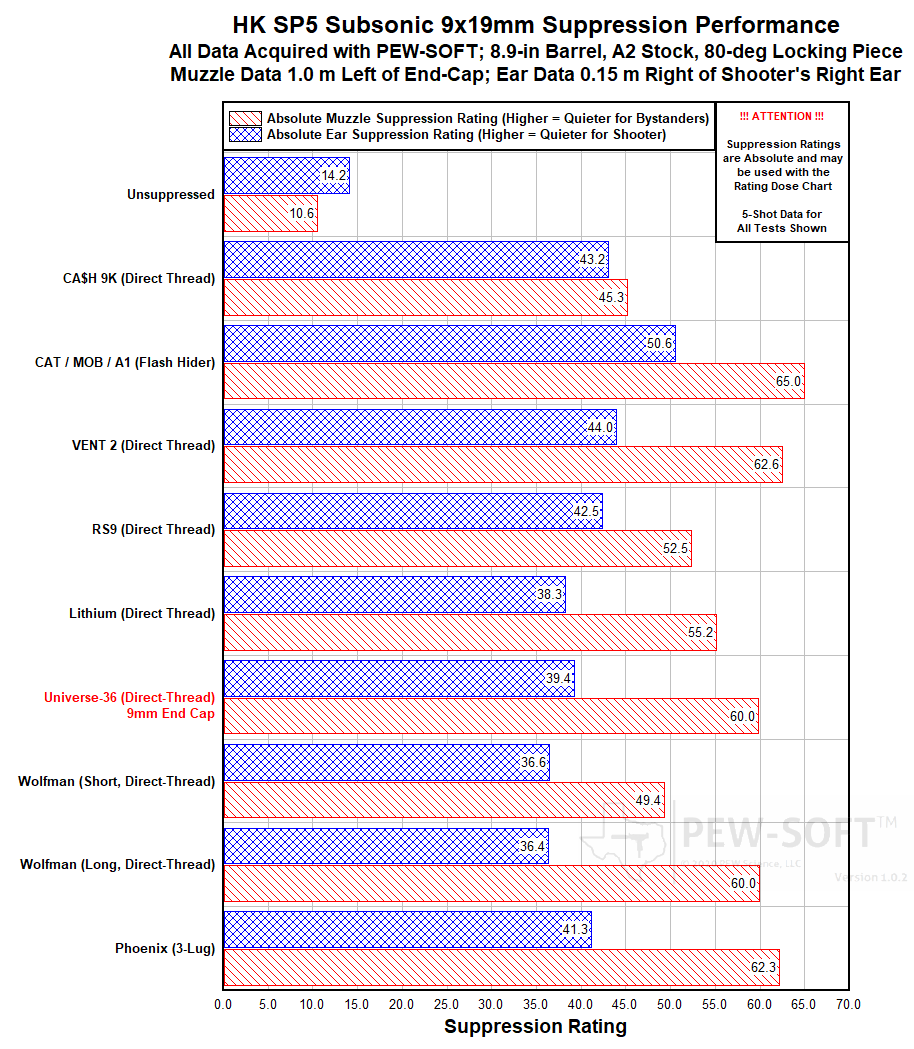
Figure 16. Suppression Rating Comparisons of the Otter Creek Labs Universe-36 with the Dead Air Wolfman, CAT/MOB/A1, PTR VENT 2, Otter Creek Labs Lithium, HUXWRX CA$H 9K, Resilient Suppressors RS9, and GSL Phoenix on the HK SP5-A2, Using PEW-SOFT 9x19mm Subsonic Test Data and PEW Science Analysis
The following gross conclusions can be made from the subsonic 9mm submachine gun suppression performance metrics presented in Figure 16, above:
The Otter Creek Labs Universe-36 essentially behaves like a somewhat shorter higher flow rate Dead Air Wolfman with the same pure suppression performance and more robust operator protection, with its solid 9mm end cap installed.
The Universe-36 outperforms the Otter Creek Labs Lithium, the Resilient Suppressors RS9, and the HUXWRX (OSS) CASH 9K. Though it is a hybrid design, the Universe-36 is not as advanced as the PTR VENT 2 and CAT MOB, though it does approach the bystander risk reduction of the VENT 2.
The 9mm solid end cap used in the test of the Universe-36 does increase back pressure when compared to the use of a vented end cap (untested), which stands to reason given the previous evaluations of the Otter Creek Labs Infinity on multiple weapon systems. Despite the “higher” back pressure, the Universe-36 has lower backpressure than a Wolfman as tested; this is reflected in the lower degree of operator hazard. It is likely that if the vented 9mm end cap were used with the Universe-36, its muzzle Suppression Rating would drop. It is possible that the shooter’s ear suppression performance would increase, though increased muzzle blast could overwhelm that local hazard field and nullify an operator Suppression Rating increase. Regardless, the user has the option to change end caps and the vented end cap may provide positive performance changes depending on the host weapon and ammunition type used.
PEW Science Research Note 18: The signature to which the shooter’s ear is subjected is a function of both ejection port and muzzle signature. When the silencer’s endcap is in closer proximity to the shooter, the severity is increased. The coalescing of the ejection port overpressure with the primary muzzle blast may exacerbate the severity of the signature at the shooter’s head position. It is not ejection port signature, alone, that dictates the signature measured at the shooter’s head position. As noted in the full Member Version of this article, mechanical noise factors also play a role in shooter hazard.
As the published suppressed HK MP5/SP5 dataset continues to grow, two significant conclusions drawn in previous articles once again hold true in this data and analysis:
The roller-delayed blow back MP5 operating system is still a blow back system. The delay, even when maximized with the 80-deg locking piece, still does not completely eliminate gas sensitivity during suppressed use. Silencer back pressure still influences the signature at the shooter’s ear on this suppressed weapon system.
The Flow-Baffles in the HUXWRX CA$H 9K, early-time venting in the Resilient Suppressors RS9, PIP technology in the PTR VENT 2, and DiVerge technology in the CAT MOB, and Infinity technology in the Universe-36 all significantly reduce back pressure. The suppression performance of those silencers to the shooter in the subsonic pistol cartridge regime is notable, and the MP5 is gas sensitive enough for their back pressure reduction to have efficacy. The data presented with the Otter Creek Labs Universe-36 in this report further illustrates the benefit of high flow rate designs, even on the pistol-caliber roller-delayed blow back system, and also illustrates the degree to which some legacy technologies have been surpassed in MP5 suppression performance to both the operator and bystanders.
Further study of the suppressed roller-delayed blow back system is a subject of internal PEW Science research.
The user is encouraged to be mindful of the degree to which sound signature suppression, and resulting personnel hazards, can vary across designs. Small arm weapon system suppression performance is a spectrum. The PEW Science Suppression Rating and the Silencer Sound Standard help quantify this spectrum for end users and industry, objectively.
6.223.5 Review Summary: Otter Creek Labs Universe-36 on 5.56 MK18 AR-15, .308 Bolt-Action, and 9mm HK MP5
When paired with the 10.3-in barrel MK18 and fired with Federal XM193, the Otter Creek Labs Universe-36 with direct-thread mount achieved a composite Suppression Rating™ of 28.4 in PEW Science testing.
When paired with the Savage M10 20” .308 and fired with Federal XM80, the Otter Creek Labs Universe-36 with direct-thread mount achieved a Suppression Rating of 25.4 in PEW Science testing.
When paired with the 8.9-in barrel HK SP5-A2 with 80-deg locking piece and fired with Speer Lawman 147gr, the Otter Creek Labs Universe-36 with direct-thread mount achieved a composite Suppression Rating of 60.0 in PEW Science testing.
As with all weapon systems, the user is encouraged to examine both muzzle and ear Suppression Ratings.
PEW Science Laboratory Staff Opinion:
The Otter Creek Labs Universe-36 is a multi-caliber silencer suited for use on any cartridge that can travel through the bore. The silencer is constructed from 3D-printed Inconel alloy and offers high performance suppression when paired with pistol caliber carbines (submachine guns), can withstand use on semiautomatic and automatic rifles, and can also suppress magnum rifle cartridges like .338 Lapua Magnum. Suppression efficiency with the Universe-36 will be highest with subsonic 9mm and lowest with magnum rifle cartridges. The silencer is HUB compatible, features a high flow rate, and has adjustable back pressure parameters for different cartridges through the use of modular solid and vented end cap assemblies sold by Otter Creek Labs.
The Universe-36 suppression performance increases indirectly proportionally to the degree of over-bore. As cartridge size and jet diameter increase, the silencer performance increases. The combustion propagation consistency when suppressing 7.62 weapons is significantly higher than on the short barrel 5.56 weapons. When used on a bore-appropriate cartridge with lower input blast pressure, the Otter Creek Labs Universe-36 has high performance. Its hybrid design exhibits the highest efficiency on the 9mm HK SP5 (MP5 analog) when using the solid 9mm end cap, as tested. The Infinity technology used in the Universe-36 possesses secondary annular gas expansion paths that pay significant dividends in suppression performance when they aren’t overwhelmed by high pressure, long duration combustion from rifle cartridges.
Universe-36 system back pressure is not severe, even with solid end caps installed. The Universe-36 uses Otter Creek Labs Infinity technology and similar solid and vented end cap options to vary flow rate in accordance with weapon system and ammunition choice. The Infinity core hybrid design in the Universe-36 still possesses high(er) early-time flow rate than a conventional silencer and this pays dividends in somewhat reducing operator hazard on both semiautomatic weapon system tests showcased in this report. On the MK18, operator hazard is somewhat similar to that from a Surefire SOCOM556-RC2, despite the more severe muzzle blast loads from the over-bored Universe-36. On the HK SP5 (MP5 analog), the operator hazard reduction exceeds that of a Dead Air Wolfman despite having similar bystander protection.
It is likely that high pressure, long duration combustion suppression efficiency is low(er) with the Universe-36. For example, the pure 7.62 NATO suppression performance is relatively low, even with the solid 7.62 end cap installed. In this volumetric envelope, the Infinity core technology may need further refinement to excel in that combustion regime, particularly with a .36 caliber over-bore. Though the Universe-36 can be used on any cartridge that fits through the bore, such as .338 Lapua Magnum, the suppression performance is not expected to be robust under those conditions.
The vented end cap options (5.56, 7.62, and 9) were not evaluated with the Universe-36 in this test program. It can reasonably be assumed that pure muzzle suppression performance on the respective weapons would be reduced by the use of the vented end caps in lieu of the solid end caps tested. Back pressure would also be reduced. While this may decrease the severity of ejection port blast on reciprocating weapon systems, the increase in muzzle blast severity may nullify those operator risk reductions. These phenomena will vary based on weapon system and ammunition type.
The Universe-36 is postulated to be extremely durable, as it is constructed from 3D-printed Inconel. Also HUB-mount compatible, the silencer may be mounted to a large variety of weapon systems. The user is encouraged to contact the manufacturer to determine use case suitability.
In this review, the Otter Creek Labs Universe-36 performance metrics depend upon suppressing supersonic centerfire rifle cartridges on a short barrel gas-operated rifle and a bolt action rifle, as well as a subsonic centerfire pistol cartridge on a roller-delayed blowback submachine gun. Suppression of all of these weapon systems is an incredibly difficult task. PEW Science encourages the reader to remain vigilant with regard to all firearm suppression claims. The gas volume and combustion products created by the firing of these cartridges can be significant; the measured pressure and impulse magnitudes, and their durations, illustrate this fact. Silencer performance on automatic (reciprocating) rifles depends on many factors. Weapon configuration may significantly influence total suppressed small arm system performance.
The hearing damage potential of supersonic centerfire rifle use is significant. PEW Science encourages the reader to consider the Suppression Rating when deciding on an appropriate silencer and host weapon combination for their desired use.