SSS.6.214 - Suppressed .45 ACP Historical Case Study: HK MK23 and USP45 Silencers - KAC vs. B&T
/KAC MOD.MK23/USP and B&T Impulse-IIA SD Mk23 Rev.03 on the HK MK23 and USP45 Tactical Full-Size Semiautomatic Pistols
This report summarizes the testing and analysis results of a PEW Science internal research (IR) program characterizing the signature suppression performance of the historic U.S. SOCOM MK23 Offensive Handgun (OHG) weapon system. In addition to the OHG system components, additional testing was performed to characterize the other commonly available combat handgun and silencer deemed adjacent to the system. Testing was performed of the following .45 ACP pistol silencers:
KAC MOD.MK23/USP
B&T Impulse-IIA SD Mk23 Rev. 03
Two .45 ACP combat handgun host weapons were used in testing:
HK MK23
HK USP45 Tactical
The above combination of apparatus resulted in a 6-test evaluation matrix in the IR program, characterizing the blast and shock dynamics of each assembly both suppressed and unsuppressed. Free field blast overpressure histories were recorded during the full time regime of system operation and comprehensive waveform post-processing was performed. Personnel risk metrics were calculated using the PEW Science Suppression Rating, and external gas momentum transfer rates were calculated using the Omega Metric research parameter. Hazard Maps were created to illustrate personnel risk, spatially.
The silencers were fired “dry” (absence of liquid ablative media) in all IR program tests. “Wet” suppression performance of .45 ACP pistol silencers, in which water-based liquid inside the silencer is flashed to steam resulting in significant phase change-derived energy transfer, is the subject of future PEW Science research.
The KAC MOD.MK23/USP silencer developed as part of the OHG program represents the genesis of modern centerfire combat handgun suppression and recoil system technology. It is our hope that this report provides all interested parties a comprehensive high-fidelity view of real personnel risk reduction metrics for the above systems and a window into their technical performance characterized with state-of-the-art methods. This type of performance characterization has remained unpublished since the OHG development program concluded in the 1990s. Please enjoy!
KAC MOD.MK23/USP
The MOD.MK23/USP is designed and manufactured by Knights Armament Company. It is a .45 ACP centerfire pistol silencer, intended to suppress the .45 ACP cartridge from the Heckler and Koch MK23 and USP45 Tactical semiautomatic combat handguns. The MOD.MK23/USP has a 1.37-inch primary diameter and is 7.63 inches in length from base of piston to distal end. The silencer weighs 14.7 ounces with the piston assembly installed. Three internal inertial decoupling pistons produced by KAC exist for the silencer. Each piston is tuned for the specific dynamics of the following .45 ACP host pistols:
HK MK23 (16x1mm RH)
HK USP45 Tactical (16x1mm LH)
Glock 21 (16x1mm LH)
The PEW Science laboratory possesses the HK-compatible pistons used in this test program in inventory. The Glock-compatible piston availability is currently unknown. The KAC piston assemblies use O-ring retention to help prevent loosening as the system is shot. The O-ring is replaceable and will become damaged with repeated silencer installation and removal. Replacements are available as KAC Part # 23015, O-RING, OD 0.674 X ID 0.544 X 0.065 THICK. Third-party O-rings may be used if close in dimensions and durometer. PEW Science recommends heat resistant O-ring material like Viton fluoroelastomer or similar.
The external tube of the MOD.MK23/USP is constructed from TIG-welded stainless steel and the internal press-crimped-cone baffles are plug-welded to the tube. Piston rotational indexing functionality is enabled by the rear threaded piston assembly retention cap, which when removed, exposes keyed notches in the tube body that interface with the piston cage assembly. Point-of-impact (POI) shift compensation is achieved by piston rotational index and full instructions for operator zero POI adjustment are provided in the silencer technical manual.
The KAC MOD.MK23/USP silencer is no longer manufactured at large scale. However, modern additive manufacturing may revive the silencer’s legacy in the future. The reader is encouraged to contact KAC for details.
B&T Impulse-IIA SD Mk23 Rev. 03
The B&T Impulse-IIA SD Mk23 Rev. 03 is designed and manufactured by Brügger & Thomet AG, now B&T AG and B&T USA. Like the KAC MOD.MK23/USP, it is also a .45 ACP centerfire pistol silencer intended to suppress the .45 ACP cartridge from combat handguns. Its primary purpose is to suppress the Heckler and Koch MK23 and it therefore, like the KAC silencer, possesses an inertial decoupling piston assembly tuned for the dynamics of the weapon. The Impulse-IIA SD Mk23 Rev. 03 has a 1.38-inch primary diameter and is 7.81 inches in length from base of piston to distal end. The silencer weighs 12.1 ounces with the piston assembly installed. The B&T Impulse family of centerfire pistol silencers may be equipped with a plethora of inertial decoupling pistons to match the requisite dynamics of the host weapon to prevent weapon damage. As with the aforementioned KAC silencer, this test program used the following B&T piston assemblies with the B&T silencer:
HK MK23 (16x1mm RH)
HK USP45 Tactical (16x1mm LH)
The gross B&T inertial decoupler mechanical design concept is derived from the KAC design, but simpler with less parts. It is important to note that the two systems are not compatible and installation of the KAC piston parts into the B&T silencer, and vice-versa, is not possible. The rear thread-cap indexing system used in the B&T silencer is also derived from the KAC design. Again, parts are not compatible between the two systems.
The external tube of the Impulse-IIA SD Mk23 Rev. 03 is constructed from anodized aluminum and the internal baffles are also aluminum. The B&T Impulse baffles are machined derivatives of the KAC press-crimped-cone baffles.
The B&T Impulse-IIA SD Mk23 silencer is still manufactured and has undergone multiple revisions. Users interested in obtaining the silencer are encouraged to contact B&T USA.
Silencer Hazard Maps:
The predicted personnel hazards generated by the KAC and B&T silencers on the tested HK MK23 weapon system in this report, in the free field, are shown in the adjacent Silencer Hazard Maps. Click or tap the Maps to enlarge. Please reference Silencer Hazard Map Brief 8.1.11 for further details. The PEW-SOFT HD Blast Hazard Prediction Tool and Hazard Mapper is presented in Report 8.1.1.
KAC MOD.MK23/USP HK MK23 Free Field Hazard Map Produced by PEW-SOFT HD Blast Hazard Prediction Tool using PEW Science Test Data
B&T Impulse-IIA SD Mk23 Rev. 03 HK MK23 Free Field Hazard Map Produced by PEW-SOFT HD Blast Hazard Prediction Tool using PEW Science Test Data
Centerfire Pistol Silencer Technology Historical Notes
The concept of a “muzzle booster” or “recoil booster” being used to influence recoil forces by harnessing thrust components of expanding combustion gasses is common and noted in literature as early as 1894 in Hiram Maxim’s machine gun patent applications. The physics of harnessing distal blast thrust to influence weapon mechanics and dynamics continued to be studied throughout the history of small arms, even to the present day. In the 1980s, the U.S. government contractor Qual-A-Tec experimented with using centerfire pistol combustion thrust to help actuate inertial-decoupling systems for modified Browning-action (tilting barrel) centerfire handguns to achieve cyclic reliability with the added mass of a silencer. Early examples lacked rotational index features for repeatable POI, and the axial mechanics continued to be refined. The KAC Offensive Handgun (OHG) suppressor developed for the SOCOM MK23 project in the early 1990s resulted in the first perfected production example of the silencer recoil system. As such, the KAC MK23 silencer evaluated in this report is credited by many as forming the genesis of modern centerfire pistol silencer recoil system technology. All modern centerfire pistol silencer recoil system mechanisms are derived from the KAC design.
Qual-A-Tec (Rex Stephens, Doug Olson, Charles “Mickey” Finn, and others) is credited not only with the development and refinement of modern pistol silencer recoil system technology, but also with the press-crimped-cone baffles used in most legacy KAC silencers and adopted in the B&T machined derivatives. The relatively high surface area and turbulence generating geometries of the baffles remain an example of high efficiency even in the modern silencer age. The reader is encourage to examine the performance of the previously evaluated KAC QDSS-NT4 5.56 NATO rifle silencer, which uses a similar baffle type.
The KAC MOD.MK23/USP silencer has historically been lauded by many as the first “hearing safe - dry” .45 ACP pistol silencer, due to weighted (filtered) peak blast overpressure transients measured with simplified testing methods around the time of its development. Regardless, the silencer is universally recognized for its advanced suppression performance compared to other models developed after its creation. This is especially notable due to the general technical difficulty of suppressing the relatively low pressure, large diameter .45 ACP cartridge fired from semiautomatic combat handguns. Since the time of development, the suppressed small arms state of practice has advanced and it is understood that “hearing safety” is a function of dose and may be quantified by damage risk criteria (DRC) such as the PEW Science Suppression Rating. Nonetheless, the “dry” (absence of liquid ablative media) suppression performance of the KAC silencer is competitive with several modern designs of similar size. “Wet” suppression performance of .45 ACP pistol silencers, in which water-based liquid inside the silencer is flashed to steam resulting in significant phase change-derived energy transfer, is the subject of future PEW Science research.
.45 ACP Ammunition Historical Notes
This research program used Speer Lawman 230gr .45 ACP ammunition and all future PEW Science Laboratory publications evaluating .45 ACP cartridge suppression performance will use this ammunition. However, it is important to note that historical records indicate the OHG contract ammunition for the MK23 weapon system may have included 230gr and 185gr .45 cartridges loaded to elevated pressures (+P, etc). These cartridges and similar higher-power .45 ACP-compatible cartridges like .45 Super, are loaded to higher pressures than .45 ACP. The HK MK23 and KAC silencer may operate reliably with .45 Super, though the USP45 Tactical may require upgraded components to do so. Muzzle blast pressure is elevated and projectile velocity may be supersonic in air. Therefore, the MK23 .45 ACP suppression performance presented in this report is likely unconservative when compared to fielding of the KAC and B&T silencers on the MK23 with higher pressure .45 ammunition. Furthermore, is is possible that the B&T silencer may be damaged by the use of such ammunition. User caution is advised.
Heckler and Koch .45 ACP Host Weapon Notes (MK23 and USP45 Tactical)
This research program focuses primarily on the suppression of the HK MK23 combat handgun with the two silencers officially approved by HK for use on the weapon. However, the PEW Science Laboratory acknowledges the history, market position, and proliferation of both the MK23 and the USP45 Tactical. In program planning, the silencer evaluations were deemed incomplete if they omitted examinations of USP45 suppression performance, especially given that USP-specific silencer piston recoil systems are available for both silencers.
Full testing and analysis of both silencers on the HK USP45 Tactical was also conducted in the program and abbreviated analytical test summaries are included in this report. The calculated Suppression Rating metrics for the two silencers on the USP45 Tactical system are presented in the graphics below. Hazard Maps for these USP45 Tactical suppressed system evaluations may be produced and published as an addendum to this report at a later date as resources allow.
Acknowledgements
The PEW Science Laboratory would like to thank Consumer and Corporate PEW Science members for their unwavering support and dedication to this effort, including assistance with KAC silencer procurement, loan of the B&T silencer and requisite B&T piston assemblies, monetary contributions, and general enthusiasm for combustion propagation and human risk research. Your patience is also sincerely appreciated.
Summary and Table of Contents
This Sound Signature Review contains test results and analysis for four weapon system configurations in six tests. Test data was generated using the KAC MOD.MK23/USP and B&T Impulse-IIA SD Mk23 Rev. 03 on the HK MK23 and USP45 Tactical full-size semiautomatic pistols, chambered in .45 ACP with 5.87-in and 5.09-in factory HK threaded barrels, respectively. Speer Lawman 230gr ammunition was used in the tests. Unsuppressed combustion phenomena are also examined.
Section 6.214.1 contains Suppression Rating comparisons of all systems evaluated in this research program along with unsuppressed .45 ACP muzzle blast pressure and impulse comparisons from the HK MK23 and HK USP45 Tactical.
Section 6.214.2 contains the KAC MOD.MK23/USP test results and analysis on the HK MK23.
Section 6.214.3 contains the B&T Impulse-IIA SD Mk23 Rev. 03 test results and analysis on the HK MK23.
Section 6.214.4 contains the abbreviated KAC MOD.MK23/USP test results and analysis on the HK USP45 Tactical.
Section 6.214.5 contains the abbreviated B&T Impulse-IIA SD Mk23 Rev. 03 test results and analysis on the HK USP45 Tactical.
Section 6.214.6 repeats the initial summary suppression performance comparisons with additional commentary.
Section 6.214.7 contains the review summary and PEW Science laboratory staff opinions.
Summary: When paired with the HK MK23 full-size semiautomatic pistol and fired with Speer Lawman 230gr ammunition, the KAC MOD.MK23 / USP achieved a Suppression Rating™ of 38.3 in PEW Science testing. The B&T Impulse-IIA SD Mk23 Rev. 03 with the same host weapon and the same ammunition achieved a Suppression Rating of 29.0.
When paired with the HK USP45 Tactical full-size semiautomatic pistol and fired with Speer Lawman 230gr ammunition, the KAC MOD.MK23 / USP achieved a Suppression Rating™ of 36.9 in PEW Science testing. The B&T Impulse-IIA SD Mk23 Rev. 03 with the same host weapon and the same ammunition achieved a Suppression Rating of 27.9.
As with all weapon systems, the user is encouraged to examine both muzzle and ear Suppression Ratings.
Relative Suppression Rating Performance is Summarized in SSS.7 - PEW Science Rankings.
6.214.1 KAC and B&T HK MK23 and USP45 Tactical Performance Summary
The PEW Science Silencer Sound Standard includes the evaluation of several centerfire pistol silencers suppressing the 9x19mm cartridge from a combat handgun. This report introduces .45 ACP combustion phenomenology and its suppression from two combat handguns; the HK MK23 and USP45 Tactical. Two silencers are included in the case study: the KAC MOD.MK23/USP developed for the SOCOM MK23 Offensive Handgun (OHG) program and the B&T Impulse-IIA SD Mk23 Rev. 03 designed to function on the same host weapons.
Unsuppressed and suppressed muzzle blast pressure histories were measured from all systems in the free field. Data reduction was performed to derive blast impulse histories as well as computations of the PEW Science Suppression Rating DRC metrics at the fielded pressure sensor locations in accordance with the Silencer Sound Standard and compatible with MIL-STD 1474E.
Suppression Rating calculations from all test data in the research program are summarized in Figure 1.
Fig 1. Suppression Rating Comparisons of KAC MOD.MK23/USP and B&T Impulse-IIA SD Mk23 Rev. 03 silencers on the HK MK23 and USP45 Tactical full-size semiautomatic pistols Using PEW-SOFT Test Data and PEW Science Analysis
From the above performance comparisons, the following gross conclusions can be made:
The KAC MOD.MK23/USP silencer, and its requisite inertial-decoupling piston assemblies, provide scalable signature suppression and personnel hazard reduction performance on the two HK combat handgun host weapons. The KAC system performance is more robust than the B&T system performance.
The HK MK23 system signature may be suppressed to a greater degree than the HK USP45 Tactical system signature. This is a function of the longer MK23 barrel generating lower muzzle blast pressure input into the silencer(s), as well as system lock time mechanics and dynamics.
Unsuppressed blast loads from both weapon systems are exceedingly hazardous to personnel in the near field. Silencer use is recommended not only to minimize operational signature, but to reduce damage to the unprotected human ear.
Unsuppressed blast loads from the two weapon systems are presented in the subsection below, for completeness. Future .45 ACP combat handgun suppression performance in the Silencer Sound Standard may not utilize these HK host weapons. The below blast phenomenology should be viewed by the reader as relevant to this research study, though unsuppressed muzzle blast from other .45 ACP combat handguns is similar in amplitude, timing, and wave shape.
6.214.1.1 Unsuppressed Muzzle Blast Loads - HK MK23 vs. USP45 Tactical
The unsuppressed muzzle blast pressures measured from the first shots from the HK MK23 and HK USP45 Tactical .45 ACP combat handguns, in the free field, are presented in Figure 2. The time scale has been trimmed such that significant early time waveform features can be viewed in detail. Therefore, later time weapon mechanics signatures are not shown (please reference the full-time scale suppressed system data plots later in this report to view those phenomena). Note that each vertical axis provides pressure in different units. Metric pressure units are on the left axis [Pa] with imperial pressure units on the right axis [psi]. The vertical axes scales are linear. Logarithmic pressure units with 20 micropascal reference [dB] are shown in plot annotations.
Fig 2. Unsuppressed muzzle Blast Pressure from the HK MK23 and USP45 Tactical full-size semiautomatic pistols measured by PEW Science with PEW-SOFT
Similarly to the above, the unsuppressed muzzle blast impulse, in the free field, is presented in Figure 3. Again, linear metric and imperial units are presented with logarithmic units annotated on the plot. The time scale is kept constant for comparison.
Fig 3. Unsuppressed muzzle Blast Impulse from the HK MK23 and USP45 Tactical full-size semiautomatic pistols measured by PEW Science with PEW-SOFT
From the above raw blast overpressure and impulse plots, it can be concluded that unsuppressed combat handgun signatures are severe, despite the use of subsonic ammunition. The timing of the signatures differ between the two weapon systems due to barrel length. The signatures have been synced in time in accordance with the initiation of the precursor blast events.
The precursor events in the figures result from two phenomena:
Chamber blowby resulting from obturation delay (blast load leak around the projectile as it seats in the chamber which then propagates from the gun barrels prior to bullet uncorking and primary muzzle blast exit).
Compression of the air column in the barrel from the subsonic projectile, forming a pressure wave in air (this does not occur in supersonic projectile flight as shock loads are generated instead that couple with the primary muzzle blast).
Ground reflection of primary muzzle blast is significant, as annotated. Again, the test data is generated with subsonic ammunition.
PEW Science encourages the use of silencers with small arms. The suppression of primary muzzle blast significantly reduces personnel hazards when compared to the firing of unsuppressed small arm weapon systems.
Detailed suppressed signature evaluations of the subject weapon systems follow.
6.214.2 KAC MOD.MK23/USP HK MK23 Sound Signature Test Results
A summary of the principal Silencer Sound Standard performance metrics of the KAC MOD.MK23/USP tested on the HK MK23 is shown in Table 1. The data acquired 1.0 m (39.4 in) left of the muzzle is available for viewing to all. This is a members-only review and includes pressure and impulse waveforms measured at the shooter’s ear. PEW Science thanks you for your support; further testing, research, and development of PEW-SOFT and the Silencer Sound Standard is made possible by members like you!
Table 1. KAC MOD.MK23/USP HK MK23 Sound Metric Summary
6.214.2.1 SOUND SIGNATURES AT THE MUZZLE
Real sound pressure histories from a 6-shot test acquired with PEW-SOFT™ are shown below. Six cartridges were loaded into the magazine and the weapon was fired until the magazine was empty, and the slide locked back on the slide-release lever actuated by the follower of the empty magazine. Only five shots are considered in the analysis. The signatures of Shot 6 are displayed in the data presentation but are not included in the analysis to maintain consistency with the overall PEW Science dataset. The waveforms are not averaged, decimated, or filtered. The data acquisition rate used in all PEW Science testing is 1.0 MS/s (1 MHz). The peaks, shape, and time phasing (when the peaks occur in relation to absolute time and to each other) of these raw waveforms are the most accurate of any firearm silencer testing publicly available. PEW-SOFT data is acquired by PEW Science independent testing; the industry leader in silencer sound research. For more information, please consult the Silencer Sound Standard.
The primary sound signature pressure histories for all 6 shots with the KAC MOD.MK23/USP tested on the HK MK23 are shown in Figure 4a. The sound signatures of Shot 1 and Shot 2 are shown in Figure 4b, in early time. The real sound impulse (momentum transfer potential) histories from the same 6-shot test are shown in Figure 5a. In Figure 5b, a shorter timescale is shown comparing the impulse of Shots 1 through 3.
Fig 4a. KAC MOD.MK23/USP Subsonic .45 ACP HK MK23 Semiautomatic Pistol Muzzle Sound Pressure Signature
Fig 4b. KAC MOD.MK23/USP Subsonic .45 ACP HK MK23 Semiautomatic Pistol Sound Pressure Signature
Figure 5a. KAC MOD.MK23/USP Subsonic .45 ACP HK MK23 Semiautomatic Pistol Muzzle Sound Impulse Signature
Figure 5b. KAC MOD.MK23/USP Subsonic .45 ACP HK MK23 Semiautomatic Pistol Muzzle Sound Impulse Signature
PEW Science Research Note 1 (Mechanical Operation): The KAC MOD.MK23/USP is a silencer designed for combat handgun use and it, along with the B&T Impulse-IIA SD MK23, are the only silencers approved for use by HK on the MK23 weapon system. This approval is due to the mechanical operation of the recoil system and the resulting dynamic loads that are induced as the weapon system cycles with a silencer. It is important to note that silencer use with centerfire combat handguns, in general, may result in weapon system damage. Locking block damage, along with barrel lug damage, will occur if the inertial decoupling system dynamics have not been tuned for the silencer mass, silencer back pressure, and weapon system recoil kinematics. This potential damage is not necessarily a function of weapon system quality. Users may field pistol silencers on centerfire combat handguns with infrequent use without realizing the potential for damage, leading them to believe the system is operating within acceptable dynamic parameters. Users are therefore encouraged to contact weapon system manufacturers to determine which silencers, if any, are suitable for use on their weapon systems. Installation and use of a pistol silencer on a combat handgun is done at the user’s own risk. Not all weapon system manufacturers have performed the required testing to determine which silencers, if any, are truly mechanically compatible with their systems. It is highly unlikely that most silencer manufacturers have performed such testing, as it is expensive, time consuming, and technically demanding. Military and government contracting often dictates performance requirements which therefore dictates testing practice for success. This is partially the reason why the KAC and B&T silencers exist in their current forms. The reader should not misconstrue the above cautions as cynicism. The reality of mechanical shock dynamics and blast dynamics in suppressed small arm weapon systems dictate proper engineering practice to ensure system reliability and longevity.
It is somewhat rare to encounter small arm silencers specifically designed for a given weapon system. Although many silencers are developed by silencer manufacturers with a specific weapon system in mind, it is less common for a silencer to exist as part of a complete system that must meet the entire set of performance parameters for a professional end-user group:
Signature reduction
Shot precision
Durability
Mechanical reliability
Size and weight
Flow rate (back pressure)
Aesthetics (looking cool)
Rifle silencers, and other small arm silencers with very few moving parts, may often meet requisite performance requirements with proper engineering of their mechanical coupling attachments, material compatibility, blast load propagation and flow characteristics, and signature reduction performance. To be clear, this is still a challenge. However, the suppression of combat handguns adds further engineering complexity. Not only must the silencer accomplish the performance requirements, it must do so while allowing the complete system to operate in a specific window of dynamics with a human operator holding the weapon through the complete recoil cycle. Handguns are not shouldered; recoil mechanics are even more complex than in shouldered rifle systems and the added mass of the silencer presents significant challenges. Inertial decouplers, as described in the introduction to this report, are used to facilitate reliable suppressed operation of modified Browning-action tilting barrel combat handguns. The KAC design remains the industry leader.
To complicate the challenges of combat handgun suppression, specifically of the HK MK23, the .45 ACP cartridge is of significantly larger diameter than the commonly fielded 9x19mm cartridge, and it also operates at a lower combustion pressure. This creates complexities in balancing distal flow rate with adequate turbulence generation and heat transfer. The larger the exit aperture, the more difficult the signature suppression, all other things equal. When combustion pressure drops, some silencer technologies lose suppression efficiency to a greater degree than do others.
The crimped-cone baffle geometry in the KAC MOD.MK23/USP seems to scale relatively well to low pressures when it is manufactured by crimping or casting. In the KAC silencer, significant performance is achieved in the 7.6-in length envelope. This is relatively short for a .45 ACP pistol silencer. Performance observed from the above measured blast loads in the MK23 test include the following:
Relatively controlled initial jetting with defined precursor from the large bore aperture (Fig. 4b).
First-round-pop (FRP) divergence occurs in primary jet accumulation and does continue until the end of primary blast. Some latent jet momentum is noted post-peak, but it is not severe (Fig. 5).
Post-FRP consistency is robust. After initial jetting, all shots including FRP maintain consistent momentum accumulation rates (Fig. 5b).
The overall behavior of suppressed .45 ACP systems is somewhat similar to that of suppressed 9x19mm systems, with the primary differences resulting from large bore aperture precursor flow and significant primary blast propagation in early time.
PEW Science Research Note 2: The contrast of .45 ACP suppression with 9mm suppression described above can immediately be viewed in the early-time blast impulse accumulation waveforms displayed in Figure 5a. Note the early contribution of precursor and primary jetting to the momentum history; the reader is encouraged to compare this data with that of so-called “short” configurations of 9mm pistol silencers evaluated in the research pedigree, to date. While this behavior results from the large .45 ACP bore diameter, it also occurs with 9mm pistol silencers when their length is truncated. The KAC MOD.MK23/USP is optimized for both bore diameter and length. It is most likely the shortest it can reasonably be, for the type of technology it employs, and still meet the suppression performance requirements.
PEW Science Research Note 3: On closed-breech weapons, or weapons in which the chamber may be closed or extraction delayed by a relatively significant amount of time, high silencer flow rate is of less significance. However, almost all known traditional combat handguns using a modified Browning tilting-barrel action exhibit lock times unfavorable to significant backpressure generation. Back pressure in a silencer design is not blowback. Back pressure is caused by blast load impulse accumulation above given thresholds in various parts of the silencer, and therefore occurs in multiple time regimes. Blast load impulse accumulation is the result of not only pressure stagnation, but additive load reflections. Without clearing (venting), impulse will continue to accumulate during the time regimes of interest. Matching the time regime of clearing to the requisite weapon function sequence is paramount to the design process used by suppressed small arm weapon system developers (developers of the whole systems; silencers and hosts). The back pressure generated by the KAC silencer on this weapon system is lower than generated by some modern designs.
PEW Science Research Note 4: As in most semiautomatic weapon testing, a second pressure pulse originates from the ejection-port signature of the weapon and it occurs early enough in time such that its waves coalesce with that of the muzzle signature. However, in late time (at approximately 80 ms in Figure 4a) the mechanical noise of the slide closing is observed. The pressure signature of Shot 6 does not display this event due to the slide remaining locked to the rear after the sixth and final round is fired from the magazine.
The shape, timing, and magnitudes of the early-time pressure pulses and overall shape of the impulse waveforms measured at the muzzle, from shot-to-shot, are relatively consistent. The consistency of the waveform amplitudes highlight the silencer’s overall sound performance consistency at the muzzle after the FRP, as well as the relative consistency of the tested semiautomatic firearm configuration.
PEW Science Research Note 5: Note that the muzzle Suppression Rating of the KAC MOD.MK23/USP on the HK MK23 semiautomatic handgun test host is 32.1 and the shooter’s-ear Suppression Rating is 36.7; which are in the same zone on the Suppression Rating Dose Chart. The gross suppression of a silencer, as well as its flow rate, influences the holistic signature on a semiautomatic host weapon. The reader is encouraged to consult the Hazard Maps at the beginning of this report and in Hazard Map Brief 8.1.11 to view personnel risk spatially. The signatures measured at the shooter’s ear are presented and examined below.
6.214.2.2 SOUND SIGNATURES AT SHOOTER’S EAR
Real sound pressure histories from the same 6-shot test of the KAC MOD.MK23/USP on the MK23 acquired with PEW-SOFT at the shooter’s ear are shown below. Again, the waveforms are not averaged, decimated, or filtered. The data acquisition rate used in all PEW Science testing is 1.0 MS/s (1 MHz).
The primary sound signature pressure histories at the ear for all 6 shots are shown in Figure 6. The primary sound signature history is shown in Figure 6a. A zoomed-in timescale is displayed in Figure 6b, in the region of peak sound pressure for Shot 1 and Shot 2. The real sound impulse (momentum transfer potential) histories at the ear from the same 6-shot test are shown in Figure 7. Again, full and short timescales are shown.
Figure 6a. KAC MOD.MK23/USP Subsonic .45 ACP HK MK23 Semiautomatic Pistol Ear Sound Pressure Signature
Figure 6b. KAC MOD.MK23/USP Subsonic .45 ACP HK MK23 Semiautomatic Pistol Ear Sound Pressure Signature, Short Time Window
Figure 7a. KAC MOD.MK23/USP Subsonic .45 ACP HK MK23 Semiautomatic Pistol Ear Sound Impulse Signature
Figure 7b. KAC MOD.MK23/USP Subsonic .45 ACP HK MK23 Semiautomatic Pistol Ear Sound Impulse Signature Peaks
As is the case in many suppressed combat handgun signatures, there is persistent breech shock noted in the above measured data with the KAC MOD.MK23/USP silencer on the MK23. Note the blast pressures at approximately 28.4 ms in Figure 6b and the resulting blast impulse accumulation in Figure 7 in all shots. The momentum is highlighted in Figure 7b in the plot annotation. This phenomenon occurs on both HK host pistols with both the KAC and B&T silencers (it is common in all program tests).
Post-breech blast, muzzle blast propagation is shown to be relatively uniform. There does exist FRP muzzle blast divergence, as expected, as is mirrored from the muzzle measurements and propagated toward the operator’s head. A key observation (both anecdotally and in the measured test data) is that FRP severity differential with the KAC silencer is less severe to the MK23 weapon operator than it is to bystanders adjacent to the silencer end.
PEW Science Research Note 6: There appears to be a distinct lack of significant mechanical shock in the measured signatures near the operator’s head. This is in contrast with many tested 9mm pistol silencers in the research. It is postulated that the system mass of the HK MK23 and the KAC silencer may induce less mechanical resonance than other silencers (e.g. the B&T model evaluated in this report). Anecdotal experience from laboratory staff firing the weapon system supports this hypothesis. Further research with other .45 ACP pistol silencers is ongoing to draw signature comparisons.
This concludes the evaluation of the KAC silencer on the MK23 system. The next section addresses the evaluation of the B&T silencer on the same weapon.
6.214.3 B&T Impulse-IIA SD Mk23 Rev. 03 HK MK23 Sound Signature Test Results
A summary of the principal Silencer Sound Standard performance metrics of the B&T Impulse-IIA SD Mk23 Rev. 03 tested on the HK MK23 is shown in Table 2. The data acquired 1.0 m (39.4 in) left of the muzzle is available for viewing to all. As stated in Section 6.214.2, this is a members-only review and includes pressure and impulse waveforms measured at the shooter’s ear. PEW Science thanks you for your support; further testing, research, and development of PEW-SOFT and the Silencer Sound Standard is made possible by members like you!
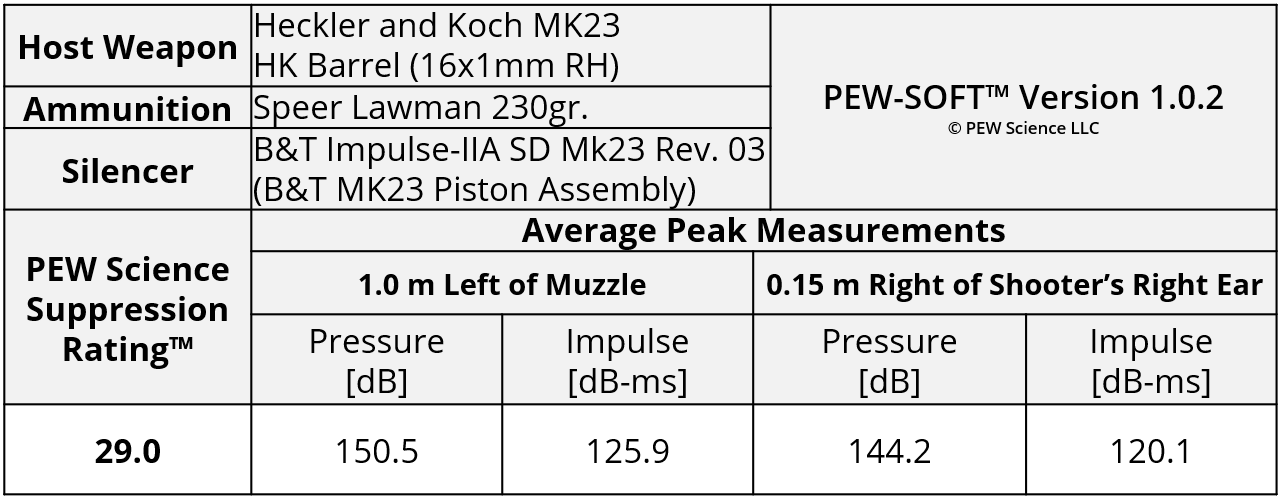
Table 2. B&T Impulse-IIA SD Mk23 Rev. 03 HK MK23 Sound Metric Summary
6.214.3.1 SOUND SIGNATURES AT THE MUZZLE
Real sound pressure histories from a 6-shot test acquired with PEW-SOFT™ are shown below. Six cartridges were loaded into the magazine and the weapon was fired until the magazine was empty, and the slide locked back on the slide-release lever actuated by the follower of the empty magazine. Only five shots are considered in the analysis. The signatures of Shot 6 are displayed in the data presentation but are not included in the analysis to maintain consistency with the overall PEW Science dataset. The waveforms are not averaged, decimated, or filtered. The data acquisition rate used in all PEW Science testing is 1.0 MS/s (1 MHz). The peaks, shape, and time phasing (when the peaks occur in relation to absolute time and to each other) of these raw waveforms are the most accurate of any firearm silencer testing publicly available. PEW-SOFT data is acquired by PEW Science independent testing; the industry leader in silencer sound research. For more information, please consult the Silencer Sound Standard.
The primary sound signature pressure histories for all 6 shots with the B&T Impulse-IIA SD Mk23 Rev. 03 tested on the HK MK23 are shown in Figure 8a. The sound signatures of Shot 1 and Shot 2 are shown in a shorter time window in Figure 8b. The real sound impulse (momentum transfer potential) histories from the same 6-shot test are shown in Figure 9a. In Figure 9b, a shorter timescale is shown comparing the impulse of Shot 1 to that of Shot 2 and Shot 3.
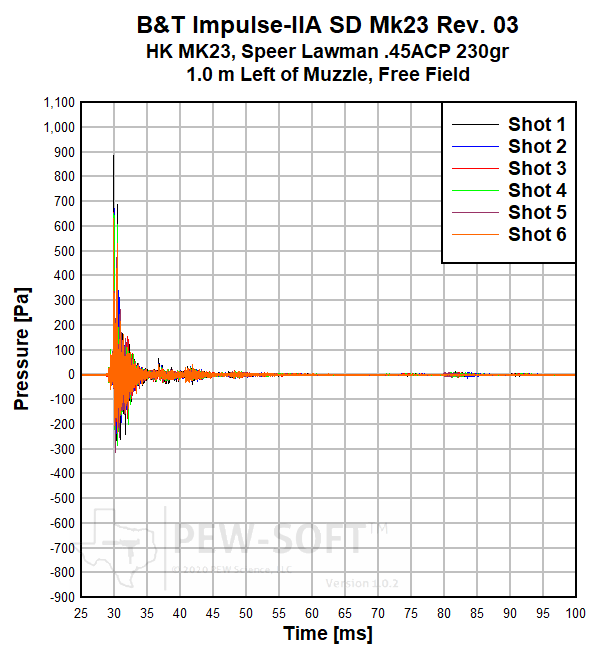
Fig 8a. B&T Impulse-IIA SD Mk23 Rev. 03 Subsonic .45 ACP HK MK23 Semiautomatic Pistol Muzzle Sound Pressure Signature

Fig 8b. B&T Impulse-IIA SD Mk23 Rev. 03 Subsonic .45 ACP HK MK23 Semiautomatic Pistol Muzzle Sound Pressure Signature
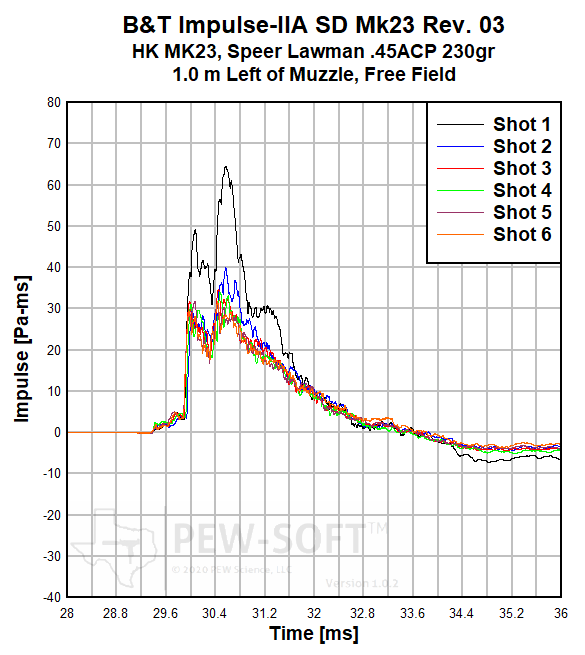
Fig 9a. B&T Impulse-IIA SD Mk23 Rev. 03 Subsonic .45 ACP HK MK23 Semiautomatic Pistol Muzzle Sound Impulse Signature

Fig 9b. B&T Impulse-IIA SD Mk23 Rev. 03 Subsonic .45 ACP HK MK23 Semiautomatic Pistol Muzzle Sound Impulse Signature
It is extremely interesting to note that the baffle geometry inside the B&T Impulse-IIA SD Mk23 Rev. 03 is extremely similar to that in the KAC MOD.MK23/USP silencer, but not identical. The B&T baffles are machined. Therefore, they are missing some key geometric features and curvature that, apparently based upon the measured test data in the research program, make a significant difference in performance.
As a general note (and important technical point of record), the shapes of the blast pressure and impulse histories shown in the above measured B&T silencer signatures are very similar to those measured from the KAC silencer. This is only possible due to similar internal geometry. The small (but additive) differences in the baffle geometries in the two silencers result in the following gross performance differences:
Primary blast is elevated in amplitude, along with secondary jetting (Fig. 8b).
Secondary jetting is more severe and occurs with faster (more impulsive) onset (Fig. 9a).
FRP jetting is more severe with FRP secondary jetting being significantly more severe with additional pronounced latent momentum (Fig. 9b).
Slide closing signatures occur slightly later (Fig. 8a).
PEW Science Research Note 7: The above behavioral differences in the two silencers highlight an excellent example of how geometric details of a silencer baffle, even if seemingly small, can significantly impact performance. Note that the FRP severity differential when using the B&T silencer is approximately 100% (the signature may be perceived as twice as severe to bystanders than follow-up shots, on average).
The Suppression Rating of the B&T Impulse-IIA SD Mk23 Rev. 03 on the HK MK23 with Speer Lawman 230gr .45 ACP ammunition is 26.5 1.0 m left of the silencer’s end cap, on average, compared with 32.1 1.0 m left of the end cap of the KAC MOD.MK23/USP on the same weapon with the same ammunition. This severity differential is significant and will be noticeable to bystanders. Again, the reader is encouraged to consult the Hazard Maps at the beginning of this report and in Hazard Map Brief 8.1.11 to view personnel risk spatially. The signatures measured at the shooter’s ear are presented and examined below.
6.214.3.2 SOUND SIGNATURES AT SHOOTER’S EAR
Real sound pressure histories from the same 6-shot test acquired with PEW-SOFT at the shooter’s ear are shown below. Again, the waveforms are not averaged, decimated, or filtered. The data acquisition rate used in all PEW Science testing is 1.0 MS/s (1 MHz).
The primary sound signature pressure histories at the ear for all 6 shots with the B&T Impulse-IIA SD Mk23 Rev. 03 tested on the HK MK23 are shown in Figure 10a. A zoomed-in timescale is displayed in Figure 10b, in the region of peak sound pressure. The real sound impulse (momentum transfer potential) histories at the ear from the same 6-shot test are shown in Figure 11.
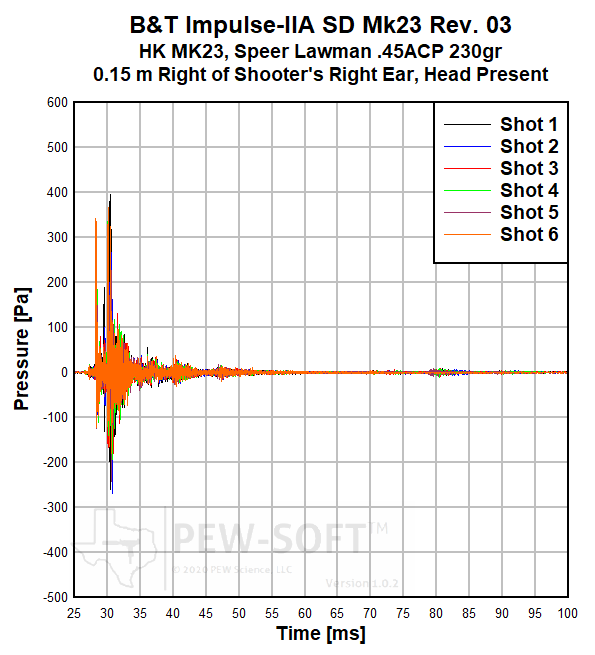
Figure 10a. B&T Impulse-IIA SD Mk23 Rev. 03 Subsonic .45 ACP HK MK23 Semiautomatic Pistol Ear Sound Pressure Signature

Figure 10b. B&T Impulse-IIA SD Mk23 Rev. 03 Subsonic .45 ACP HK MK23 Semiautomatic Pistol Ear Sound Pressure Signature

Figure 11a. B&T Impulse-IIA SD Mk23 Rev. 03 Subsonic .45 ACP HK MK23 Semiautomatic Pistol Ear Sound Impulse Signature

Figure 11b. B&T Impulse-IIA SD Mk23 Rev. 03 Subsonic .45 ACP HK MK23 Semiautomatic Pistol Ear Sound Impulse Signature
Again, the similarities in baffle geometry between the B&T and KAC silencers produce similar signature shapes but the detailed phenomena measured at the operator’s head are radically different, just as they were measured adjacent to the silencer end caps.
Every performance difference observed at the muzzle is mirrored at the shooter’s head:
Primary blast is elevated in amplitude, along with secondary jetting (Fig. 10b).
Secondary jetting is more severe and occurs with faster (more impulsive) onset (Fig. 11a). This results in erratic accumulation near the operator (Fig. 11b).
FRP jetting is more severe (Fig. 11).
Slide closing signatures occur slightly later (Fig. 10a).
Breech blast appears to be reduced in amplitude (Fig. 10b), which may indicate congruence with a back pressure increase causing the phenomenon in (4).
Again, the designs are similar but not identical, and the geometric details are meaningful with regard to performance. The shooter’s ear Suppression Rating of the B&T silencer on the HK MK23 is 24.2, on average, compared with 36.7 with the KAC MOD.MK23/USP on the same weapon with the same ammunition. This severity differential is even more significant to operators. Again, the reader is encouraged to consult the Hazard Maps at the beginning of this report and in Hazard Map Brief 8.1.11 to view personnel risk spatially. It is likely that the differing mass and piston dynamics of the two silencers result in nested mechanical shock and resonance components in the B&T silencer signature that are not present with the KAC system. Anecdotal experience supports this hypothesis. The perceived “mechanical noise” from the B&T system is more pronounced to the operator.
It is very important to note that what you, as a human, hear is a function of every pressure source propagating through the atmosphere that reaches your pressure sensors (your ears). In early time, the risk to your ear is highest. In late time, after the primary combustion events have vented, there are signature components that may propagate downrange, adjacent to your location, and even back toward you upon reflecting from objects such as tree lines, automobiles, or structures. Those late time signature components can give a subjective impression to the operator that may induce a perception of “loudness.” Loudness, as defined in the Silencer Sound Standard however, is objective hearing damage risk potential.
Factors that may increase the actual objective loudness (the risk to you, the operator) of using a system with a lower muzzle Suppression Rating despite the same or higher shooter’s ear Suppression Rating include shooting the suppressed weapon system:
Indoors.
In a vehicle or adjacent to a vehicle.
Adjacent to a building, berm, awning, or tree line.
The following two sections present abbreviated evaluations of the KAC and B&T silencers on the HK USP45 Tactical, colloquially known as the “MK23 Compact.” (That’s a MK23 user joke).
6.214.4 KAC MOD.MK23/USP HK USP45 Tactical Sound Signature Test Results
A summary of the principal Silencer Sound Standard performance metrics of the KAC MOD.MK23/USP tested on the HK USP45 Tactical is shown in Table 3. The data acquired 1.0 m (39.4 in) left of the muzzle is available for viewing to all. This is a members-only review and includes pressure and impulse waveforms measured at the shooter’s ear. PEW Science thanks you for your support; further testing, research, and development of PEW-SOFT and the Silencer Sound Standard is made possible by members like you!
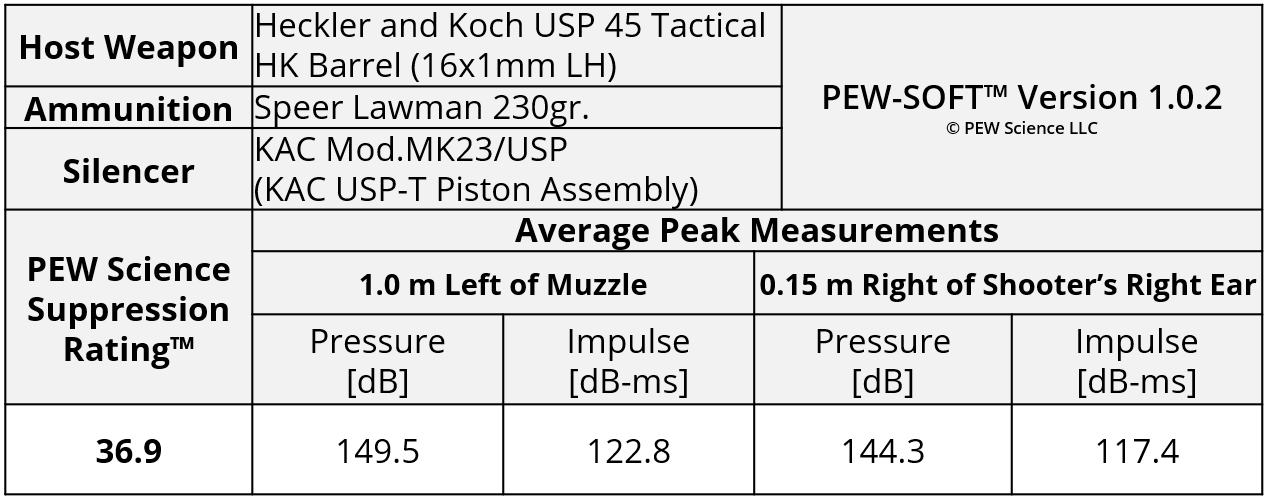
Table 3. KAC MOD.MK23/USP HK USP45 Tactical Sound Metric Summary
6.214.4.1 SOUND SIGNATURES AT THE MUZZLE
Real sound pressure histories from a 6-shot test acquired with PEW-SOFT™ are shown below. Six cartridges were loaded into the magazine and the weapon was fired until the magazine was empty, and the slide locked back on the slide-release lever actuated by the follower of the empty magazine. Only five shots are considered in the analysis. The signatures of Shot 6 are displayed in the data presentation but are not included in the analysis to maintain consistency with the overall PEW Science dataset. The waveforms are not averaged, decimated, or filtered. The data acquisition rate used in all PEW Science testing is 1.0 MS/s (1 MHz). The peaks, shape, and time phasing (when the peaks occur in relation to absolute time and to each other) of these raw waveforms are the most accurate of any firearm silencer testing publicly available. PEW-SOFT data is acquired by PEW Science independent testing; the industry leader in silencer sound research. For more information, please consult the Silencer Sound Standard.
The primary sound signature pressure histories for all 6 shots with the KAC MOD.MK23/USP tested on the HK USP45 Tactical are shown in Figure 12. The real sound impulse (momentum transfer potential) histories from the same 6-shot test are shown in Figure 13.

Fig 12. KAC MOD.MK23/USP Subsonic .45 ACP HK USP45 Tactical Semiautomatic Pistol Muzzle Sound Pressure Signature
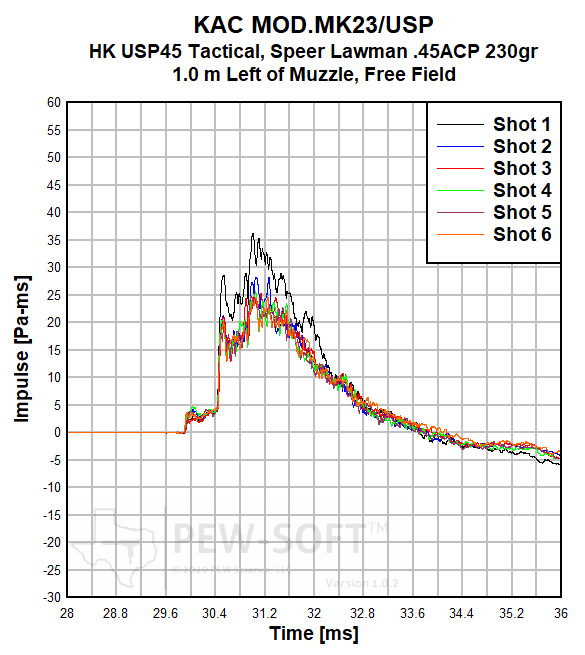
Fig 13. KAC MOD.MK23/USP Subsonic .45 ACP HK USP45 Tactical Semiautomatic Pistol Muzzle Sound Impulse Signature
When compared with fielding the MK23 with the KAC silencer, the USP45 Tactical produces higher blast pressure and more severe blast impulse, in the free field. Relative FRP severity is reduced when compared to MK23 use. However, it is important to note that all shots will generally be less severe from the KAC silencer when fired with the MK23 compared with the USP45 Tactical, all other things equal. The Suppression Rating drop (29.1 from 32.1) is not severe, but it is measurable and noticeable to bystanders.
Severity differentials result from barrel length and system lock time.
Signatures measured near the operator’s head from the same instrumented blast test are presented below.
6.214.4.2 SOUND SIGNATURES AT SHOOTER’S EAR
Real sound pressure histories from the same 6-shot test acquired with PEW-SOFT at the shooter’s ear are shown below. Again, the waveforms are not averaged, decimated, or filtered. The data acquisition rate used in all PEW Science testing is 1.0 MS/s (1 MHz).
The primary sound signature pressure histories at the ear for all 6 shots with the KAC MOD.MK23/USP tested on the HK USP45 Tactical are shown in Figure 14. The real sound impulse (momentum transfer potential) histories at the ear from the same 6-shot test are shown in Figure 15.
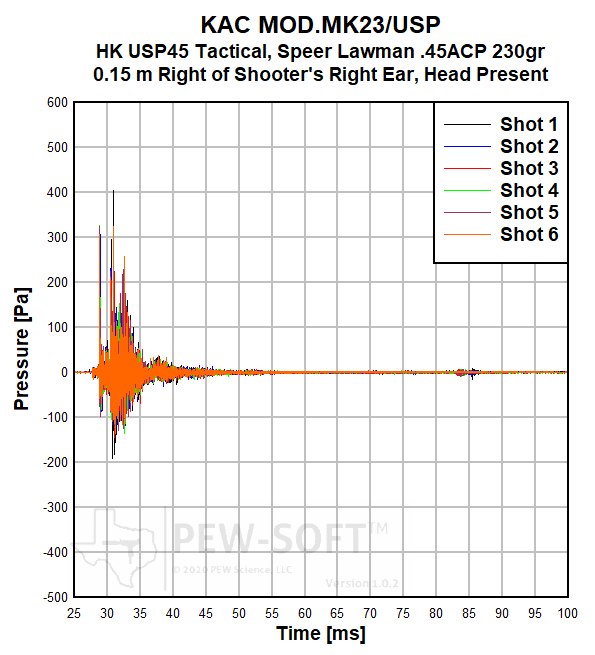
Fig 14. KAC MOD.MK23/USP Subsonic .45 ACP HK USP45 Tactical Semiautomatic Pistol Ear Sound Pressure Signature

Fig 15. KAC MOD.MK23/USP Subsonic .45 ACP HK USP45 Tactical Semiautomatic Pistol Ear Sound Impulse Signature
Similarly to the signatures measured at the muzzle, the signatures measured near the operator’s head display the same behavioral changes with the USP45 Tactical compared to the MK23, with the KAC silencer. The Suppression Rating drop (35.8 from 36.7) is less significant than the bystander (muzzle) Suppression Rating drop, and is less impactful to the operator.
Similar abbreviated evaluation of the B&T silencer on the USP system is presented below.
6.214.5 B&T Impulse-IIA SD Mk23 Rev. 03 HK USP45 Tactical Sound Signature Test Results
A summary of the principal Silencer Sound Standard performance metrics of the B&T Impulse-IIA SD Mk23 Rev. 03 tested on the HK USP45 Tactical is shown in Table 4. The data acquired 1.0 m (39.4 in) left of the muzzle is available for viewing to all. As stated in Section 6.214.4, this is a members-only review and includes pressure and impulse waveforms measured at the shooter’s ear. PEW Science thanks you for your support; further testing, research, and development of PEW-SOFT and the Silencer Sound Standard is made possible by members like you!
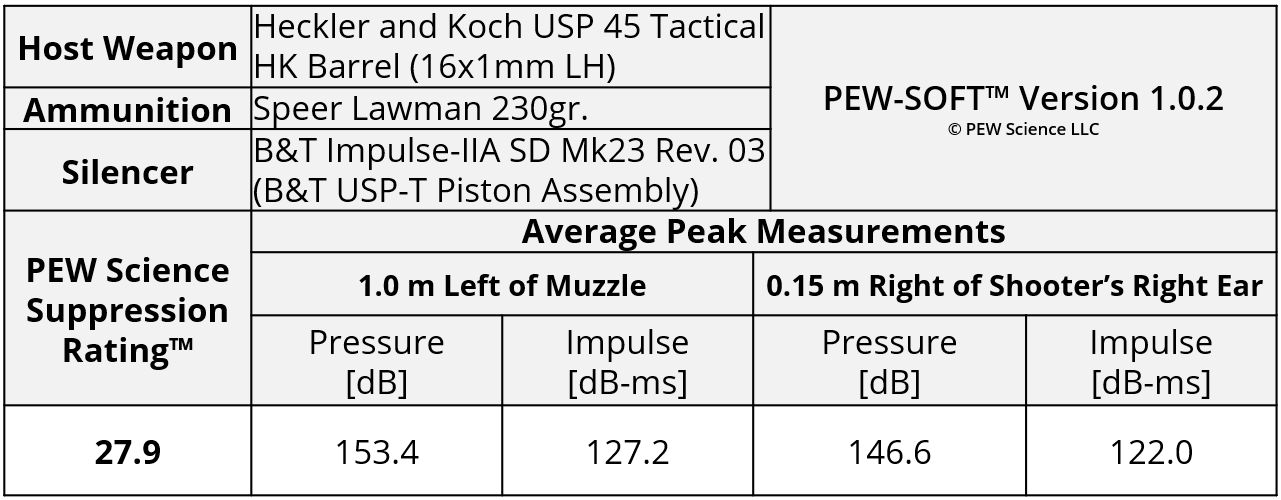
Table 4. B&T Impulse-IIA SD Mk23 Rev. 03 HK USP45 Tactical Sound Metric Summary
6.214.5.1 SOUND SIGNATURES AT THE MUZZLE
Real sound pressure histories from a 6-shot test acquired with PEW-SOFT™ are shown below. Six cartridges were loaded into the magazine and the weapon was fired until the magazine was empty, and the slide locked back on the slide-release lever actuated by the follower of the empty magazine. Only five shots are considered in the analysis. The signatures of Shot 6 are displayed in the data presentation but are not included in the analysis to maintain consistency with the overall PEW Science dataset. The waveforms are not averaged, decimated, or filtered. The data acquisition rate used in all PEW Science testing is 1.0 MS/s (1 MHz). The peaks, shape, and time phasing (when the peaks occur in relation to absolute time and to each other) of these raw waveforms are the most accurate of any firearm silencer testing publicly available. PEW-SOFT data is acquired by PEW Science independent testing; the industry leader in silencer sound research. For more information, please consult the Silencer Sound Standard.
The primary sound signature pressure histories for all 6 shots with the B&T Impulse-IIA SD Mk23 Rev. 03 tested on the HK USP45 Tactical are shown in Figure 16. The real sound impulse (momentum transfer potential) histories from the same 6-shot test are shown in Figure 17.

Fig 16. B&T Impulse-IIA SD Mk23 Rev. 03 Subsonic .45 ACP HK USP45 Tactical Semiautomatic Pistol Muzzle Sound Pressure Signature

Fig 17. B&T Impulse-IIA SD Mk23 Rev. 03 Subsonic .45 ACP HK USP45 Tactical Semiautomatic Pistol Muzzle Sound Impulse Signature
When fielded on the HK USP45 Tactical, the B&T Impulse-IIA SD Mk23 Rev. 03 exhibits a pure suppression performance drop from the MK23 that is more severe than observed with the KAC MOD.MK23/USP silencer. It is postulated that the somewhat higher flow rate (somewhat lower back pressure) induced by the B&T baffles may be partially responsible for this performance differential. The bystander (muzzle) Suppression Rating drops from 26.5 (MK23) to 22.0 (USP45 Tactical). Behavior is characterized by much more significant blast propagation, in both pressure and impulse space. The shorter USP gun barrel is postulated to be the primary driver.
Interestingly, performance seems to plateau at the operator’s head with a weapon system change, with the B&T silencer. Those measured signatures are examined below.
6.214.4.2 SOUND SIGNATURES AT SHOOTER’S EAR
Real sound pressure histories from the same 6-shot test acquired with PEW-SOFT at the shooter’s ear are shown below. Again, the waveforms are not averaged, decimated, or filtered. The data acquisition rate used in all PEW Science testing is 1.0 MS/s (1 MHz).
The primary sound signature pressure histories at the ear for all 6 shots with the B&T Impulse-IIA SD Mk23 Rev. 03 tested on the HK USP45 Tactical are shown in Figure 18. The real sound impulse (momentum transfer potential) histories at the ear from the same 6-shot test are shown in Figure 19.
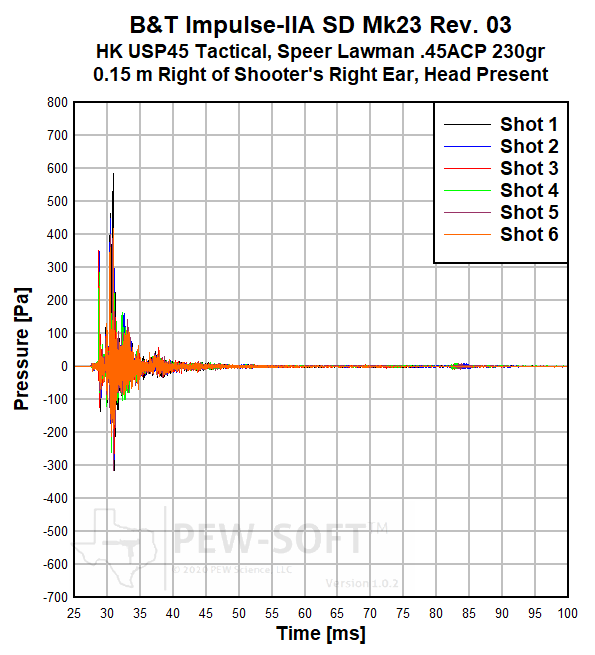
Fig 18. B&T Impulse-IIA SD Mk23 Rev. 03 Subsonic .45 ACP HK USP45 Tactical Semiautomatic Pistol Ear Sound Pressure Signature

Fig 19. B&T Impulse-IIA SD Mk23 Rev. 03 Subsonic .45 ACP HK USP45 Tactical Semiautomatic Pistol Ear Sound Impulse Signature
In accordance with the above measured signatures, the operator experiences a somewhat more consistent (less erratic) propagated blast load throughout the shot string. FRP severity is greatly reduced. This is postulated to be a function of the slightly higher B&T silencer flow rate, coupled with the shorter USP barrel length resulting in a more severe forward momentum propagation with minimal ejection port blast increase. The operator (shooter’s ear) Suppression Rating slightly increases from 24.2 (MK23) to 26.0 (USP45 Tactical). This difference may be of minimal concern to the weapon operator.
The overall performance summary presented in Section 6.214.1 is repeated below with additional commentary.
6.214.6 Suppression Rating Comparisons (Subsonic .45 ACP from the HK MK23 and USP 45 Tactical)
Figure 20 again presents a comparison of the calculated PEW Science Suppression Ratings of the KAC MOD.MK23/USP and B&T Impulse-IIA SD Mk23 Rev. 03 silencers on both full-size HK MK23 and USP45 Tactical semiautomatic combat handguns using subsonic Speer Lawman 230gr .45 ACP ammunition. Unsuppressed system risk metrics are also presented.
Fig 20. Suppression Rating Comparisons of KAC MOD.MK23/USP and B&T Impulse-IIA SD Mk23 Rev. 03 silencers on the HK MK23 and USP45 Tactical full-size semiautomatic pistols Using PEW-SOFT Test Data and PEW Science Analysis
From the above performance comparisons, the following gross conclusions can be made:
The KAC MOD.MK23/USP silencer, and its requisite inertial-decoupling piston assemblies, provide scalable signature suppression and personnel hazard reduction performance on the two HK combat handgun host weapons. The KAC system performance is more robust than the B&T system performance.
The HK MK23 system signature may be suppressed to a greater degree than the HK USP45 Tactical system signature. This is a function of the longer MK23 barrel generating lower muzzle blast pressure input into the silencer(s), as well as system lock time mechanics and dynamics.
Unsuppressed blast loads from both weapon systems are exceedingly hazardous to personnel in the near field. Silencer use is recommended not only to minimize operational signature, but to reduce damage to the unprotected human ear.
The B&T Impulse-IIA SD Mk23 Rev. 03 produces a plateauing (and slight increase) in operator protection when moving from the HK MK23 system to the shorter barrel HK USP45 Tactical system. This is a function of the silencer’s slightly higher flow rate than the KAC model and the different inertial decoupling system dynamics combined with the different pistol lock time mechanics. Nonetheless, the risk field produced by the suppressed USP45 Tactical is more severe, globally, than that produced by the suppressed MK23 with both silencers, on average. The reader is encouraged to examine localized risk differentials using the Hazard Maps at the beginning of this report and in Hazard Map Brief 8.1.11.
As previously discussed in Research Note 7, the behavioral differences between the two silencers evaluated in this study highlight an excellent example of how geometric details of a silencer baffle, even if seemingly small, can significantly impact performance. The original Qual-A-Tec derived crimped-cone geometry has undergone one of the longest tenures of any modern silencer baffle and continues to demonstrate strong performance in the current state of practice. KAC silencers, and their technology derivatives, remain influential in silencer history. The HK MK23 and the SOCOM MK23 Offensive Handgun program are responsible for direct and important contributions to the suppressed small arms state of practice. Without the KAC MOD.MK23/USP silencer, the current state of centerfire pistol silencer technology would most certainly be different.
PEW Science Research Note 8: Because the PEW Science Suppression Rating is a damage risk criterion (DRC), a lower Suppression Rating indicates a higher personnel hazard in the free field. Therefore, silencers with a lower Suppression Rating are postulated to be more hazardous to the unprotected ear than silencers with a higher Suppression Rating. To iterate, the Suppression Rating is a DRC - it is not a subjective quantity; it is an objective quantification of hearing damage risk potential.
The signature to which the shooter’s ear is subjected is a function of both ejection port and muzzle signature. When the silencer’s endcap is in closer proximity to the shooter, the severity is increased. The coalescing of the ejection port blast overpressure with the primary muzzle blast exacerbates the severity of the signature at the shooter’s head position. It is not ejection port signature, alone, that dictates the signature measured at the shooter’s head position.
6.214.6 Review Summary: KAC MOD.MK23/USP and B&T Impulse-IIA SD Mk23 Rev.03 on the HK MK23 and USP45 Tactical Full-Size Semiautomatic Pistols
When paired with the HK MK23 full-size semiautomatic pistol and fired with Speer Lawman 230gr ammunition, the KAC MOD.MK23 / USP achieved a Suppression Rating™ of 38.3 in PEW Science testing. The B&T Impulse-IIA SD Mk23 Rev. 03 with the same host weapon and the same ammunition achieved a Suppression Rating of 29.0.
When paired with the HK USP45 Tactical full-size semiautomatic pistol and fired with Speer Lawman 230gr ammunition, the KAC MOD.MK23 / USP achieved a Suppression Rating™ of 36.9 in PEW Science testing. The B&T Impulse-IIA SD Mk23 Rev. 03 with the same host weapon and the same ammunition achieved a Suppression Rating of 27.9.
As with all weapon systems, the user is encouraged to examine both muzzle and ear Suppression Ratings.
PEW Science Laboratory Staff Opinion:
The KAC MOD.MK23/USP .45 ACP silencer is the historical “mother” silencer to which all modern centerfire pistol silencers owe their lineage. The development and refinement of the inertial decoupling piston system (also known as recoil booster, Neilson device, and linear inertial decoupler (LID), etc), by Qual-A-Tec in the 1980s set the groundwork for future innovation. Doug Olson’s career journey from Qual-A-Tec to Knights Armament Company brought not only pistol silencer recoil system innovation that made its way into the pivotal SOCOM MK23 Offensive Handgun program, but also highly efficient and deceptively geometrically complex crimped-cone baffle technology that permeated through most KAC silencer models over the last three decades. The B&T Impulse line of silencers and specifically the Impulse-IIA SD Mk23 evaluated in this study, also owe lineage to KAC designs and further demonstrate the wide proliferation of these advancements, worldwide. The KAC and B&T silencers evaluated in this program remain the only two silencers officially accepted by Heckler and Koch for use on the MK23 and USP45 Tactical combat handguns. The research and development of centerfire pistol silencer inertial decoupling recoil mechanisms, and purposeful engineering to ensure system reliability and longevity, is a dying art. It is our hope that this research presentation helps to reignite that practice area and bring discussion of these small arm weapon system performance parameters back into public interest and scrutiny.
In general, the MK23 system presents a superior silencer host weapon to the smaller and less robust USP45 Tactical. Nonetheless, it is acknowledged that the size of the MK23 is not practical for some users. For completeness, this study evaluated the performance of the two silencers on both weapon systems. The signature evaluation confirms historical anecdotal reports of both host performance comparison and silencer performance comparison. The KAC MK23 silencer produces superior signature suppression performance to the B&T MK23 silencer, regardless of weapon system. This is largely a consequence of the baffle complexity and piston system. The B&T machined versions of the KAC crimped-cones lack several distinct surface area and curvature features tuned for efficient heat transfer and turbulence generation in the design envelope and the mechanical resonance of the B&T system is more severe. It should be noted that the KAC silencer is only 7.6 inches long (and the B&T version only 7.8 inches long). These silencers are significantly shorter than many modern .45 ACP silencers on the current market. The performance of the KAC silencer, for its length, is highly competitive with modern designs.
Both KAC and B&T silencers may be used with the MK23 and USP45 Tactical by changing their inertial decoupling assemblies. The piston assemblies are tuned for the dynamics of each weapon system. User caution is advised when adopting these silencers for use with other combat handguns. In general, the user should contact the weapon system manufacturer and silencer manufacturer to verify system compatibility for performance, reliability, and longevity.
The suppression of .45 ACP combat handguns is more difficult, technically, than the suppression of 9mm combat handguns due to the factors discussed in this report. Oftentimes, “wet” use in which a small bottle cap full of water is placed in the blast chamber of the silencer, distributed throughout the baffle stack by silencer rotation, and then installed on the weapon, may be preferred for operational engagements. The flashing of the water to steam by expanding combustion gasses is an efficient energy transfer mechanism and will significantly reduce the severity of blast propagation from the silencer. Wet silencer evaluation is the subject of future PEW Science research.
The KAC MOD.MK23/USP silencer is no longer in large scale production. We hope additive manufacturing provides opportunity for future generations to enjoy its use.
In this review, the KAC MOD.MK23/USP and B&T Impulse-IIA SD Mk23 Rev. 03 performance metrics depend upon suppressing two historic full-size combat handguns firing the full-power .45 ACP subsonic centerfire pistol cartridge. PEW Science encourages the reader to carefully consider action dynamics, barrel lengths, and other characteristics in the selection of centerfire pistol silencer hosts.
The hearing damage potential of centerfire pistol use is significant. PEW Science encourages the reader to consider the Suppression Rating when deciding on an appropriate silencer and host weapon combination for their desired use. Note that the presence of nearby reflecting surfaces, as well as ammunition choice, can influence the sound signature to which both the shooter and bystanders are subjected.