SSS.6.232 - T&K Vorix 30 Ti Multi-Cartridge Suppressor Tests - .308 and Subsonic 300 BLK (Free Version)
/T&K Vorix 30 Ti on 20-in Barrel .308 and 8-in Barrel 300 BLK Bolt-Action Rifles
The Vorix 30 Ti is designed by T and K Suppressors (T&K). It is a .30 caliber centerfire rifle silencer, intended to suppress most cartridges with projectiles appropriately sized to travel through the bore, up to magnum rifle cartridges. It has a 1.47-in diameter and is 7.4 inches long with no mount installed. The rear of the silencer is threaded 1.375-24tpi to accommodate “HUB” compatible mounting systems; the included direct-thread mount increases the total system length to 7.81 inches. The core of the silencer is 3D-printed titanium and DLC coated. The removable direct-thread mount is titanium. The silencer weighs 10.2 ounces and the direct-thread mounts weighs 1 ounce, for a total system weight of 11.2 ounces, as tested. The Vorix 30 Ti can be obtained from T&K Dealers.
System Suppression Ratings and Silencer Hazard Maps:
This report includes two (2) different tests of the Vorix 30 Ti. Composite and Detailed Suppression Ratings, along with the predicted personnel hazards generated by the tested weapon systems in this report in the free field, are shown in the below graphics and Silencer Hazard Maps. Click or tap the Maps to enlarge. Please reference Silencer Hazard Map Brief 8.1.29 for further details. The PEW-SOFT HD Blast Hazard Prediction Tool and Hazard Mapper is presented in Report 8.1.1.
T&K Vorix 30 Ti 20-in .308 Bolt-Action Free Field Hazard Map Produced by PEW-SOFT HD Blast Hazard Prediction Tool using PEW Science Test Data
T&K Vorix 30 Ti 20-in 300 BLK Subsonic Bolt-Action Free Field Hazard Map Produced by PEW-SOFT HD Blast Hazard Prediction Tool using PEW Science Test Data
PEW Science is an independent private testing laboratory and also hosts the world’s only independent public suppressed small arms research cooperative. Testing, data analysis, and reporting is generated with funding provided by PEW Science members. Any test data that is generated with any portion of private funding contains this disclosure. The testing and analysis production for this Sound Signature Review was funded in part by PEW Science Project PEW-TK-160-001-26. Therefore, data pertaining to the T&K Vorix 30 Ti in this Sound Signature Review is published with the express written permission of T&K Hunting Gear, LLC.
The testing and analysis presented in this Sound Signature Review is of the T&K Vorix 30 Ti in the following configurations:
Direct-thread mounted on the Savage Model 10 Precision Carbine rifle, chambered in .308WIN with a 20-inch barrel. Federal XM80 149gr ammunition was used in the test.
Direct-thread mounted on the Q mini Fix rifle, chambered in 300 BLK with an 8-inch barrel. Discreet Ballistics 190gr target ammunition was used in the test, in which its velocity was subsonic.
Report Table of Contents:
Section 6.232.1 contains a T&K Vorix 30 Ti performance summary comparison from this test program.
Section 6.232.2 contains Vorix 30 Ti test results and analysis on .308 bolt-action rifle.
Section 6.232.3 contains Vorix 30 Ti test results and analysis on 300 BLK subsonic bolt-action rifle.
Overall Suppression Rating comparisons of the Vorix 30 Ti with other silencers on the above two host weapons are provided in each report section. Comprehensive comparisons are available in the Rankings Section of the Standard.
Section 6.232.4 contains an article summary and PEW Science laboratory staff opinions.
Summary: When paired with the Savage M10 20” .308 and fired with Federal XM80, the T&K Vorix 30 Ti with direct-thread mount achieved a composite Suppression Rating™ of 48.7 in PEW Science testing.
When paired with the Q mini FIX 8” 300 BLK and fired with Discreet Ballistics 190gr, the T&K Vorix 30 Ti with direct-thread mount achieved a composite Suppression Rating of 66.4 in PEW Science testing.
As with all weapon systems, the user is encouraged to examine both muzzle and ear Suppression Ratings.
Relative Suppression Rating Performance is Summarized in SSS.7 - PEW Science Rankings.
6.232.1 T&K Vorix 30 Ti Suppressor Performance Summary (.308 and 300 BLK)
It is common for users to field .30 caliber silencers on multiple different weapon systems. Typically, there are performance compromises when doing so. However, when adhering to the design intent(s) of a silencer, these compromises may be reduced.
Regardless whether a silencer is optimized for a certain use case (supersonic rifle, subsonic rifle, submachine gun, etc), it will most certainly produce a different resultant signature, and therefore varying personnel risk, when being used on different weapons. The combustion pressure, duration, and jet diameter from different weapon systems all interact with silencer internals differently.
This report presents a third-party laboratory performance evaluation of the T&K Vorix 30 Ti silencer on two standard PEW Science test weapons. Two combustion regimes are evaluated:
Full rifle cartridge (high pressure, long duration) on the 20-in .308 bolt-action.
Pistol cartridge, subsonic (low pressure, short duration) on the 8-in 300 BLK bolt-action.
The reader may sort and filter all public Rankings here to compare all personnel hazards from all weapon systems on the same universal scale. The T&K Vorix 30 Ti test results are shown in Figure 1, below. Metrics shown are in terms of PEW Science Suppression Rating, which is a human risk metric calculated from raw free field blast overpressure test data. The calculated risk metrics for the unsuppressed cases of each weapon system are also presented.
Figure 1. Supersonic 308 and Subsonic 300 BLK Suppression Rating Comparisons of the the T&K Vorix 30 Ti silencer Using PEW-SOFT Test Data and PEW Science Analysis
The Vorix 30 Ti is a purposely designed lightweight and compact bolt-action rifle silencer, in that it is intended to be used on bolt-action weapon systems.
From the above data, it is shown that:
As expected, blast overpressure signature severity is more severe with long duration, high pressure combustion, when compared with that of short duration, low pressure combustion. This should be intuitive to the reader. However, what may be counterintuitive is that some other silencers have similar performance in both these combustion regimes, or their performance metrics flip showing poor subsonic suppression performance with more robust supersonic suppression performance. Typically, these outlier cases occur with technologies relying on significant long duration surface area contact with combustion gasses (e.g. HUXWRX FLOW series). The Vorix 30 Ti, however, is a conventional silencer that displays typical performance scaling proportionally to pressure input amplitude and duration.
The muzzle (bystander) and ear (shooter) Suppression Rating differential is relatively high with long duration, high pressure combustion. Note the fairly extreme gap in the .308 Suppression Ratings at muzzle and ear. This is not without precedent; blast overpressure field shape, and thus personnel hazard risk field shape, is a function of several suppressed signature components, including flow rate and duration. These components may vary during the time regime of blowdown. Care must be taken to ensure user expectations are reasonable when examining the Suppression Rating metrics, particularly when only the Composite Ratings are viewed (the big numbers in the Suppression Rating graphics). The Silencer Hazard Maps shown at the top of this report are intended to assist the reader with a best estimate of spatial hazards, in the free field. As always, personnel hazards increase when reflecting surfaces enter the environment. Buildings, cliff faces, berms, vehicles, and other environmental features reflect blast loads and thus alter resultant blast overpressure waveform components. A decrease in the calculated Suppression Rating metric corresponds to an increase in personnel hazard.
Personnel hazards with short duration, low pressure combustion are balanced. For its length, the Vorix 30 Ti provides exceptionally competitive subsonic 300 BLK suppression performance and the pure blast overpressure hazards are balanced in the risk field, as indicated by the similar muzzle (bystander) and ear (shooter) Suppression Ratings. Again, the Silencer Hazard Maps display spatial risk. Jet stability out of the end of the silencer, directly related to flow rate, is markedly higher in the subsonic 300 BLK combustion regime with this silencer. This performance is particularly interesting and stands to reason due to its relatively small diameter in the modern silencer market (slightly less than 1.5 inches). This increase in efficiency is driven by both the significantly lower combustion gas volume and baffle design optimization. This allows high performance despite relatively low volumetric expansion.
Oftentimes, additive manufacturing is required to implement the engineering solutions present in many high performing silencers. In the case of the Vorix 30 Ti, it is likely the silencer could be traditionally manufactured. While producing high performance for its size and weight, the design is somewhat conventional (but highly optimized). One sometimes overlooked benefit of additive manufacturing is rapid prototyping allowing for design iteration. The Vorix 30 Ti is an end product example of this practice.
It is important to note that some designs perform better than others, even in the same size classes; there are clear behavioral differences that are showcased with real measured test data and engineering analysis. The performance differentials may be nontrivial, even between new technologies released today.
User caution: The relative performance metrics of the Vorix 30 Ti displayed above should not be extrapolated to other silencers.
Detailed T&K Vorix 30 Ti test data and analysis follows on both of the host weapons with two different types of ammunition.
6.232.2 T&K Vorix 30 Ti Sound Signature Test Results (.308)
A summary of the principal Silencer Sound Standard .308 performance metrics of the T&K Vorix 30 Ti is shown in Table 1. The data acquired 1.0 m (39.4 in) left of the muzzle is available for viewing to all. The data acquired 0.15 m (6 in) right of the shooter’s ear is only available to membership supporters of PEW Science and the Silencer Sound Standard. You can support public PEW Science testing, research, and development with a membership, here. State-of-the-art public firearm sound signature testing and research conducted by PEW Science is supported by readers like you.
Table 1. T&K Vorix 30 Ti .308 Sound Metric Summary
6.232.2.1 SOUND SIGNATURES AT THE MUZZLE (.308)
Real sound pressure histories acquired with PEW-SOFT™ are shown below. The waveforms are not averaged, decimated, or filtered. The data acquisition rate used in all PEW Science testing is 1.0 MS/s (1 MHz). The peaks, shape, and time phasing (when the peaks occur in relation to absolute time and to each other) of these raw waveforms are the most accurate of any firearm silencer testing publicly available. PEW-SOFT data is acquired by PEW Science independent testing; the industry leader in silencer sound research. For more information, please consult the Silencer Sound Standard.
The primary sound signature pressure histories for all 5 shots with the T&K Vorix 30 Ti are shown in Figure 2a. The sound signatures of Shot 1 and Shot 2 are shown in Figure 2b, in very early time. Typical early time views are shown in Figure 2c. The real sound impulse (momentum transfer potential) histories from the same 5-shot test are shown in Figure 3a. In Figure 3b, a shorter timescale is shown comparing the impulse of Shot 1 to that of Shot 2 and Shot 3.
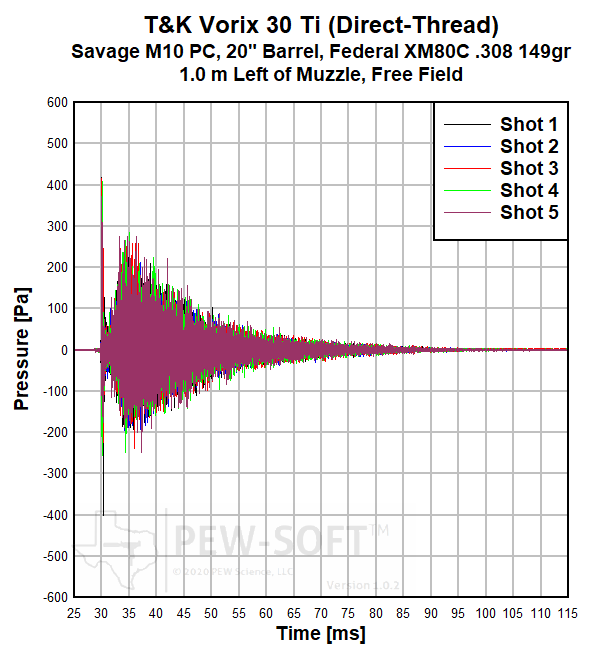
Fig 2a. T&K Vorix 30 Ti Bolt Action Rifle Muzzle Sound Pressure Signature
Fig 2b.T&K Vorix 30 Ti Bolt Action Rifle Muzzle Sound Pressure Signature, Early Short Time Window
Fig 2c. T&K Vorix 30 Ti Bolt Action Rifle Muzzle Sound Pressure Signature, Short Time Window
Fig 3a. T&K Vorix 30 Ti Bolt Action Rifle Muzzle Sound Impulse Signature
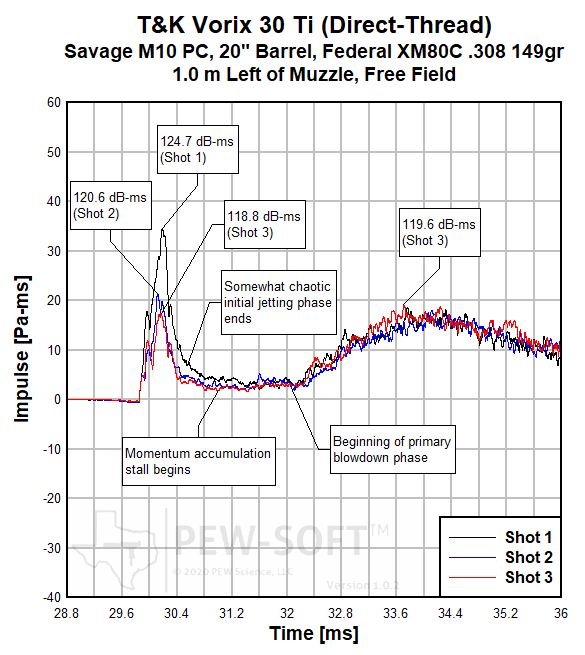
Fig 3b. T&K Vorix 30 Ti Bolt Action Rifle Muzzle Sound Impulse Signature, Short Time Window
The T&K Vorix 30 Ti is a highly optimized, lightweight, and compact bolt-action silencer. The internal design, while 3D-printed, is conventional. It is still considered advanced in that highly optimized baffle geometry and porting locations give way to significant stagnation relief without the use of annular expansion or significant off-axis flow. As the silencer is not intended for heavy use on reciprocating systems, back pressure is of no design concern; only pure blast overpressure suppression.
The Vorix 30 Ti has a symmetrical straight cone blast baffle with porting on the main wall and throat. Porting is continued on the remainder of the notched cone baffle array, though it diminishes with distance from the blast chamber. This is a typical design feature driving efficiency across pressure drop. Again, back pressure is purposely high.
The measured blast overpressure data from the test of the Vorix 30 Ti display relatively unique signature components, in both pressure and impulse space. Some of these features are unusual and further described below.
PEW Science Research Note 1: The following observations are noted in the above measured test data:
Somewhat typical decoupled initial jetting and primary long duration blowdown (Fig. 2a).
In an extreme early time view of the initial blast pressures (Fig. 2b), very consistent internal combustion is noted, along with consistency in the first coupled jet. However, immediate jet onset after Mach wave coupling occurs with higher velocity, as shown with accompanying unusually greater amplitude rarefaction components. Though significant during the first shot, this phenomenon is pervasive in all shots, as highlighted previously in Fig. 2a. Significant rarefaction occurs in multiple pulses, indicating this is not errant jetting, but consistent (albeit almost uncontrolled) jetting occurring prior to the primary blowdown phase.
There is a distinct delay between the start of primary jetting and initiation of the primary blowdown phase (Fig. 2c).
First-round-pop (FRP) divergence is almost completely limited to the initial jetting phases and relaxes prior to blowdown (Fig. 3a and Fig. 3b).
Blast momentum propagation is extremely consistent and stable through much of the time regime (Fig. 3b).
The observations in (2) indicate that the Vorix 30 Ti likely behaves consistently and produces a somewhat hazardous short duration, high velocity gas jet almost immediately after the projectile leaves the silencer, and then transitions to a typical restrictive blowdown phase as described in (3), (4), and (5). This is somewhat unusual because silencers of this performance level typically display more control immediately after projectile exit. It is likely that this is a limitation (or consequence) of the conventional design, relying on pure volumetric expansion through the main baffle volumes. The test data shows that the chaotic jetting phase ends quickly and the baffle geometry and porting optimization is shown to result in consistent propagation. Again, it is somewhat unusual for very high velocity jetting to occur early, post-bullet Mach wave, with almost immediate re-establishment of control. This is notable because a silencer of this size would typically not recover its signature stability after those initial events, or at least not do so as quickly. An interesting attribute of this behavior is that it has some behavioral commonality during lower pressure and duration combustion input (from subsonic 300 BLK) evaluated later in this report. High pressure input exacerbates the behavior. Regardless, some degree of early high velocity jetting will happen with this silencer regardless of input pressure or projectile velocity. This is colloquially known in PEW Science research as a “silencer fingerprint.”
PEW Science Research Note 2: The suppression performance of the Vorix 30 Ti when used with a .308 rifle cartridge can generally be considered competitive, especially for the silencer’s size. In this very competitive class of silencers, the Composite Suppression Rating of the Vorix 30 Ti on this host places it just outside the Top 10 in the PEW Science Rankings on the bolt-action rifle host weapon. When considering the 7.8-in length of the silencer, it is in the Top 3 Ranked silencers less than or equal to 8 inches long. There are, of course, silencers that exhibit almost identical overall performance, on average, that are slightly shorter, such as the Liberty Precision Machine Anthem-S2 QD (6.170) and Aero Precision Lahar-30L (6.112). The reader is encouraged to examine the comparisons shown in Figure 6 of this report as well as the comprehensive Rankings Table in Section 7 of the Standard. Note that PEW Science Members may also filter by silencer length and weight using a Suppression Rating visualization scatter plot tool.
The FRP to bystanders from the T&K Vorix 30 Ti on this host weapon is noticeable and more severe than it is to the shooter.
PEW Science Research Note 3: The Vorix 30 Ti protects bystanders similarly to a Off Grid Suppressors Trident Ti (6.165), Silencer Central Banish 30 Gold (6.69), and a Thunder Beast ULTRA 9 (6.24). It almost reaches the pure muzzle suppression performance of a PWS BDE 762 in the long configuration (6.121) and an Abel Company Theorem-L (6.117).
To illustrate these comparisons further with silencers similar in size to the Vorix 30 Ti, please see Figure 6 in this report.
PEW Science Research Note 4: The Omega Metric of the Vorix 30 Ti is relatively high; it is computed as 1.47 [1/Pa x 10] from the measured blast impulse signatures in Figure 3a, above. This places the silencer in Omega Zone 7, very close in external momentum transfer behavior to silencers like those highlighted in Research Note 3. Omega metric technical details can be found in PEW Science Public Research Supplement 6.40.
As typically indicated, first-round sound signatures always differ from subsequent shots, as the atmosphere within the silencer changes. The FRP phenomenon cannot always be shown by viewing only the peak sound pressure. This is one of the reasons why The Silencer Sound Standard requires examining multiple sound signature metrics. Ammunition consistency can play a role in the determination of FRP, however, the close examination of measured pressure and impulse waveforms typically excludes ammunition from the possible factors influencing true FRP, due to the relative consistency of most high quality factory ammunition.
PEW Science has made a concerted effort to characterize the FRP phenomenon with true physiological human inner-ear response analyses. Additional PEW Science Member Research Supplements containing this information are released periodically.
The T&K Vorix 30 Ti shooter’s ear suppression performance on the .308 bolt-action is examined in the full Member Version of this report.
Overall performance comparisons with silencers of similar length on this weapon system are presented below.
6.232.2.3 Relative Suppression Rating and Length Comparisons (.30 Rifle Silencers)
The T&K Vorix 30 Ti suppressor is intended to provide competitive sound signature suppression in a relatively compact and lightweight envelope.
Figure 6 shows supersonic ammunition suppression comparisons of silencers less than or equal to 8 inches long, inclusive of mount, as tested. The 7.62mm (30 caliber) rifle silencers shown are taken from public PEW Science Sound Signature Reviews, as of the date of this review publication. The results shown in Figure 6 are calculated from real test data acquired with PEW-SOFT.
The figures present the silencers in order of total tested system length.
Figure 6. Suppression Rating and Length Comparisons Of the T&K Vorix 30 Ti with .308 Rifle Silencers Less than or Equal to 7.5 inches long Using PEW-SOFT Data and Analysis
The following gross conclusions can be made from the .308 bolt-action suppression performance metrics presented in Figure 6, above:
The T&K Vorix 30 Ti produces free field bystander hazard reduction on par with the following silencers on a .308 bolt-action rifle:
The free field operator (shooter) hazard reduction of the T&K Vorix 30 Ti is on par with that of the:
Anthem-S2 QD (again)
There are longer silencers not shown in Figure 6 that have similar performance to the Vorix 30 Ti, including the aforementioned Silencer Central Banish 30 Gold (6.69), Thunder Beast ULTRA 9 (6.24), and Abel Company Theorem-L (6.117). These three silencers are longer than the Vorix.
This concludes the T&K Vorix 30 Ti .308 suppression performance evaluation. The performance evaluation with lower pressure and duration combustion from subsonic 300 BLK, follows.
6.232.3 T&K Vorix 30 Ti Sound Signature Test Results (Subsonic 300 BLK)
A summary of the principal Silencer Sound Standard subsonic 300 BLK performance metrics of the T&K Vorix 30 Ti is shown in Table 2. The data acquired 1.0 m (39.4 in) left of the muzzle is available for viewing to all. The data acquired 0.15 m (6 in) right of the shooter’s ear is only available to membership supporters of PEW Science and the Silencer Sound Standard. You can support public PEW Science testing, research, and development with a membership, here. State-of-the-art public firearm sound signature testing and research conducted by PEW Science is supported by readers like you.
Table 2. T&K Vorix 30 Ti Subsonic 300 BLK Sound Metric Summary
6.223.4.1 SOUND SIGNATURES AT THE MUZZLE (300 BLK)
Real sound pressure histories acquired with PEW-SOFT™ are shown below. The waveforms are not averaged, decimated, or filtered. The data acquisition rate used in all PEW Science testing is 1.0 MS/s (1 MHz). The peaks, shape, and time phasing (when the peaks occur in relation to absolute time and to each other) of these raw waveforms are the most accurate of any firearm silencer testing publicly available. PEW-SOFT data is acquired by PEW Science independent testing; the industry leader in silencer sound research. For more information, please consult the Silencer Sound Standard.
The primary sound signature pressure histories for all 5 shots with the T&K Vorix 30 Ti are shown in Figure 7a. The sound signatures of Shot 1 and Shot 2 are shown in Figure 7b, in early time. The real sound impulse (momentum transfer potential) histories from the same 5-shot test are shown in Figure 8a. In Figure 8b, a shorter timescale is shown comparing the impulse of Shot 1 to that of Shot 2 and Shot 3.
Fig 7a. T&K Vorix 30 Ti Bolt Action Subsonic 300 BLK Muzzle Sound Pressure Signature
Fig 7b. T&K Vorix 30 Ti Bolt Action Subsonic 300 BLK Muzzle Sound Pressure Signature, Short Time Window
Fig 8a. T&K Vorix 30 Ti Bolt Action Subsonic 300 BLK Muzzle Sound Impulse Signature
Fig 8b. T&K Vorix 30 Ti Bolt Action Subsonic 300 BLK Muzzle Sound Impulse Signature, Short Time Window
The somewhat conventional but highly optimized internal design of the Vorix 30 Ti exhibits high performance subsonic 300 BLK suppression. In a compact envelope (gross dimensions of 1.4 x 7.3 inches), volumetric expansion in the Vorix is lower than many competing silencers, and typically, advanced hybrids can make up for some volume deficiency with off-axis gas rerouting. As it stands, the optimized porting in the conventional 3D printed baffle array of the Vorix provides efficient stagnation relief, as displayed in the high pressure and long duration (.308) test previously presented. This efficiency continues as the pressure drops in amplitude and duration with subsonic 300 BLK.
PEW Science Research Note 6: The performance increase described above can also be thought of by the reader as “the propensity for the silencer being overwhelmed is less likely” with subsonic 300 BLK, compared with a full rifle cartridge like 7.62 NATO. This may seem like a simple performance conclusion; however, it is important to note that the Q Half Nelson (6.29) is 6.85 inches in length and has a 1.75-in diameter. The Half Nelson provides significantly more volumetric expansion that the Vorix 30 Ti (volume scales by the square of the diameter), but is underperformed by the Vorix 30 on average and to a significant extent in FRP management. In general, although volumetric expansion is important for silencer performance, it can be a poor predictor of performance with modern silencer technology. Stagnation relief (porting design) can significantly influence performance when suppressing both high pressure and low pressure combustion input (supersonic and subsonic ammunition).
It is interesting to note that the colloquial “silencer fingerprint” mentioned in Research Note 1 is visible in the above measured Vorix 30 Ti subsonic 300 BLK test data:
Note the initial jetting component after precursor flow in all shots (Figure 7). This culminates in the initial jet momentum highlighted in Figure 8.
Initial combustion and precursor momentum is very consistent (Fig. 8b).
Blast impulse accumulation during blowdown is incredibly consistent with only nominal FRP divergence (Figure 8).
Observations (1) and (2) are scaled down behaviors already observed in Vorix high pressure suppression. Observation (3) is a result of the efficiency described in Research Note 6.
PEW Science Research Note 7: The suppression performance of the Vorix 30 Ti is very efficient with subsonic 300 BLK, just as it is with supersonic .308, which is relatively uncommon, historically. Its Composite Suppression Rating with 300 BLK places it just inside the Top 10 in the PEW Science Rankings on the bolt-action rifle host weapon. Again, the reader is encouraged to examine the comparisons shown in Figure 6 of this report as well as the comprehensive Rankings Table in Section 7 of the Standard. Note that PEW Science Members may also filter by silencer length and weight using a Suppression Rating visualization scatter plot tool.
The FRP to bystanders from the T&K Vorix 30 Ti on this host weapon is again considered minor.
PEW Science Research Note 8: When accounting for length, and considering silencers less than or equal to 8 inches long, the Vorix 30 Ti enters the Top 5 in Composite Suppression Rating. Its bystander (muzzle) Suppression Rating is similar to that of the Resilient Suppressors Jolene (6.138), which is 9.1 inches long. This is a notable performance indicator, especially considering the FRP suppression performance of the Vorix 30 Ti with subsonic 300 BLK. The operator (shooter’s ear) Suppression Rating of the T&K Vorix 30 Ti is very similar to that of silencers like the Diligent Defense Enticer L-Ti (6.88) but with superior FRP control compared to that of the Enticer. The performance of the Vorix is more akin to that of the Sig Sauer SRD762Ti-QD (6.39) in that regard.
To illustrate these comparisons further, please see Figure 11 in this report.
The signatures measured at the shooter’s ear with the Vorix 30 Ti silencer are presented in the full Member Version of this report.
Overall performance comparisons with silencers on this 300 BLK weapon system are presented below.
6.223.4.3 Suppression Rating Comparison (Subsonic 300 BLK)
As previously stated, the T&K Vorix 30 Ti suppressor is intended to provide competitive sound signature suppression in a relatively compact and lightweight envelope. The silencer achieves this in multiple combustion regimes. As previously discussed, its supersonic and subsonic sound signature suppression performance may be considered high relative to several other systems in the research. Figure 11 shows a performance comparison of many 30 caliber rifle silencer configurations tested with the subsonic 300 BLK cartridge shown in public PEW Science testing, to date. Unsuppressed and suppressed Suppression Ratings are shown for both the shooter and bystanders. The silencers in the figure are shown in order of tested system length.
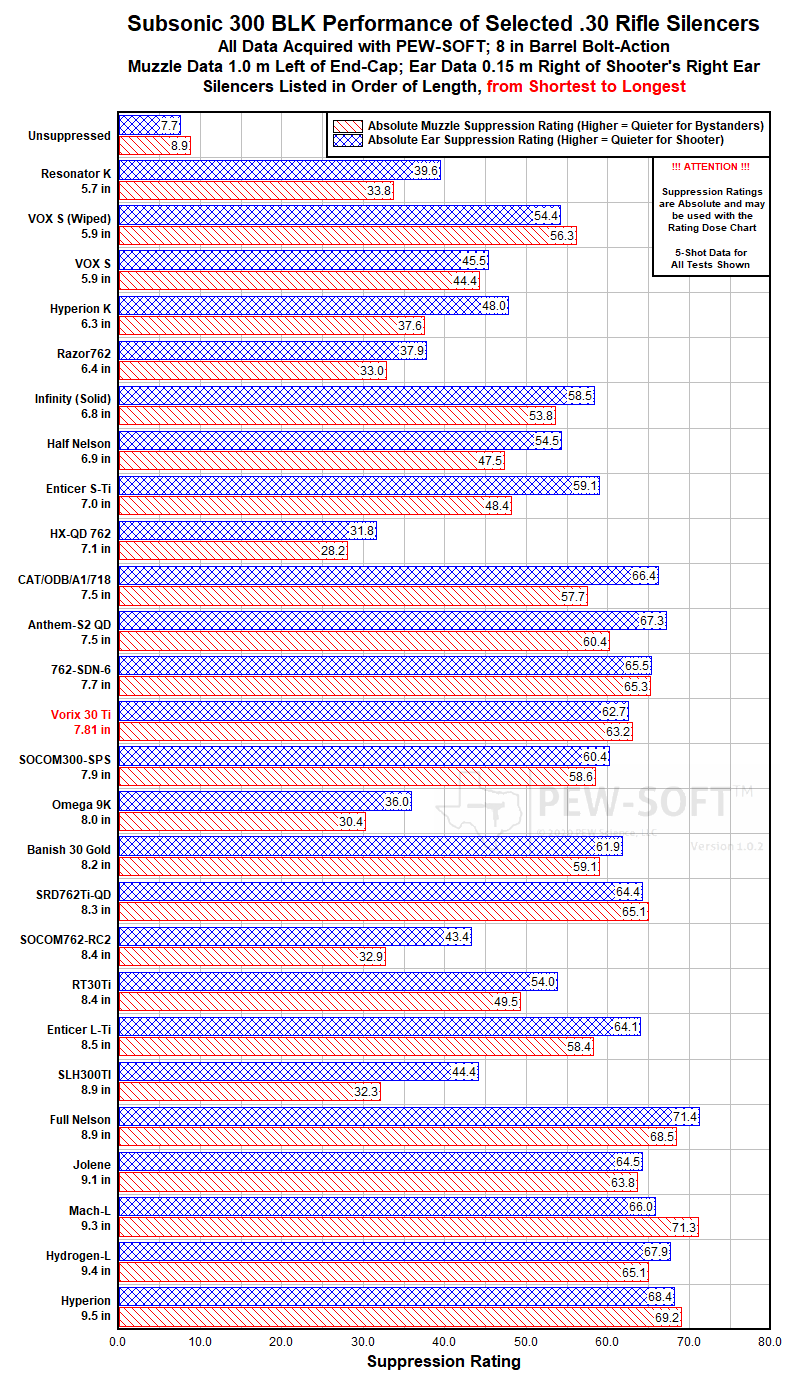
Figure 11. Suppression Rating Comparisons of the T&K Vorix 30 Ti with other 30 caliber silencers on an 8-in 300 BLK subsonic Bolt-action Rifle, Using PEW-SOFT Test Data and PEW Science Analysis
The following gross conclusions can be made from the subsonic 300 BLK bolt-action suppression performance metrics presented in Figure 11, above:
The T&K Vorix 30 Ti produces free field bystander hazard reduction on par with the following silencers on a 300 BLK bolt-action rifle:
The free field operator (shooter) subsonic 300 BLK hazard reduction of the T&K Vorix 30 Ti is on par with that of the:
Diligent Defense Enticer L-Ti (6.88) but with superior FRP control compared to that of the Enticer.
As previously stated in Research Note 8, when accounting for length, and considering silencers less than or equal to 8 inches long, the Vorix 30 Ti enters the Top 5 in Composite Suppression Rating.
PEW Science Research Note 9: It should be noted that the T&K Vorix 30 Ti does exhibit high back pressure, but it is also a purposely designed bolt-action rifle silencer. If users seek high performance from a subsonic 300 BLK silencer with a combined high flow rate, such silencers do exist. Examples include the CAT ODB (6.122) and new generation AAC 762-SDN-6 (6.221). With regard to balancing flow rate with suppression, the reader is encouraged to examine how high flow rate silencers with Flow-Through technology from HUXWRX (OSS) may result in significantly reduced performance with the lower pressure and duration combustion of the subsonic 300 BLK cartridge. This is showcased in the HUXWRX HX-QD 762 300 BLK test report (6.45). This type of performance inefficiency is also examined in the Sig Sauer SLH300Ti 300 BLK test report (6.107). Hybrid technologies offer users more versatile silencer solutions than these two examples.
The difference in sound signature suppression performance from silencers in the subsonic 300 BLK suppression regime can be extremely significant. The user is encouraged to be mindful of the degree to which sound signature suppression, and resulting personnel hazards, can vary across designs. Small arm weapon system suppression performance is a spectrum. The PEW Science Suppression Rating and the Silencer Sound Standard help quantify this spectrum for end users and industry, objectively.
6.223.4 Review Summary: T&K Vorix 30 Ti on 20-in Barrel .308 and 8-in Barrel 300 BLK Bolt-Action Rifles
When paired with the Savage M10 20” .308 and fired with Federal XM80, the T&K Vorix 30 Ti with direct-thread mount achieved a composite Suppression Rating™ of 48.7 in PEW Science testing.
When paired with the Q mini FIX 8” 300 BLK and fired with Discreet Ballistics 190gr, the T&K Vorix 30 Ti with direct-thread mount achieved a composite Suppression Rating of 66.4 in PEW Science testing.
As with all weapon systems, the user is encouraged to examine both muzzle and ear Suppression Ratings.
PEW Science Laboratory Staff Opinion:
The T&K Vorix 30 Ti is a lightweight and compact to mid-size titanium purposely designed bolt-action rifle silencer. At 7.4 inches without a mount, slightly smaller than 1.5 inches in diameter, and close to 10 ounces, it may be attractive for field use. The signature suppression performance of the Vorix 30 Ti is relatively high, regardless of size. When considering the size of the silencer, the performance is highly competitive with both supersonic and subsonic cartridges. The combustion propagation consistency, along with first round pop control with subsonic cartridges, are performance highlights. Users should note that as a bolt-action rifle silencer, it does have high back pressure. The Vorix 30 is an example of additive manufacturing being used for efficient prototyping and design optimization; not necessarily for exotic geometry.
The suppression performance of the Vorix 30 Ti when used with a .308 rifle cartridge can generally be considered competitive, especially for the silencer’s size. In this very competitive class of silencers, the Composite Suppression Rating of the Vorix 30 Ti on this host places it just outside the Top 10 in the PEW Science Rankings on the bolt-action rifle host weapon. When considering the 7.8-in length of the silencer, it is in the Top 3 Ranked silencers less than or equal to 8 inches long. There are, of course, silencers that exhibit almost identical overall performance, on average, that are slightly shorter, such as the Liberty Precision Machine Anthem-S2 QD and Aero Precision Lahar-30L. The reader is encouraged to examine the comparisons shown in this report as well as the comprehensive Rankings Table in Section 7 of the Standard. Note that PEW Science Members may also filter by silencer length and weight using a Suppression Rating visualization scatter plot tool.
The suppression performance of the Vorix 30 Ti is very efficient with subsonic 300 BLK, just as it is with supersonic .308, which is relatively uncommon, historically. Its Composite Suppression Rating with 300 BLK places it just inside the Top 10 in the PEW Science Rankings on the bolt-action rifle host weapon. When accounting for length, and considering silencers less than or equal to 8 inches long, the Vorix 30 Ti enters the Top 5 in Composite Suppression Rating with subsonic 300 BLK. Its bystander (muzzle) Suppression Rating is similar to that of the Resilient Suppressors Jolene, which is 9.1 inches long. This is a notable performance indicator, especially considering the FRP suppression performance of the Vorix 30 Ti with subsonic 300 BLK. The operator (shooter’s ear) Suppression Rating of the T&K Vorix 30 Ti is very similar to that of silencers like the Diligent Defense Enticer L-Ti but with superior FRP control compared to that of the Enticer. The performance of the Vorix is more akin to that of the Sig Sauer SRD762Ti-QD in that regard.
The user may choose to field the titanium Vorix 30 Ti silencer with a variety of mounting systems of their preference. The silencer is HUB mount compatible; the included titanium direct thread mount is easily installed or removed with a 1-in open-ended wrench and only adds 1 ounce to the silencer. As the silencer has high back pressure, is titanium, and relatively lightweight, it is generally not well suited for machineguns. However, use on semiautomatic weapons is possible; the user is encouraged to contact the manufacturer for use case guidance.
In this review, the T&K Vorix 30 Ti performance metrics depend upon suppressing both a supersonic full rifle cartridge and a subsonic intermediate rifle or pistol cartridge. While the sound signature of such cartridges can be suppressed to levels that may result in the desire of the shooter and bystanders to not wear hearing protection, PEW Science encourages the reader to remain vigilant with regard to all subsonic rifle cartridge suppression claims. The gas volume and combustion products created by firing a subsonic intermediate rifle cartridge such as 300 BLK are still significant; the measured pressure and impulse magnitudes, and their durations, illustrate this fact.
The hearing damage potential of subsonic rifle use is not insignificant. PEW Science encourages the reader to consider the Suppression Rating when deciding on an appropriate silencer and host weapon combination for their desired use.