SSS.6.233 - Otter Creek Labs Infinity 556K on the MK18: Multiple End Cap and Tone Comparison Case Study (Free Version)
/Otter Creek Labs Infinity 556K on the MK18 5.56x45mm AR15 with 10.3-in Barrel
The Infinity 556K is a .243 caliber centerfire rifle silencer designed by Otter Creek Labs. The Infinity 556K is intended to suppress both 6mm and 5.56mm cartridges, and may be used with severe firing schedules. It has a 1.74-inch diameter and is 5.5 inches long without a mount. The silencer is offered with and without a mount; the proximal end of the Infinity is threaded 1.375-24 tpi to accommodate HUB compatible mounting systems. The silencer body is 3D-printed from Haynes 282 alloy and the retail package includes a partially vented heat-treated stainless steel end cap. The end cap of the silencer is changeable to a solid (non vented) version or fully vented version to change system behavior; the user may choose to install different end caps to achieve varying flow states appropriate for the combustion dynamics of the chosen cartridge and weapon system. The additional end caps are available from Otter Creek Labs. With an end cap installed, the silencer weighs 15.3 ounces and with a Rearden Atlas mount and single port brake muzzle device, weighs 18.9 ounces and is 6.125 inches long, as tested. The Otter Creek Labs Infinity 556K can be obtained from Silencer Shop.
Infinity 556K End Cap Note: Only the partially vented end cap is included with the silencer. End cap changes can produce complex signature variations on different weapon systems. To assist the reader in understanding these differences, an accompanying Members Only tone analysis is included in this report comparing the physics and inner ear response produced by all three end caps. The PEW Science Suppression Rating calculations always consider tone mathematically, by default, as it is an inherent signature characteristic.
System Suppression Ratings and Silencer Hazard Maps:
This report includes three (3) different tests of the Infinity 556K, with the solid end cap, partially vented end cap, and fully vented end cap, respectively. Composite and Detailed Suppression Ratings, along with the predicted personnel hazards generated by the tested silencer configurations in this report in the free field, are shown in the below graphics and Silencer Hazard Maps. Click or tap the Maps to enlarge. Please reference Silencer Hazard Map Brief 8.1.30 for further details. The PEW-SOFT HD Blast Hazard Prediction Tool and Hazard Mapper is presented in Report 8.1.1.
Otter Creek Labs Infinity 556K Solid End Cap 10.3-in MK18 AR-15 Free Field Hazard Map Produced by PEW-SOFT HD Blast Hazard Prediction Tool using PEW Science Test Data
Otter Creek Labs Infinity 556K Partially Vented End Cap 10.3-in MK18 AR-15 Free Field Hazard Map Produced by PEW-SOFT HD Blast Hazard Prediction Tool using PEW Science Test Data
Otter Creek Labs Infinity 556K Fully Vented End Cap 10.3-in MK18 AR-15 Free Field Hazard Map Produced by PEW-SOFT HD Blast Hazard Prediction Tool using PEW Science Test Data
PEW Science is an independent private testing laboratory and also hosts the world’s only independent public suppressed small arms research cooperative. Testing, data analysis, and reporting is generated with funding provided by PEW Science members. Any test data that is generated with any portion of private funding contains this disclosure. The testing and analysis production for this Sound Signature Review was funded in part by PEW Science Project PEW-OCL-162-001-26. Therefore, data pertaining to the Infinity 556K in this Sound Signature Review is published with the express written permission of Otter Creek Labs, LLC
The testing and analysis presented in this Sound Signature Review are of the Otter Creek Labs Infinity with three different end caps on the MK18 Automatic AR15 rifle rifle, chambered in 5.56x45mm NATO with a 10.3-inch barrel. Federal XM193 55gr ammunition was used in the test. The standard PEW Science MK18 test host weapon system is described in Public Research Supplement 6.51.
Report Table of Contents:
Section 6.233.1 contains an abbreviated overall summary of Otter Creek Labs Polonium and Infinity rifle silencer performance on the standard 5.56 MK18. Contextual comparisons are provided for the Polonium, Polonium-K, Polonium-30, and all tested configurations of the Infinity and Infinity 556K.
Section 6.233.2 contains an advanced signature tone analysis of the three different Infinity 556K end caps (Members Only)
Section 6.233.3 contains Infinity 556K Solid End Cap test results and analysis.
Section 6.233.4 contains Infinity 556K Partially Vented End Cap test results and analysis.
Section 6.233.5 contains Infinity 556K Fully Vented End Cap test results and analysis.
Section 6.233.6 contains overall Suppression Rating comparisons of the Infinity 556K with 3 end caps with dedicated 223 and 30 caliber silencers on the current market on the MK18.
Section 6.233.7 contains an article summary and PEW Science laboratory staff opinions.
Summary: When paired with the 10.3-in barrel MK18 and fired with Federal XM193 with the solid end cap, the the Otter Creek Labs Infinity 556K achieved a Suppression Rating™ of 36.4 in PEW Science testing. With the partially vented end cap, the silencer achieved a Suppression Rating of 38.0. With the fully vented end cap, the silencer achieved a Suppression Rating of 33.8.
As with all weapon systems, the user is encouraged to examine both muzzle and ear Suppression Ratings.
Relative Suppression Rating Performance is Summarized in SSS.7 - PEW Science Rankings.
6.233.1 Otter Creek Labs Rifle Silencer 5.56 Automatic Rifle Performance Summary
The Silencer Sound Standard public research pedigree includes the 5.56x45mm NATO evaluation of six (6) rifle silencers designed and manufactured by Otter Creek Labs, in ten (10) configurations. Comprehensive performance Rankings are tabulated in Section 7 of the Standard. The scope of this report contains standard MK18 reciprocating weapon system combustion suppression analysis. To that end, Figure 1 presents a performance comparison of nine (9) Otter Creek Labs rifle silencer configurations (excluding the Universe-36 which is a true multicaliber silencer with significant over bore). They include:
6.75 - Polonium: a conventional cone design .243 silencer (full-size).
6.95 - Polonium-K: a conventional cone design .243 silencer (compact-size).
6.143 - Polonium-30: a conventional cone design .30 caliber silencer (compact-size for the bore size class).
6.179 - Infinity (5.56 mm solid end cap): a hybrid design .30 caliber silencer with only axial bore venting at the distal end.
6.179 - Infinity (5.56 mm vented end cap): a hybrid design .30 caliber silencer with ancillary axial and annular venting at the distal end, with a 5.56-sized primary orifice.
6.179 - Infinity (7.62 mm vented end cap): a hybrid design .30 caliber silencer with ancillary axial and annular venting at the distal end, with an over-bored 7.62-sized primary orifice.
6.233 - Infinity 556K (Solid end cap): a hybrid design .243 caliber silencer with only axial bore venting at the distal end.
6.233 - Infinity 556K (Partially Vented end cap): a hybrid design .243 caliber silencer with ancillary annular venting at the distal end.
6.233 - Infinity 556K (Fully Vented end cap): a hybrid design .243 caliber silencer with ancillary axial and annular venting at the distal end.
The silencers are presented in order of their product release timeline.
Note that the Infinity 556K is approximately 1.1 inches shorter than the Infinity, without considering an installed mount.
Figure 1. Suppression Rating Comparisons of Otter Creek Labs Rifle Silencers Using PEW-SOFT 5.56x45mm Supersonic Test Data and PEW Science Analysis
As the silencers in Figure 1 are ordered by product release, generational performance advancement can be viewed:
The original Polonium silencer is a conventional and durable .243 caliber model with relatively high back pressure. Blast loads enter the silencer and are unable to expediently clear off of the first reflector; this increases the accumulation of internal blast impulse. This additional internal blast loading, along with reflections down the weapon bore, contribute to elevated chamber pressure for a longer duration. On an untuned weapon system (e.g. the standard untuned MK18 PEW Science test host weapon), these blast dynamics exacerbate ejection port blast hazards to the operator, driving down the shooter’s ear (operator) Suppression Rating in the free field. With weapon tuning (adjustable gas block, or heavier recoil buffer), the chamber may remain closed longer, somewhat reducing initial ejection port blast pressure at the time of unlock. This drives the shooter’s ear Suppression Rating higher. However, continuous firing, injecting underexpanded gas jets into the superheated blast chamber, will produce late-time gaseous fumes (blowback) due to the aforementioned undesirable internal blast impulse accumulation that can’t be remedied by weapon system tuning.
The Polonium-K silencer is approximately an inch shorter than the original Polonium. Other than fewer baffles, it is functionally identical; the early time flow rate described above is the same. Only the late time flow rate differs due to less downstream restriction. The result of these design changes are a somewhat shorter and lighter silencer that exhibits similar back pressure. The slight increase in operator protection is largely offset by more severe muzzle blast which coalesces with the ejection port blast. This is why the muzzle (bystander) Suppression Rating of the Polonium-K is lower than the Polonium and their shooter’s ear (operator) Suppression Ratings on a standard untuned SBR are almost identical.
The Polonium-30 silencer is identical to the original Polonium but bored for .30 caliber projectiles. The over bore, alone, does increase the gross flow rate of the silencer, in both early and late time, reducing back pressure when compared to that of both the original Polonium and the Polonium-K. However, PEW Science research indicates that back pressure reduction by only over bore (e.g. using over bore with a conventional baffle design to reduce back pressure) is relatively inefficient in that early time blast impulse accumulation still occurs and muzzle blast severity is often significantly exacerbated. This is demonstrated in the tested and calculated performance of the Polonium-30 in that its muzzle (bystander) Suppression Rating drops relative to even the Polonium-K. Note that there is a modest increase in operator protection from the decreased back pressure that would increase further had the muzzle blast suppression performance not dropped.
The Infinity silencer, being a .30 caliber model, is also over bored for the 5.56x45mm NATO cartridge, like the Polonium-30. However, in the case of the Infinity, it is a hybrid design utilizing early blast chamber venting as well as annular flow channels. The Infinity is also larger, introducing more volumetric expansion, and it is adaptable in that multiple end caps can be used with the silencer. Due to the internal design of the Infinity, the different end caps functionally change gas routing behavior, not only distal exit bore orifice area. The Infinity series exhibits a significantly higher early time flow rate than the Polonium series and the late time flow rate (distal momentum control) may be changed with the different end caps, resulting in suppression performance that exceeds that of an original Polonium in all aspects. Note that the vented Infinity end caps may induce erratic combustion propagation in some shots; this is a consequence of primary baffle over bore combined with high distal flow rate. Back pressure is lower than the Polonium family and “gas blow back” to the weapon operator is lower, accordingly.
The Infinity 556K silencer (the subject of this report) is a .243 caliber model like the original Polonium and Polonium-K. At approximately 1.1 inches shorter than the Infinity, and approximately 0.3 inches shorter than a Polonium, the Infinity 556K can be considered a full-size to compact 5.56 silencer in this role. The internal design of the Infinity 556K is very similar to that of the Infinity, with some differences in early vent arrays in the first expansion chamber and less downstream baffles. The combination of a more dedicated bore for the cartridge and its variable end cap venting configurations produce the most balanced MK18 hazard fields of any Otter Creek Labs rifle silencer, to date. Furthermore, the dedicated bore completely mitigates the erratic combustion propagation observed with the Infinity, with all tested end caps. It is interesting to note that the partially vented end cap produces somewhat higher pure suppression performance than the solid end cap. This is driven by blast overpressure field shape and tone factors which are examined in the Hazard Maps and the advanced tone analysis in the next section of this report.
For further details on the above performance factors, the reader is encouraged to examine the performance comparisons in the full PEW Science performance Rankings contained in Section 7 of the Silencer Sound Standard.
An advanced signature analysis with the different end caps installed in the Infinity 556K follows for PEW Science Members. Thank you for your support.
6.233.2 Otter Creek Labs Infinity 556K - Advanced Tone Analysis (Members Only)
Blast loads can be simple (from high explosives or unsuppressed gun shots) and they can also be complex (when they come out of a silencer). Due to complications in phase, frequency, and duration of blast overpressure waveform components when they are expelled from a silencer, it is not always possible to determine relative, objective loudness from only the measured average peak blast overpressure amplitude and measured peak blast overpressure momentum transfer potential (impulse).
The above is why PEW Science calculates the Suppression Rating, which considers physical ear response to measured sound and blast signatures, including objective response to signature characteristics like “tone.” Therefore, tone is inherently part of the Suppression Rating; it is not possible to remove it from the calculation. All Suppression Rating calculations in the Silencer Sound Standard include silencer signature characteristics like tone because they consider objective human inner ear response.
The complete signature tone analysis in the full version of this article is only available to members. You can support PEW Science testing, research, and development with a membership, here. State-of-the-art firearm sound signature testing and research conducted by PEW Science is supported by readers like you. Thank you for your support!
The remainder of the Free Version report with the three different end caps follows.
6.233.3 Otter Creek Labs Infinity 556K Solid End Cap Sound Signature Test Results
A summary of the principal Silencer Sound Standard performance metrics of the Otter Creek Labs Infinity 556K with solid end cap is shown in Table 1. The data acquired 1.0 m (39.4 in) left of the muzzle is available for viewing to all. The data acquired 0.15 m (6 in) right of the shooter’s ear is only available to membership supporters of PEW Science and the Silencer Sound Standard. You can support public PEW Science testing, research, and development with a membership, here. State-of-the-art public firearm sound signature testing and research conducted by PEW Science is supported by readers like you.
Table 1. Otter Creek Labs Infinity 556K Solid End Cap Sound Metric Summary
6.233.3.1 SOUND SIGNATURES AT THE MUZZLE
Real sound pressure histories from a 6-shot test acquired with PEW-SOFT™ are shown below. Six cartridges were loaded into the magazine, the fire control group positioned to single-shot, and the weapon was fired until the magazine was empty and the bolt locked back on the follower of the empty magazine. Only five shots are considered in the analysis. The signatures of Shot 6 are displayed in the data presentation but are not included in the analysis to maintain consistency with the overall PEW Science public dataset and bolt-closing signatures. The waveforms are not averaged, decimated, or filtered. The data acquisition rate used in all PEW Science laboratory sound signature testing is 1.0 MS/s (1 MHz). The peaks, shape, and time phasing (when the peaks occur in relation to absolute time and to each other) of these raw waveforms are the most accurate of any firearm silencer testing publicly available. PEW-SOFT data is acquired by PEW Science independent laboratory testing; the recognized industry leader in silencer sound research. For more information, please consult the Silencer Sound Standard.
The primary sound signature pressure histories for all 6 shots with the Otter Creek Labs Infinity 556K with solid end cap are shown in Figure 3a. The sound signatures of Shot 1 and Shot 2 are shown in Figure 3b, in early time. The real sound impulse (momentum transfer potential) histories from the same 6-shot test are shown in Figure 4a. In Figure 4b, a shorter timescale is shown comparing the impulse of Shot 1 to that of Shots 2 and 3.
Fig 3a. Otter Creek Labs Infinity 556K Solid End Cap 5.56x45mm NATO MK18 Automatic Rifle Muzzle Sound Pressure Signature
Fig 3b. Otter Creek Labs Infinity 556K Solid End Cap 5.56x45mm NATO MK18 Automatic Rifle Sound Pressure Signature
Figure 4a. Otter Creek Labs Infinity 556K Solid End Cap 5.56x45mm NATO MK18 Automatic Rifle Muzzle Sound Impulse Signature
Figure 4b. Otter Creek Labs Infinity 556K Solid End Cap 5.56x45mm NATO MK18 Automatic Rifle Muzzle Sound Impulse Signature
Much of the physics demonstrated by the Otter Creek Labs Infinity 556K in this report are illustrated and explained in the MK18 evaluation of the .30 caliber Otter Creek Labs Infinity silencer (6.179). In that previous report, the Infinity was also evaluated with three different end caps. However, it is important to note that the evaluated end cap combinations with the two silencers are different:
The Infinity 556K solid end cap produces a dedicated bore silencer with dedicated bore end cap. The Infinity solid end cap MK18 test evaluated an over bored silencer with a dedicated end cap for the caliber.
The Infinity 556K partially vented end cap maintains the same primary axial bore flow as the solid end cap and adds some annular venting. The Infinity 5.56 vented end cap adds venting from both the primary bore and annulus.
The Infinity 556K fully vented end cap mirrors the function of the Infinity 5.56 vented end cap described above. The Infinity 7.62 vented end cap continues the baffle over bore to the end cap with the venting of the 5.56 vented end cap.
The net result of the end cap and primary silencer bore differences in the comparison cases highlighted above between the Infinity 556K and the Infinity is that the Infinity is much more likely to exhibit runaway or inconsistent combustion propagation on 5.56 weapons than is the Infinity 556K, despite the larger volume and longer length of the Infinity. This is an excellent case study on the detriment of over bore to the suppression of intermediate rifle cartridge combustion out of a short barrel.
PEW Science Research Note 3: The above blast overpressure and impulse measurements from the solid end cap configuration of the Infinity 556K display the following characteristics:
Relatively long blowdown duration with fully coupled ground reflection (Fig. 3a).
Very consistent initial coupled jetting (Fig. 3b).
Rapid first-round-pop (FRP) momentum accumulation (Fig. 4a).
Continued high FRP momentum through peak accumulation (Fig. 3b and Fig. 4b).
Extremely consistent post-FRP blast propagation (Fig. 4a).
Observation (1) with the Infinity 556K solid end cap is similar in behavior to the larger Infinity with solid 5.56 end cap. However, observations (2) and (5) are not as pronounced with the larger silencer and show improvement with the 556K. Observations (3) and (4) show a performance decrease with the Infinity 556K relative to the larger Infinity, driven by silencer volume and length. As the internal designs of the two silencers are very similar, and one is smaller, the smaller silencer is outperformed in suppression, in a gross sense.
PEW Science Research Note 4: Though the solid end cap configuration of the Infinity 556K is the most restrictive of the three evaluated, the early time flow rate of the silencer, which is a byproduct of its blast chamber vent array and blast baffle geometry, is still high. Like the larger Infinity silencer, this allows the 556K to induce less backpressure into the weapon system and balance personnel protection throughout the hazard field, albeit with more “blowback” during rapid fire when compared to the vented end cap variants.
PEW Science Research Note 5: It is extremely important for the reader to understand the Suppression Ratings are computed with free field test data, and are therefore universal when translating the weapon and operator to different environments without reflections. However, when the environment becomes complex with many reflecting surfaces, performance translation of different systems is not yet possible; sound field shapes and particle velocities result in varied blast wave time-of-arrivals, as well as changes of blast load angles of incidence; these variations change amplitude and phase waveform components. As a result of these inevitable environmental complexities, user impressions will vary, as both the shooter and bystander, in some environments. Nonetheless, hazard reduction efficacy in the free field, as characterized by the Suppression Rating, holds. The Suppression Rating comparisons are the current state-of-the-art, and the most “apples to apples” sound suppression performance comparisons that currently exist. Further research is ongoing.
PEW Science Research Note 6: As in all semiautomatic AR15 weapon testing, a second pressure pulse originates from the ejection-port signature of the weapon and it occurs early enough in time such that its waves coalesce with that of the muzzle signature. However, in late time (at approximately 87 ms in Figure 1a) the mechanical noise of the bolt closing is observed. The pressure signature of Shot 6 does not display this event due to the bolt remaining open after the sixth and final round is fired from the magazine.
PEW Science Research Note 7: The closing time of the AR15 bolt is directly related to the flow restriction of a silencer for a given weapon system. PEW Science has determined bolt closing time variation from the unsuppressed state to be a reliable indicator of silencer back pressure, with strong correlation with the PEW Science Back Pressure Metric, Omega and the alpha parameter. However, PEW Science has also determined that the indicator is unreliable upon upper receiver fouling. Sound signatures are not influenced by this fouling, as these kinematics occur in late time, after gas venting to atmosphere. Momentum transfer, weapon condition (upper receiver fouling), and other factors, can significantly influence bolt closing time. PEW Science urges the reader to exercise extreme caution if using the published bolt closing time to make determinations regarding silencer flow restriction (back pressure) or weapon system kinematics. This type of calculation may provide erroneous results, as the weapon condition at the time of each test is not published data. The time-scale duration showing bolt closing time is only published by PEW Science such that the signature data pedigree may be verified.
The shape, timing, and magnitudes of the early-time pressure pulses and overall shape of the impulse waveforms measured at the muzzle, from shot-to-shot, are relatively consistent. The consistency of the waveform amplitudes highlight the silencer’s overall sound performance consistency at the muzzle after the FRP, as well as the relative consistency of the tested automatic rifle firearm configuration.
As typically indicated, first-round sound signatures always differ from subsequent shots, as the atmosphere within the silencer changes. The FRP phenomenon cannot always be shown by viewing only the peak sound pressure. This is one of the reasons why The Silencer Sound Standard requires examining multiple sound signature metrics. Ammunition consistency can play a role in the determination of FRP, however, the close examination of measured pressure and impulse waveforms typically excludes ammunition from the possible factors influencing true FRP, due to the relative consistency of most high quality factory ammunition.
PEW Science Research Note 8: Note that the muzzle Suppression Rating of the Otter Creek Labs Infinity 556K with solid end cap is 35.9 and the at-ear Suppression Rating is 24.9; different zones on the Suppression Rating Dose Chart. The lower back pressure of the Infinity 556K with solid end cap does contribute to a less severe ejection port blast signature than silencers like the Otter Creek Labs Polonium or Polonium-K, but the back pressure is not low enough to substantially reduce the ejection port blast loads to the shooter on the standard MK18 weapon system. An end cap change may be required for the user’s particular weapon system. And, accordingly, weapon tuning may influence hazard reduction efficacy, and is outside the scope of this study.
The signatures measured at the shooter’s ear with the solid end cap are presented in the full Member Version of this report.
The evaluation in this section covered the performance of the silencer with high early-time flow rate and restricted / relatively low late-time flow rate. By changing the end cap to the partially vented configuration, late-time flow rate is elevated; the blast load is able to now vent from the annular space. Test results and analysis of that configuration are presented in the following section.
6.233.4 Otter Creek Labs Infinity 556K Partially Vented End Cap Sound Signature Test Results
A summary of the principal Silencer Sound Standard performance metrics of the Otter Creek Labs Infinity 556K with partially vented end cap is shown in Table 2. The data acquired 1.0 m (39.4 in) left of the muzzle is available for viewing to all. The data acquired 0.15 m (6 in) right of the shooter’s ear is only available to membership supporters of PEW Science and the Silencer Sound Standard. You can support public PEW Science testing, research, and development with a membership, here. State-of-the-art public firearm sound signature testing and research conducted by PEW Science is supported by readers like you.
Table 2. Otter Creek Labs Infinity 556K Partially Vented End Cap Sound Metric Summary
6.233.4.1 SOUND SIGNATURES AT THE MUZZLE
Real sound pressure histories from a 6-shot test acquired with PEW-SOFT™ are shown below. Six cartridges were loaded into the magazine, the fire control group positioned to single-shot, and the weapon was fired until the magazine was empty and the bolt locked back on the follower of the empty magazine. Only five shots are considered in the analysis. The signatures of Shot 6 are displayed in the data presentation but are not included in the analysis to maintain consistency with the overall PEW Science public dataset and bolt-closing signatures. The waveforms are not averaged, decimated, or filtered. The data acquisition rate used in all PEW Science laboratory sound signature testing is 1.0 MS/s (1 MHz). The peaks, shape, and time phasing (when the peaks occur in relation to absolute time and to each other) of these raw waveforms are the most accurate of any firearm silencer testing publicly available. PEW-SOFT data is acquired by PEW Science independent laboratory testing; the recognized industry leader in silencer sound research. For more information, please consult the Silencer Sound Standard.
The primary sound signature pressure histories for all 6 shots with the Otter Creek Labs Infinity with partially vented end cap are shown in Figure 7a. The sound signatures of Shot 1 and Shot 2 are shown in Figure 7b, in early time. The real sound impulse (momentum transfer potential) histories from the same 6-shot test are shown in Figure 8a. In Figure 8b, a shorter timescale is shown comparing the impulse of Shot 1 to that of Shots 2 and 3.
Fig 7a. Otter Creek Labs Infinity 556K Partially Vented End Cap 5.56x45mm NATO MK18 Automatic Rifle Muzzle Sound Pressure Signature
Fig 7b. Otter Creek Labs Infinity 556K Partially Vented End Cap 5.56x45mm NATO MK18 Automatic Rifle Sound Pressure Signature
Fig 8a. Otter Creek Labs Infinity 556K Partially Vented End Cap 5.56x45mm NATO MK18 Automatic Rifle Muzzle Sound Impulse Signature
Fig 8b. Otter Creek Labs Infinity 556K Partially Vented End Cap 5.56x45mm NATO MK18 Automatic Rifle Muzzle Sound Impulse Signature
As previously discussed, the partially vented end cap of the Infinity 556K is unique in that it does not introduce additional primary bore venting; it only introduces venting from annular space. This differs from the 5.56 and 7.62 vented end caps evaluated in the larger 30 caliber Infinity silencer test program. Because the partially vented 556K end cap still enables primary bore flow restriction, combustion propagation remains controlled.
In the above measured blast overpressure and impulse waveforms from the partially vented end cap test, there are some differences observed compared to the solid end cap:
Blast pressure blowdown is somewhat accelerated and bolt carrier group return to battery is somewhat delayed (Fig. 7a).
Early jetting is somewhat more erratic (Fig. 7b).
Blast impulse accumulation occurs faster and to a higher amplitude (Fig. 8a).
Blast momentum changes are similar but delayed (Fig. 8b).
Observations (1), (2), and (3) occur due to a greater proportion of annular utilization. As more of the silencer is now being exercised, observation (4) occurs. The end result of these changes may be counterintuitive to the reader. Although impulse accumulation is elevated, it is still very controlled. The partially vented end cap configuration of the Infinity 556K drives blast signature frequency lower, and thus to personnel immediately adjacent to the end cap of the silencer, the signature is nominally less severe to the unprotected ear.
The above conclusion has relatively significant consequences, as it indicates users may implement the partially vented end cap and receive the benefits of lower back pressure, and thus less severe ejection port blast and less severe blow back, while not inducing adverse blast hazards in the free field. This is a notable trait of this configuration of the Infinity 556K and that may be why it is the retail package offering of the silencer from Otter Creek Labs.
PEW Science Research Note 10: The silencer has now changed function; the Infinity 556K with the partially vented end cap is no longer a low-alpha, moderate-omega hybrid- it has been transformed into a low-alpha, lower-omega hybrid. This configuration of the Infinity 556K may be considered the most balanced of any Otter Creek Labs silencer on the standard untuned 5.56 MK18. It exhibits the highest shooter’s ear (operator) Suppression Rating of any of the other Otter Creek Labs silencers, while matching the pure suppression performance of the original Polonium, and does so in a somewhat shorter design envelope. This is a notable design improvement. Another notable design improvement is the lack of errant or inconsistent combustion propagation from this configuration of the Infinity 556K compared with the vented end cap configurations of the larger .30 caliber Infinity. This benefit is driven directly by the dedicated bore size of the Infinity 556K.
Signature analysis of test data acquired near the operator’s head with the partially vented end cap are presented in the full Member Version of this report.
The evaluation in this section covered the performance of the silencer with high early-time flow rate and elevated late-time flow rate. By changing the end cap from the partially vented configuration to the fully vented configuration, late-time flow rate is even further elevated; the blast load is now able to additionally vent from the primary bore as well as from annular space. Test results and analysis of that final configuration are presented in the following section.
6.233.5 Otter Creek Labs Infinity 556K Fully Vented End Cap Sound Signature Test Results
A summary of the principal Silencer Sound Standard performance metrics of the Otter Creek Labs Infinity 556K fully vented end cap is shown in Table 3. The data acquired 1.0 m (39.4 in) left of the muzzle is available for viewing to all. The data acquired 0.15 m (6 in) right of the shooter’s ear is only available to membership supporters of PEW Science and the Silencer Sound Standard. You can support public PEW Science testing, research, and development with a membership, here. State-of-the-art public firearm sound signature testing and research conducted by PEW Science is supported by readers like you.
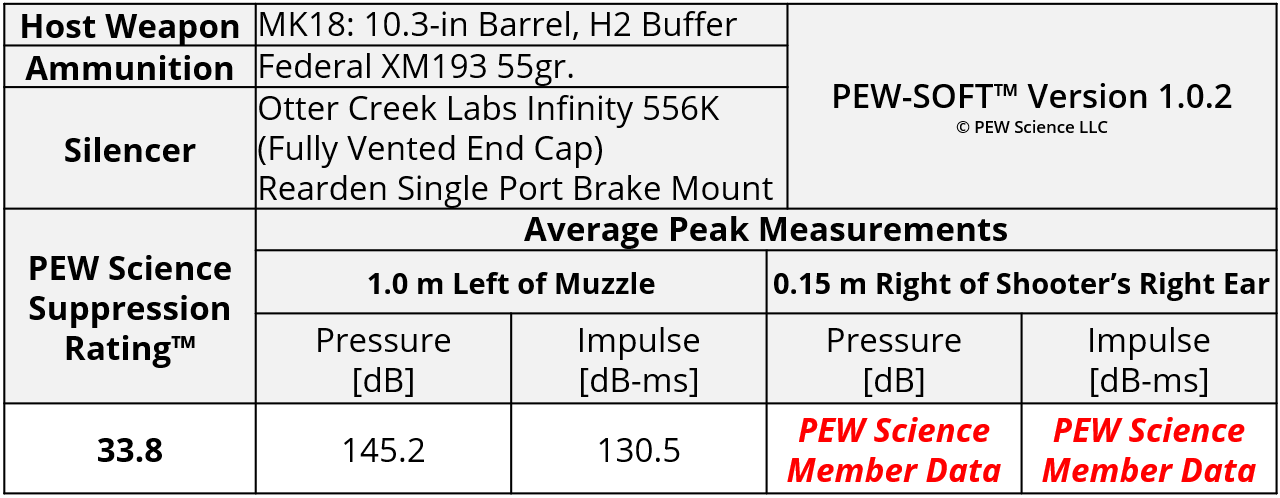
Table 3. Otter Creek Labs Infinity 556K Fully Vented End Cap Sound Metric Summary
6.233.5.1 SOUND SIGNATURES AT THE MUZZLE
Real sound pressure histories from a 6-shot test acquired with PEW-SOFT™ are shown below. Six cartridges were loaded into the magazine, the fire control group positioned to single-shot, and the weapon was fired until the magazine was empty and the bolt locked back on the follower of the empty magazine. Only five shots are considered in the analysis. The signatures of Shot 6 are displayed in the data presentation but are not included in the analysis to maintain consistency with the overall PEW Science public dataset and bolt-closing signatures. The waveforms are not averaged, decimated, or filtered. The data acquisition rate used in all PEW Science laboratory sound signature testing is 1.0 MS/s (1 MHz). The peaks, shape, and time phasing (when the peaks occur in relation to absolute time and to each other) of these raw waveforms are the most accurate of any firearm silencer testing publicly available. PEW-SOFT data is acquired by PEW Science independent laboratory testing; the recognized industry leader in silencer sound research. For more information, please consult the Silencer Sound Standard.
The primary sound signature pressure histories for all 6 shots with the Otter Creek Labs Infinity 556K fully vented end cap are shown in Figure 11a. The sound signatures of Shot 1 and Shot 2 are shown in Figure 11b, in early time. The real sound impulse (momentum transfer potential) histories from the same 6-shot test are shown in Figure 12a. In Figure 12b, a shorter timescale is shown comparing the impulse of Shot 1 to that of Shots 2 and 3.
Fig 11a. Otter Creek Labs Infinity 556K Fully Vented End Cap 5.56x45mm NATO MK18 Automatic Rifle Muzzle Sound Pressure Signature
Fig 11b. Otter Creek Labs Infinity 556K Fully Vented End Cap 5.56x45mm NATO MK18 Automatic Rifle Muzzle Sound Pressure Signature
Fig 12a. Otter Creek Labs Infinity 556K Fully Vented End Cap 5.56x45mm NATO MK18 Automatic Rifle Muzzle Sound Impulse Signature
Fig 12b. Otter Creek Labs Infinity 556K Fully Vented End Cap 5.56x45mm NATO MK18 Automatic Rifle Muzzle Sound Impulse Signature
The fully vented end cap configuration of the Otter Creek Labs Infinity 556K is the most radical change to the silencer, and yet the overall blast load propagation measured in the test is exceedingly controlled when compared to the vented end cap configurations of the larger .30 caliber Infinity. This, again, highlights the inefficiency of overbore and the optimized performance of dedicated bore silencers.
Note that the muzzle blast propagation from the fully vented end cap, now originating from larger axial bore area and annular vent area, is significantly increased in both amplitude and rate when compared to that of the solid end cap and partially vented end cap configurations. The following observations from the measured test data are noted:
Blast load blowdown duration is more expedient with decoupling of ground reflection evident (Fig. 11a).
Early jetting is more severe with significantly higher gas velocity (Fig. 11b).
Blast momentum accumulation occurs with the highest rate of the three configurations (Fig. 12a) but consistency is only somewhat reduced (Fig. 12b).
Observations (1) and (2) should intuitively make sense to the reader. The fact that consistency is largely maintained as observed in (3) is highly notable and once again demonstrates dedicated bore silencer suppression superiority for the platform.
As was observed above in the vented 5.56 end cap testing of the larger .30 caliber Infinity, and in the vented 7.62 end cap testing showcased in the 7.62 NATO evaluation of the .30 caliber Infinity, when fitted with the vented 7.62 end cap, the 5.56 MK18 performance of the Otter Creek Labs .30 caliber Infinity changed significantly. In addition to annular venting and ancillary axial bore venting, the primary bore vent itself was enlarged. That is the highest vent area configuration of the .30 caliber Infinity and provides the highest distal flow rate possible. In this test of the Infinity 556K, the highest vet area configuration presents completely different behavior. As discussed in the PEW Science Silencer Sound Standard research pedigree ad nauseum, over-bore as a mechanism of flow rate increase (back pressure reduction) is seldom efficient.
PEW Science Research Note 12: There does not exist an inefficient configuration of the Infinity 556K on the MK18, and that is largely due to the dedicated bore of the silencer. Even with significant annular venting and additional primary bore venting, the design is able to control blast load propagation to a high degree. It should be noted that the more severe muzzle blast from the fully vented configuration of the silencer does impact operator hazard, even though ejection port blast is significantly reduced. This give and take typically manifests as distal flow rates elevate to this degree, and is not unique to this silencer.
Operator hazards with the fully vented end cap configuration are detailed in the full Member Version of this report.
A comprehensive performance comparison summary on the MK18 is provided below.
6.233.6 Suppression Rating Comparison (5.56x45mm from the MK18)
Figure 15 presents a comparison of the PEW Science Suppression Rating of the Otter Creek Labs Infinity 556K, in three different end cap configurations, with that of several other silencers on the MK18 weapon system. The standard PEW Science MK18 test host weapon system is described in Public Research Supplement 6.51.
Figure 15. Suppression Rating Comparisons of the Otter Creek Labs Infinity and other rifle silencers, Using PEW-SOFT 5.56x45mm Supersonic Test Data and PEW Science Analysis
Figure 15 presents an overall summary of the postulated hazards to the operator and bystanders when fielding a variety of different silencers on the standard MK18 weapon system. The three configurations of the Otter Creek Labs Infinity 556K from this test program are shown in red. Hazards are expressed with the Suppression Rating; a holistic parameter that captures human inner ear damage risk potential from a measured impulsive complex overpressure signature during the entire time regime of weapon operation, including combustion, complete blowdown, and all mechanical operation, including the carrier group returning to battery, in the true free field. The parameter may be used with the dose chart at the beginning of this report. The PEW Science Suppression Rating is a damage risk criterion (DRC), a lower Suppression Rating indicates a higher personnel hazard in the free field - it is not a subjective quantity; it is an objective quantification of hearing damage risk potential. Due to its true free field test data origin and complete waveform analytical calculation basis, it is the only known universal suppressed weapon system signature comparison metric available and includes “tone” characteristics, inherently.
The following gross conclusions can be made from the metrics presented above and the test data in this report:
All three end cap configurations of the Otter Creek Labs Infinity 556K provide relatively balanced performance on the standard untuned MK18, and are competitive in overall suppression performance throughout the risk field, for their length.
The partially vented end cap configuration is the most balanced of any configuration of the Infinity 556K and of any Otter Creek Labs silencer evaluated with 5.56 NATO by PEW Science, to date. It is the standard retail configuration of the silencer.
Changing the end cap to the solid variant, and tuning the rifle, could potentially produce superior signature suppression performance to the other end cap variants. User impressions of signature severity will vary based upon the factors highlighted in the advanced tone analysis Member Research Supplement in Section 6.223.2 of this report.
The fully vented end cap configuration of the Infinity 556K will produce the least “gas blow back” to the weapon operator, all other things equal, during rapid fire. On a standard untuned rifle, personnel protection is not significantly compromised through the use of this end cap, though personnel in the forward field will perceive the signature as more severe and reflecting surfaces may increase personnel hazards more so than with the other two end cap variants.
Specific performance comparisons of each Infinity 556K configuration with the rest of the MK18 dataset are presented below:
Solid End Cap Configuration
The Otter Creek Labs Infinity 556K with solid end cap produces free field bystander hazard reduction on par with the following silencers on the MK18 weapon system:
The free field operator (shooter) hazard reduction of the Otter Creek Labs Infinity 556K with solid end cap with the standard untuned MK18 weapon system is similar to that of many silencers. The MK18 operator protection is on par with or exceeding that of the:
Partially Vented End Cap Configuration
The Otter Creek Labs Infinity 556K with partially vented end cap produces free field bystander hazard reduction on par with the following silencers on the MK18 weapon system:
The free field operator (shooter) hazard reduction of the Otter Creek Labs Infinity 556K with partially vented end cap with the standard untuned MK18 weapon system is on par with or exceeding that of the:
Fully Vented End Cap Configuration
The Otter Creek Labs Infinity 556K with fully vented end cap produces free field bystander hazard reduction on par with the following silencers on the MK18 weapon system:
The free field operator (shooter) hazard reduction of the Otter Creek Labs Infinity 556K with fully vented end cap with the standard untuned MK18 weapon system is on par with or exceeding that of the:
PEW Science Research Note 13: The muzzle Suppression Rating of the Otter Creek Labs Infinity 556K with partially vented end cap is just outside the Top 10 of the PEW Science laboratory MK18 Rankings, and the shooter’s ear Suppression Rating of the that configuration of the Infinity 556K is in the Top 15. Overall, the dedicated bore re-design of the Infinity 556K brings much more consistent and balanced performance when compared to the larger .30 caliber Infinity on short barrel 5.56 NATO platforms. In general, the adaptability and versatility of the Infinity family of silencers represents a step forward in the Otter Creek Labs design pedigree when compared to the legacy Polonium family technology.
As detailed in this report, signature at the operator’s head is a function of both muzzle and ejection port signatures from the AR-15 weapon system. Specific weapon system parameters will dictate modification efficacy.
Small arm weapon system suppression performance is a spectrum. The PEW Science Suppression Rating and the Silencer Sound Standard help quantify this spectrum for end users and industry, objectively.
6.233.7 Review Summary: Otter Creek Labs Infinity 556K on the MK18 5.56x45mm AR15 with 10.3-in Barrel
When paired with the 10.3-in barrel MK18 and fired with Federal XM193 with the solid end cap, the the Otter Creek Labs Infinity 556K achieved a Suppression Rating™ of 36.4 in PEW Science testing. With the partially vented end cap, the silencer achieved a Suppression Rating of 38.0. With the fully vented end cap, the silencer achieved a Suppression Rating of 33.8.
As with all weapon systems, the user is encouraged to examine both muzzle and ear Suppression Ratings.
PEW Science Laboratory Staff Opinion:
The Otter Creek Labs Infinity 556K is a severe use mid- to compact-size .243 caliber rifle silencer with an advanced but flexible hybrid design. The silencer is user-configurable for different blast load flow states and allows the operator to adapt the system to a variety of host weapons. With a high early-time flow rate, the silencer may perform well on semiautomatic platforms even in its most restrictive configuration. For sensitive platforms, the user may fully vent blast loads from multiple stages of the silencer, lowering back pressure to a minimum for this design. Unlike the larger .30 caliber Infinity silencer, the Infinity 556K produces consistent blast load propagation on 5.56 NATO weapons, in all end cap configurations, due to its more appropriate primary bore size for those platforms. The Infinity is 3D-printed from Haynes 282 alloy and is expected to offer significant durability for hard use.
The Infinity 556K is a .243 caliber model like the original Polonium and Polonium-K. At approximately 1.1 inches shorter than the Infinity, and approximately 0.3 inches shorter than a Polonium, the Infinity 556K can be considered a full-size to compact 5.56 silencer in this role. The internal design of the Infinity 556K is very similar to that of the Infinity, with some differences in early vent arrays in the first expansion chamber and less downstream baffles. The combination of a more dedicated bore for the cartridge and its variable end cap venting configurations produce the most balanced MK18 hazard fields of any Otter Creek Labs rifle silencer, to date. Furthermore, the dedicated bore completely mitigates the erratic combustion propagation observed with the Infinity, with all tested end caps. It is interesting to note that the partially vented end cap produces somewhat higher pure suppression performance than the solid end cap. This is driven by blast overpressure field shape and tone factors which are examined in the Hazard Maps and the advanced tone analysis in the full Member Version of this report.
All three end cap configurations of the Otter Creek Labs Infinity 556K provide relatively balanced performance on the standard untuned MK18, and are competitive in overall suppression performance throughout the risk field, for their length.
The partially vented end cap configuration is the most balanced of any configuration of the Infinity 556K and of any Otter Creek Labs silencer evaluated with 5.56 NATO by PEW Science, to date. It is the standard retail configuration of the silencer.
Changing the end cap to the solid variant, and tuning the rifle, could potentially produce superior signature suppression performance to the other end cap variants. User impressions of signature severity will vary based upon the factors highlighted in the aforementioned advanced tone analysis in the full Member Version of this report.
The fully vented end cap configuration of the Infinity 556K will produce the least “gas blow back” to the weapon operator, all other things equal, during rapid fire. On a standard untuned rifle, personnel protection is not significantly compromised through the use of this end cap, though personnel in the forward field will perceive the signature as more severe and reflecting surfaces may increase personnel hazards more so than with the other two end cap variants.
The muzzle Suppression Rating of the Otter Creek Labs Infinity 556K with partially vented end cap is just outside the Top 10 of the PEW Science laboratory MK18 Rankings, and the shooter’s ear Suppression Rating of the that configuration of the Infinity 556K is in the Top 15. Overall, the dedicated bore re-design of the Infinity 556K brings much more consistent and balanced performance when compared to the larger .30 caliber Infinity on short barrel 5.56 NATO platforms. In general, the adaptability and versatility of the Infinity family of silencers represents a step forward in the Otter Creek Labs design pedigree when compared to the legacy Polonium family technology.
The Otter Creek Labs Infinity 556K retail package ships with or without a mount. Appropriate mount choice for both practical field use case and blast load dynamics is paramount; the Infinity 556K has a significant degree of early-time venting. This beneficial performance trait may be compromised through the use of mounts that induce undue blast load reflection, such as compensators like the "Cherry Bomb” and others. Use of such devices may increase the effective back pressure of a system by elevating the Alpha parameter; the early-time blast load impulse accumulation inside the first expansion chamber of the silencer. PEW Science encourages the user to contact the silencer manufacturer for a recommended mounting system for their requisite application(s).
The silencer is primarily constructed from Haynes 282 alloy; users may subject the silencer to abusive firing schedules without significant damage. PEW Science has not performed durability testing or evaluation of the Infinity. The user is encouraged to contact the manufacturer for use guidance.
In this review, the Otter Creek Labs Infinity 556K performance metrics depend upon suppressing a supersonic centerfire rifle cartridge on a short barrel gas-operated rifle, which is an incredibly difficult task. PEW Science encourages the reader to remain vigilant with regard to all supersonic centerfire rifle suppression claims. The gas volume and combustion products created by the firing of the supersonic 5.56x45mm cartridge are significant; the measured pressure and impulse magnitudes, and their durations, illustrate this fact. Silencer performance on automatic (reciprocating) rifles depends on many factors. Weapon configuration may significantly influence total suppressed small arm system performance.
The hearing damage potential of supersonic centerfire rifle use is significant. PEW Science encourages the reader to consider the Suppression Rating when deciding on an appropriate silencer and host weapon combination for their desired use.