SSS.6.235 - Apparition Instruments AI 3CM and the Sig MCX 300 BLK Short Barrel Semiautomatic Rifle (Free Version)
/AI 3CM on a 300 BLK SIG SAUER MCX Virtus TACOPS with 6.75-in Barrel
The 3CM distributed by Apparition Instruments (AI), jointly developed with Combat Application Technologies (CAT). It is a modular silencer system intended to suppress the 300 BLK cartridge on reciprocating personal defense weapons (PDWs) with both supersonic and subsonic ammunition. The 3CM system has a 1.84-inch diameter and is modular in that it may be used in the long or short configuration by removing the end module. SIG SAUER includes a bushing to adapt the host weapon’s 5/8-24 tpi SIG-tapered (25-deg) muzzle for use with 90-deg shoulder muzzle devices. The bushing was used in this test program with the included 90-deg AI NANO muzzle device that uses the 1-16 tpi LH silencer thread mount system with rear wrench flats. The 3CM length is 7.75 inches in the long configuration and 4.25 inches in the short configuration, from muzzle device shoulder to distal silencer end, exclusive of the 0.5-in long first module male coupler when in that configuration. The entirety of the silencer system is DMLS (3D-printed) from a proprietary titanium alloy, and the AI NANO mount is 17-4 heat treated stainless steel. The silencer sections each individually weigh 6.9 ounces and 7.6 ounces respectively and the AI NANO mount weighs 2 ounces. Therefore, total system weights are 16.6 ounces (long) and 9.6 ounces (short), as tested. The 3CM can be obtained from Apparition Instruments.
Apparition Instruments Background:
AI is a technology developer that participates in the design of muzzle devices, weapon systems, silencers, and other accessories. AI and CAT jointly developed the AI NANO muzzle device intended for use with several CAT rifle silencers and used in the testing of the 3CM in this program. AI and CAT also jointly developed the 3CM, 5CM, and 6CM silencer family. These silencers were originally intended for use with the CAT suppressed CACM rifle systems and were subsequently developed into standalone silencer products. The 3CM is the 300 BLK silencer in that family, distributed by AI. PEW Science laboratory evaluation of the AI 5CM is forthcoming.
Silencer Hazard Maps:
This report includes two (2) different tests of the 3CM, in the long and short configurations, respectively. The predicted personnel hazards generated by the tested silencer configurations in this report in the free field, are shown in adjacent Silencer Hazard Maps. Click or tap the Maps to enlarge. Please reference Silencer Hazard Map Brief 8.1.32 for further details. The PEW-SOFT HD Blast Hazard Prediction Tool and Hazard Mapper is presented in Report 8.1.1.
Apparition Instruments AI 3CM (Long Configuration) 300 BLK SIG MCX AR-18 Semiautomatic Rifle Free Field Hazard Map Produced by PEW-SOFT HD Blast Hazard Prediction Tool using PEW Science Test Data
Apparition Instruments AI 3CM (ShortConfiguration) 300 BLK SIG MCX AR-18 Semiautomatic Rifle Free Field Hazard Map Produced by PEW-SOFT HD Blast Hazard Prediction Tool using PEW Science Test Data
PEW Science is an independent private testing laboratory and also hosts the world’s only independent public suppressed small arms research cooperative. Testing, data analysis, and reporting is generated with funding provided by PEW Science members. Any test data that is generated with any portion of private funding contains this disclosure. The testing and analysis production for this Sound Signature Review was funded in part by PEW Science Project PEW-AI-171-001-26. Therefore, data pertaining to the 3CM in this Sound Signature Review is published with the express written permission of Apparition Instruments.
The testing and analysis presented in this Sound Signature Review are of the AI 3CM in two different configurations on the SIG SAUER MCX Virtus TACOPS AR-18 derivative semiautomatic rifle, chambered in 300 AAC Blackout with a 6.75-inch barrel. This weapon system is the consumer retail analog to the USSOCOM Low Visibility Assault Weapon (LVAW). Discreet Ballistics 190gr 300 BLK subsonic ammunition was used in the test. Gas system parameter measurements of the 6.75-in SIG SAUER MCX system are presented on the PEW Science Small Arms Technical Data page. Please note the specific gas system setting used in the tests as displayed in each Test Summary Table, as well as in each Test Data Plot in this report.
Section 6.235.1 contains a SIG SAUER MCX system operation overview and AI 3CM overview to illustrate system design and applicability metrics that may assist the end user in understanding system selection and use case variables.
Section 6.235.2 contains AI 3CM long configuration test results and analysis.
Section 6.235.3 contains AI 3CM short configuration test results and analysis.
Section 6.235.4 contains overall Suppression Rating comparisons of both 3CM configurations with that of the three CAT RAT configurations on the 6.75-in SIG SAUER MCX System.
Section 6.235.5 contains an article summary and PEW Science laboratory staff opinions.
Summary: When paired with the 6.75-in barrel SIG MCX and fired with Discreet Ballistics 190gr 300 BLK subsonic ammunition, the AI 3CM in the long configuration achieved a Suppression Rating™ of 53.0 in PEW Science testing. In the short configuration, the AI 3CM achieved a Suppression Rating of 32.3.
As with all weapon systems, the user is encouraged to examine both muzzle and ear Suppression Ratings.
Relative Suppression Rating Performance is Summarized in SSS.7 - PEW Science Rankings.
6.235.1 SIG SAUER MCX / Rattler 300 BLK System Operation Overview
The PEW Science Silencer Sound Standard public research pedigree contains evaluations of silencer performance with subsonic 300 BLK ammunition primarily on an 8-in bolt-action rifle to study pure combustion propagation phenomenology from one primary blast overpressure origin. Performance comparisons may be viewed in the comprehensive performance Rankings tabulated in Section 7 of the Standard. Previously, the three configurations of the CAT RAT (6.191) were evaluated on a semiautomatic 300 BLK system. This report documents the addition of two more semiautomatic 300 BLK tests in the Standard with the long and short configurations of the AI 3CM. This report section, adapted from the previous CAT RAT report, is intended to assist the reader in their understanding of the tested weapon system and its function with silencers. If you already fully understand the SIG MCX 300 BLK AR-18 operating system suppressed with silencers, you should skip to Section 6.235.1.2.
The SIG SAUER MCX family of weapon systems is offered in a variety of cartridge chamberings, barrel lengths, gas system length configurations, and variant generations. Full historical discussion of the MCX family is outside the scope of this report. Pertinent system information is presented in this section.
6.235.1.1 SIG SAUER MCX 300 BLK System Characteristics
The entire family of MCX weapon systems are AR-18 rifle derivatives. Unlike the AR-15 and AR-10 rifle systems exemplified by the PEW Science standard MK18 Tests Host (6.51), standard M4A1 Test Host (6.127), and standard KAC SR-25 Test Host (6.210), which are all direct-impingement gas-operated rifles, AR-18 systems are short-stroke gas piston-operated rifles. There are two primary differences between the AR-15 / AR-10 and AR-18 systems:
Blast Load Momentum Application: In a direct-impingement AR-15 system, expanding combustion gasses are routed from a flow orifice at the top of the barrel into a secondary expansion chamber (gas block), and then into tertiary expansion chamber (gas tube), where they further expand and impart momentum to a bolt carrier group (BCG) to facilitate weapon action reciprocation. In a short-stroke gas piston AR-18 system, expanding combustion gasses are instead routed into a gas block that contains a linearly-actuated piston of fixed mass and dimension that is physically decoupled from the BCG. The piston is permitted to move through a fixed dimension of travel, impart its momentum to the BCG, and the decoupled BCG is then driven rearward to facilitate weapon action reciprocation. In some AR-18 operating systems, the gas block possesses a vent to atmosphere that serves the function of regulating internal gas block blast load impulse accumulation subsequently imparted to the piston. This is not the case with the 6.75-in 300 BLK SIG MCX operating system. The 300 BLK MCX system gas block does not possess a dedicated atmospheric vent. The 300 BLK piston is fitted with a spiral gas ring that effectively seals the interface between the piston and the gas block in the range of piston travel. The reader is encouraged to examine the measurements and photographs of the system shown on the PEW Science Small Arms Technical Data page.
Recoil System Mechanics: In the classical AR-15 operating system, whether direct-impingement or piston operated, the recoil system components consist of cam-delayed bolt unlock from the barrel extension, BCG inertial resistance, recoil buffer inertial resistance, and recoil buffer spring resistance. It is the buffer spring, housed in a rear buffer tube, that returns the BCG to battery upon the return-stroke in the system operation. In the AR-18 operating system, there is no buffer or buffer spring assembly. Instead, there are recoil springs housed in the upper receiver. These springs are captured by guide rods, and return the BCG to battery after short-stroke reciprocation is complete. This enables the weapon stock assembly to be mechanically decoupled from the recoil system assembly, thus simplifying “folding” capability and other mechanical adaptations. The SIG MCX adopts this AR-18 recoil system and can therefore be equipped with a variety of stock assemblies.
Both gas operation (1) and recoil operation (2) influence the blast overpressure signatures to which bystanders and the operator is subjected when suppressing the SIG MCX. Furthermore, there are system idiosyncrasies that result from the adaptation of the AR-18 operating system used in the SIG MCX with subsonic 300 BLK cartridge combustion. SIG SAUER designed system adjustability components to address potential issues. These components are discussed below.
The 300 BLK MCX system is offered in several generations and barrel lengths, including 5.5-in, 6.75-in, and 9-in. Generational adaptations include “Rattler” models, along with “MCX” models. There exist at least 3 to 4 generations of models: Gen 1 MCX, Gen 2 VIRTUS, Gen 3 SPEAR-LT, and Rattler variants existing in parallel. The current Rattler LT variants are more similar to MCX variants than previous Rattler units. The reader is encouraged to contact SIG SAUER for exact configuration differences and parts compatibility.
All MCX systems possess two-position adjustable gas valves. The 300 BLK MCX systems have specific instructional parameters, as provided by SIG SAUER in the weapon manual (Fig. 1). Measured gas system port sizes for the “+” and “-” settings on the 6.75-in barrel system are presented on the PEW Science Small Arms Technical Data page. The user should note that there exist multiple gas valves available from SIG SAUER. Gas valve designations F01 and F03 were included with the retail package of the 6.75-in VIRTUS system used in this test report. Per SIG SAUER, the F01 valve is intended for high back pressure (traditional) silencer use with the 6.75-in system. The F03 valve is intended for low(er) back pressure (higher flow rate) silencer use with the 6.75-in system. It is important to note that gas valve port size is not the only difference between MCX gas valves. Both the internal depth and diameter of the F01 valve are larger than in the F03 valve. Therefore, the F03 gas valve has smaller internal expansion volume and enables a higher amplitude of gas impulse transfer through the ports. Blast load expansion, along with port size, creates the coupled mechanism needed for system operation.
The 6.75-in MCX VIRTUS with the F03 valve switched to the “+” setting was used in this test program.
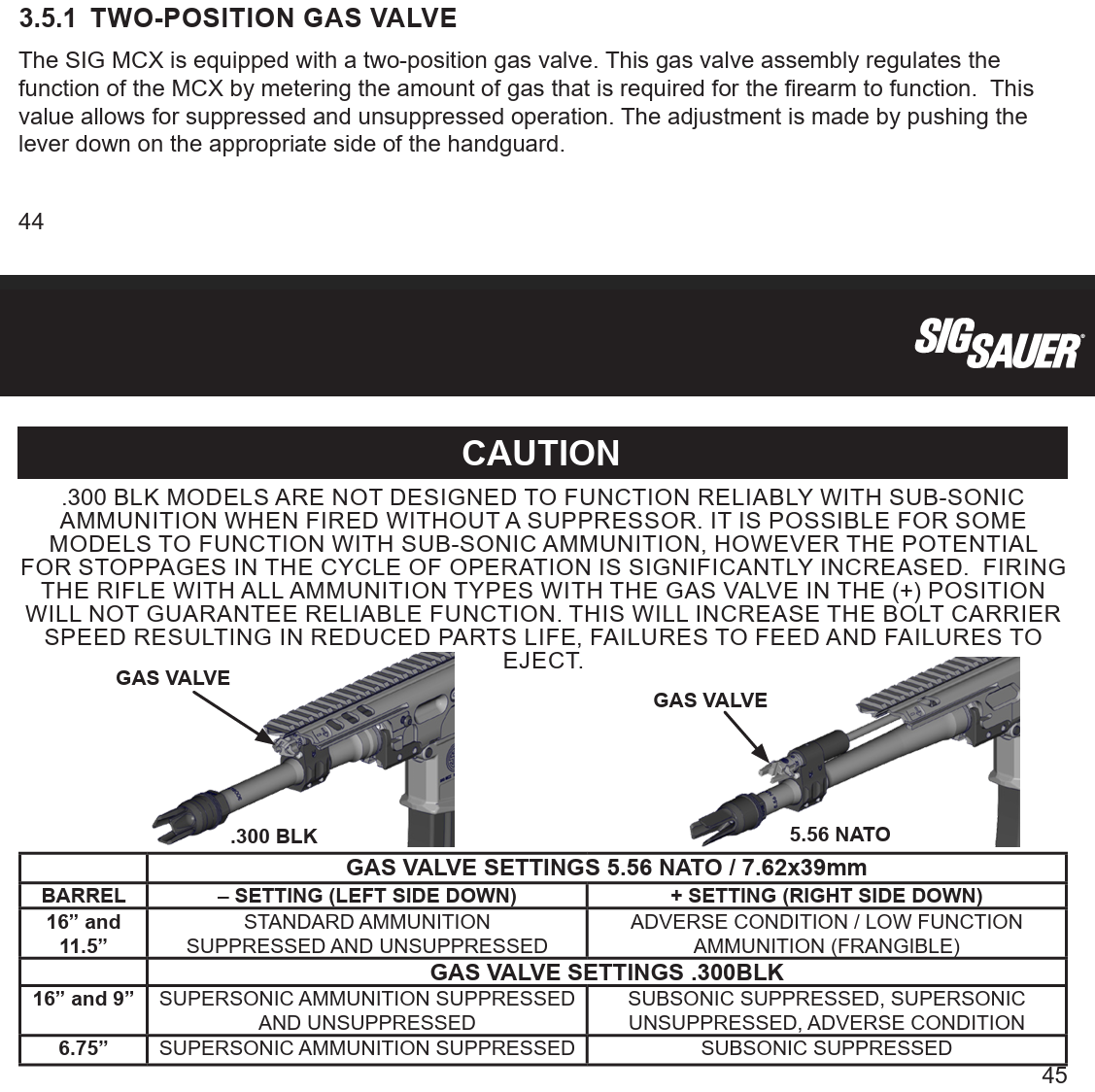
Figure 1. SIG SAUER MCX Two-Position Gas Valve Instruction Manual Pages 44-45.
As noted in Figure 1 above, some 300 BLK models may not reliably function without a silencer installed. Furthermore, after significant SIG SAUER MCX system proliferation into the consumer retail market, other issues have been known to occur:
When unsuppressed, the system may under-function with certain ammunition types.
When suppressed, the system may under-function or over-function with certain silencers, certain ammunition types, and various combinations of both.
When adapting high back pressure silencers to force function on under-functioning guns, the user may experience significant “gas blowback” regardless of gas valve adjustment, as well as system malfunctions.
When adapting low back pressure silencers to mitigate “gas blowback,” the system may be unreliable with regard to function with many ammunition types, and malfunctions may occur unpredictably. This is due to the mechanism(s) of back pressure reduction used in many “high flow rate” silencers.
The AI 3CM generally allows proper function of MCX systems with only gas valve adjustment. It is possible that the MCX Virtus system carrier will not lock to the rear after the last round is fired from the magazine with the short configuration of the AI 3CM and Discreet Ballistics 190gr ammunition (the standard PEW Science subsonic 300 BLK test ammunition). The “base module” of the previously evaluated CAT RAT (6.191) system did not experience this issue in PEW Science laboratory testing.
It is important to note that the 300 BLK MCX family of weapons (5.5-in, 6.75-in, and 9-in barrel length variants) possess different dwell times and gas port sizing, as well as different gas valves. These design differences by SIG SAUER are intended to maximize reliability. However, real-world user reports indicate that the gas impulse sensitivity of this system, along with ammunition variations (both supersonic and subsonic loadings) and silencer variations sometimes result in unpredictable function. Ongoing internal PEW Science testing of several different high flow rate silencers on the MCX system confirms this reality.
6.235.1.2 AI 3CM 300 BLK Silencer System Characteristics
The testing and analysis presented in this report of both AI 3CM configurations uses the F03 gas valve in the 6.75-in weapon system on the “+” setting, as discussed in the previous section. The F01 gas valve “+” setting may also provide function of the 6.75-in MCX VIRTUS 300 BLK system with the long configuration of the AI 3CM. However use of the F01 gas valve may result in a BCG failure to lock back on empty magazine malfunction if firing the weapon unshouldered, limp-wristed, or “from the hip.” With the short configuration of the silencer, even the F03 “+” setting may result in failure to lock back on an empty magazine with some ammunition types on this weapon system (as shown in the 3CM short configuration test in this report). For this reason, PEW Science (and SIG SAUER) recommend the use of the F03 gas valve when suppressing the 6.75-in 300 BLK MCX system with modern high flow rate or hybrid silencers. Please see the measured port size and gross volumetric expansion differences of the F01 and F03 gas valves on the PEW Science Small Arms Technical Data page. Again, port size is not the only difference between the two valves. Aftermarket gas valves may be required to achieve function with some silencer configurations and ammunition type combinations on the SIG MCX family of 300 BLK weapons. If the factory 6.75-in barrel MCX configuration is used, the following guidance holds:
If using supersonic 300 BLK ammunition, the “-” gas valve setting is permitted and recommended.
If using subsonic 300 BLK ammunition, the “+” gas valve setting is mandatory.
The two different AI 3CM configurations presented in this report are:
AI 3CM Long: This configuration provides the highest degree of overall signature suppression performance with the 3CM system. Early time flow rate is high, with distal late time flow rate being lower (the PEW Science Omega Metric is higher). Gas blowback during weapon operation will fall between that of the previously evaluated CAT RAT “COVERT” and “FLOW” configurations.
AI 3CM Short: This configuration provides a very compact and light system while still significantly reducing blast overpressure hazard to the operator and bystanders when compared to an unsuppressed system. It is intended for vehicle defense and other environments in which the smallest weapon package is required. Early time flow rate is identical to that of the Long configuration but late time flow rate is much higher (the PEW Science Omega Metric is much lower). Gas blowback to the operator is therefore low. This system behaves somewhat like the previously evaluated CAT RAT “BASE” configuration but with lower back pressure and somewhat more efficient blast momentum control. Like the RAT Base, this configuration of the AI 3CM is very short; this is intended to prevent the user from choosing to fire the weapon system unsuppressed; minimal length increase past the muzzle is provided. These are the shortest 300 BLK silencer variants evaluated by PEW Science, to date.
The blast overpressure protection capabilities of both AI 3CM configurations evaluated in this test program are compared with that of the three previously evaluated CAT RAT configurations in Figure 2, below. Note that since the evaluation of the CAT RAT, Combat Application Technologies changed the name of the “FLOW” module to the “EEFLUX” module. References to “CAT FLOW” in the Standard may be used interchangeably with “CAT EEFLUX.”
Hazards are expressed with the Suppression Rating; a holistic parameter that captures human inner ear damage risk potential from a measured impulsive complex overpressure signature during the entire time regime of weapon operation, including combustion, complete blowdown, and all mechanical operation, including the carrier group returning to battery, in the true free field. The parameter may be used with the dose chart at the beginning of this report. The PEW Science Suppression Rating is a damage risk criterion (DRC), a lower Suppression Rating indicates a higher personnel hazard in the free field - it is not a subjective quantity; it is an objective quantification of hearing damage risk potential. Due to its true free field test data origin and complete waveform analytical calculation basis, it is the only known universal suppressed weapon system signature comparison metric available.
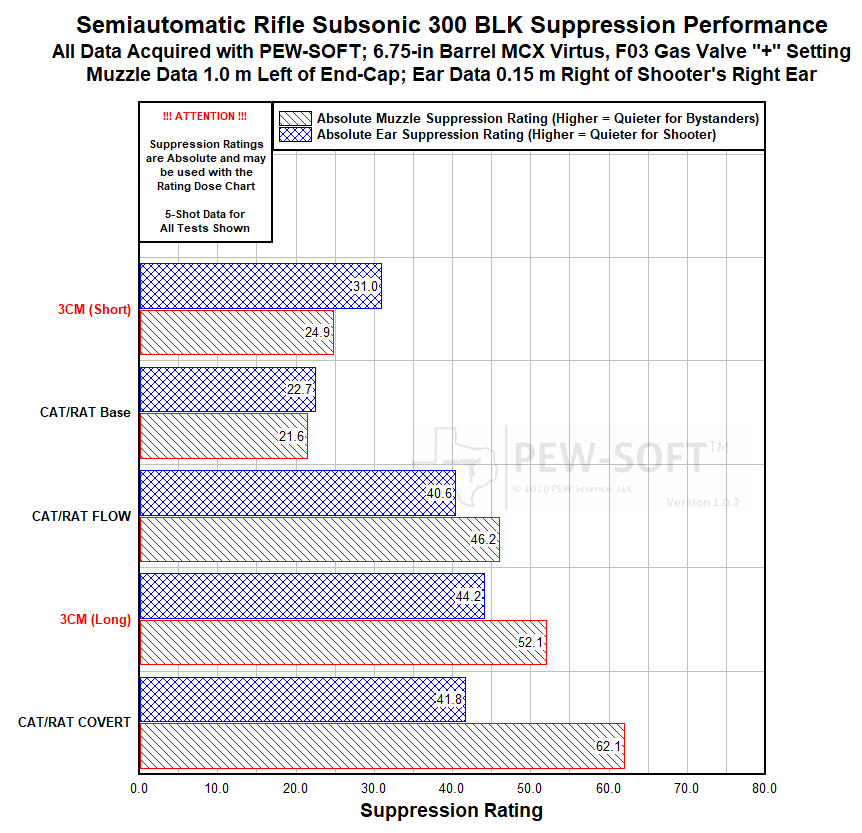
Figure 2. Suppression Rating Comparisons of the AI 3CM and CAT RAT configurations, Using PEW-SOFT 300 BLK Subsonic SIG MCX AR-18 Test Data and PEW Science Analysis
From the above semiautomatic short-barrel AR-18 rifle performance metrics, it can be concluded that:
The long configuration of the AI 3CM, with its higher system flow rate, marginally increases operator protection from blast overpressure when compared to the RAT COVERT. However, operator protection from gas blowback may be somewhat improved. These performance changes with the 3CM occur at the expense of relatively significant forward field blast overpressure signature reduction, as the muzzle (bystander) Suppression Rating of the long configuration of the AI 3CM is a full category lower than that of the RAT COVERT.
The short configuration of the AI 3CM provides increased operator protection compared with that of the RAT Base module. This is due to both the higher flow rate in the 3CM system and the somewhat greater degree of distal blast momentum control. Note that the shooter’s ear (operator) Suppression Ratings of the short configurations of these silencers are lower due to significantly more severe muzzle blast overpressure propagation compared with the long configuration counterparts. It is also important to note that both the 3CM and RAT systems create relatively hazardous forward fields, globally, compared with the longer configurations of both silencers. This is visually illustrated in the Silencer Hazard Maps at the beginning of this report and in Silencer Hazard Map Brief 8.1.32.
Outside the free field environment (inside rooms, near walls, etc.), the long configuration of the AI 3CM may induce less severe blast load reflections than the CAT RAT FLOW configuration, which could potentially impact both shooter’s ear (operator) and muzzle (bystander) Suppression Rating metrics.
Full subsonic 300 BLK 6.75 SIG MCX AR-18 evaluation of the long and short configurations of the AI 3CM follows.
6.235.2 AI 3CM Long Configuration Sound Signature Test Results
A summary of the principal Silencer Sound Standard performance metrics of the AI 3CM in the long configuration is shown in Table 1. The data acquired 1.0 m (39.4 in) left of the muzzle is available for viewing to all. The data acquired 0.15 m (6 in) right of the shooter’s ear is only available to membership supporters of PEW Science and the Silencer Sound Standard. You can support public PEW Science testing, research, and development with a membership, here. State-of-the-art public firearm sound signature testing and research conducted by PEW Science is supported by readers like you.
Table 1. Apparition Instruments AI 3CM Long Configuration Sound Metric Summary
6.235.2.1 SOUND SIGNATURES AT THE MUZZLE
Real sound pressure histories from a 6-shot test acquired with PEW-SOFT™ are shown below. Six cartridges were loaded into the magazine, the fire control group positioned to single-shot, and the weapon was fired until the magazine was empty and the bolt locked back on the follower of the empty magazine. Only five shots are considered in the analysis. The signatures of Shot 6 are displayed in the data presentation but are not included in the analysis to maintain consistency with the overall PEW Science public dataset and bolt-closing signatures. The waveforms are not averaged, decimated, or filtered. The data acquisition rate used in all PEW Science laboratory sound signature testing is 1.0 MS/s (1 MHz). The peaks, shape, and time phasing (when the peaks occur in relation to absolute time and to each other) of these raw waveforms are the most accurate of any firearm silencer testing publicly available. PEW-SOFT data is acquired by PEW Science independent laboratory testing; the recognized industry leader in silencer sound research. For more information, please consult the Silencer Sound Standard.
The primary sound signature pressure histories for all 6 shots with the AI 3CM long configuration are shown in Figure 3a. The sound signatures of Shot 1 and Shot 2 are shown in Figure 3b, in early time. The real sound impulse (momentum transfer potential) histories from the same 6-shot test are shown in Figure 4a. In Figure 4b, a shorter timescale is shown comparing the impulse of Shot 1 to that of Shots 2 and 3.
Fig 3a. Apparition Instruments AI 3CM Long Configuration subsonic 300 BLK SIG MCX AR-18 Semiautomatic Rifle Muzzle Sound Pressure Signature
Fig 3b. Apparition Instruments AI 3CM Long Configuration subsonic 300 BLK SIG MCX AR-18 Semiautomatic Rifle Sound Pressure Signature
Figure 4a. Apparition Instruments AI 3CM Long Configuration subsonic 300 BLK SIG MCX AR-18 Semiautomatic Rifle Muzzle Sound Impulse Signature
Figure 4b. Apparition Instruments AI 3CM Long Configuration subsonic 300 BLK SIG MCX AR-18 Semiautomatic Rifle Muzzle Sound Impulse Signature
The AI 3CM uses technology previously evaluated in the CAT RAT (6.191) system. As such, the 3CM is classified as a hybrid design in the PEW Science research taxonomy. More specifically, it is classified as a modular staged hybrid. Hybrid design silencers are those in which elements of both conventional and high flow rate silencers are used, coupled with other technology variations and staged elements to provide parametrically varied performance attributes. Such attributes include the ability to reduce early-time shock reflections while significantly altering the rate of proximal and distal venting. These silencers may allow for minimal reciprocating weapon functional influence, while at the same time significantly suppressing signature to the operator and bystanders. Hybrid designs span a large range of the market in both brand and performance in different combustion regimes. There also exist subcategories of this class of silencers that have been shown to demonstrate efficacy in multiple flow regimes. Discussion of these subcategories is outside the scope of this report. Other hybrid designs and staged hybrids include those from PTR, CAT, CGS, SilencerCo, Surefire, Otter Creek Labs, and others. For an overview of the three primary classes of rifle silencer designs, the reader is encouraged to review PEW Science Research Supplement 6.169.
The AI 3CM has a larger diameter than the CAT RAT and the extension module has a distal vent array not present in the RAT COVERT module. The first module of the 3CM also has a distal vent array on its coupler that is not present on the RAT Base module coupler.
Elements of previously described CAT A-PULSE technology are used in the AI 3CM, but with adaptations to achieve the following two performance goals:
Somewhat lower back pressure in the “long” configuration compared with that of the CAT RAT COVERT silencer, with more robust blast overpressure control than the CAT RAT FLOW silencer.
More efficient blast overpressure mitigation in the “short” configuration compared with that of the CAT RAT Base silencer.
The test data gathered in this program appears to validate performance characteristics congruent with those two goals. The following are observations from the above raw blast overpressure and impulse test data with the long configuration of the AI 3CM:
Blast overpressure amplitude is higher and blowdown duration is shorter than that of the CAT RAT COVERT silencer, and the amplitude is lower and blowdown duration longer than that of the CAT RAT FLOW silencer (Fig. 3a).
Precursor wave development is somewhat similar to that of the RAT COVERT and initial primary positive phase is more defined (Fig. 3b).
Rate of blast momentum propagation is significantly higher than the RAT COVERT and lower than that of the RAT FLOW (Fig. 4a).
First-round-pop (FRP) signature is more robust than that of the RAT FLOW silencer (Fig. 3b and Fig. 4b).
Observations (1) and (3) confirm the long AI 3CM possesses gross field suppression “between” that of the CAT RAT COVERT and CAT FLOW silencers. Observation (2) indicates that the blast momentum control of the long AI 3CM is still strong, but the RAT COVERT is superior from that performance standpoint. Observation (4) follows from the previous observations and is congruent.
PEW Science Research Note 1: Users seeking a somewhat higher flow rate (lower back pressure) than the RAT COVERT silencer but wanted more blast overpressure propagation control than the RAT FLOW silencer will find the AI 3CM long configuration to strike that balance, objectively.
PEW Science Research Note 2: PEW Science 6.75-in 300 BLK subsonic SIG MCX AR-18 system research is still ongoing. As it stands, the weapon system provides two distinct differentiations from the existing 8-in barrel 300 BLK bolt-action system research pedigree, to date:
Barrel Length: The shorter 6.75-in barrel results in multiple performance variables for blast load input in the silencer system. It produces higher muzzle blast pressure and also lower projectile pressure wave amplitude in the subsonic ammunition combustion regime. Different silencers will react differently to this change in barrel length, with regard to pure muzzle suppression performance. As it stands, the AI 3CM long configuration produces a 52.1 muzzle (bystander) Suppression Rating on this system. If the reader is to compare a performance analog in subsonic 300 BLK combustion suppression from the existing pedigree to date, a similar muzzle Suppression Rating of 53.8 was obtained by the Otter Creek Labs Infinity 7.62 with solid end cap (6.185) on the 8-in barrel bolt-action test platform (no ejection port blast and no mechanical operation other than the trigger actuation and firing pin drop). With its direct-thread mount, the Infinity is 6.8-in long compared with the 7.8-in long AI 3CM. Both silencers are capable of high flow rate. The AI 3CM offers more robust FRP suppression performance than the Infinity. The Energetic Armament VOX-S with a wipe (6.38) achieves a 56.3 muzzle Suppression Rating on an 8-in barrel bolt-action rifle. That silencer has exceedingly high back pressure due to wipe use and is not generally comparable for system operation. The next higher performer is the CAT ODB (6.122) which achieves a 57.7 muzzle Suppression Rating on an 8-in barrel bolt-action rifle. The ODB has a higher flow rate than the long configuration of the AI 3CM. With higher early time flow rate, potential malfunctions with the MCX system increase. With lower early time flow rate, ejection port blast hazards on semiautomatic platforms increase, in general.
Ejection Port Blast Loads: The 6.75 SIG MCX AR-18 is a semiautomatic weapon system. As demonstrated in the 169 other existing reciprocating weapon system test data records in the Rankings to date (semiautomatic rifle or pistol), ejection port blast loads may significantly influence operator hazard and therefore impact the shooter’s ear (operator) Suppression Rating. As it stands, the AI 3CM long configuration produces a 44.2 operator Suppression Rating on this system, in the free field. As more test records are populated with subsonic 300 BLK combustion from semiautomatic systems, comparison points will be generated. For now, the reader may consider the differential between an operator Suppression Rating in the 40-zone and an operator Suppression Rating for the entire semiautomatic dataset to date, including both supersonic 5.56x45mm NATO combustion, and subsonic 9x19mm combustion, omitting subsonic .22LR rimfire. The highest shooter’s ear Suppression Rating published on a standard untuned 5.56 semiautomatic rifle is 32.8 from the low back pressure Stealth Additive Works Tisha (6.209). A high back pressure silencer, the Maxim Defense DSX, achieved a 32.5 shooter’s ear Suppression Rating on the tuned SURG system (6.111) and only 22.0 on the standard untuned system (6.110). Therefore, the SIG MCX with the AI 3CM provides a significantly safer operator blast environment, high / low pressure supersonic and subsonic ammunition combustion comparison notwithstanding. Now consider the subsonic ammunition combustion regime. 8.9-in barrel length MP5 system shooter’s ear Suppression Ratings in the Rankings range from mid-30s with the Dead Air Wolfman (6.182) to just over 50 with the CAT MOB (6.148). The 6.75-in MCX system with subsonic 300 BLK ammunition brings operator protection to high performance suppressed submachine gun severity levels but with a shorter system length and projectile weights that are at least 30% heavier. An interesting comparative data point is that the SIG SAUER SLH 300TI (6.107) achieved an operator Suppression Rating of 44.4 with the 8-in bolt action rifle. The AI 3CM system operator protection differential from the SIG SLH 300 Ti is relatively small, even with the addition of ejection port blast and mechanical operation.
PEW Science Research Note 3: As 300 BLK semiautomatic weapon system evaluations continue, the multiple blast load hazards detailed above will be characterized from a variety of systems. It is likely that when certain high flow rate silencers are used with low pressure subsonic 300 BLK cartridge on reciprocating systems, mechanical reliability issues will result. This is a subject of further research. Silencer system designers are encouraged to evaluate their products on weapon systems for which they claim operational capability. As shown in the next section of this report, the short configuration of the AI 3CM did not have high enough back pressure to enable the BCG of the MCX Virtus to lock back reliably on the last round from the magazine with the test ammunition.
PEW Science Research Note 4: It is extremely important for the reader to understand the Suppression Ratings are computed with free field test data, and are therefore universal when translating the weapon and operator to different environments without reflections. However, when the environment becomes complex with many reflecting surfaces, performance translation of different systems is not yet possible; sound field shapes and particle velocities result in varied blast wave time-of-arrivals, as well as changes of blast load angles of incidence; these variations change amplitude and phase waveform components. As a result of these inevitable environmental complexities, user impressions will vary, as both the shooter and bystander. Nonetheless, hazard reduction efficacy in the free field, as characterized by the Suppression Rating, holds. The Suppression Rating comparisons are the current state-of-the-art, and the most “apples to apples” sound suppression performance comparisons that currently exist. Further research is ongoing.
PEW Science Research Note 5: As in all semiautomatic AR-18 and AR-15 weapon testing, a second pressure pulse originates from the ejection-port signature of the weapon and it occurs early enough in time such that its waves coalesce with that of the muzzle signature. However, in late time (at approximately 100 ms in Figure 3a) the mechanical noise of the bolt closing is observed. The pressure signature of Shot 6 does not display this event due to the bolt remaining open after the sixth and final round is fired from the magazine.
PEW Science Research Note 6: The closing time of the AR-18 bolt is directly related to the flow restriction of a silencer for a given weapon system. PEW Science has determined bolt closing time variation from the unsuppressed state to be a reliable indicator of silencer back pressure, with strong correlation with the PEW Science Back Pressure Metric, Omega and the alpha parameter. However, PEW Science has also determined that the indicator may be unreliable upon upper receiver fouling. Sound signatures are not influenced by this fouling, as these kinematics occur in late time, after gas venting to atmosphere. Momentum transfer, weapon condition (upper receiver fouling), and other factors, can significantly influence bolt closing time. PEW Science urges the reader to exercise extreme caution if using the published bolt closing time to make determinations regarding silencer flow restriction (back pressure) or weapon system kinematics. This type of calculation may provide erroneous results, as the weapon condition at the time of each test is not published data. The time-scale duration showing bolt closing time is only published by PEW Science such that the signature data pedigree may be verified.
The shape, timing, and magnitudes of the early-time pressure pulses and overall shape of the impulse waveforms measured at the muzzle, from shot-to-shot, are relatively consistent. The consistency of the waveform amplitudes highlight the silencer’s overall sound performance consistency at the muzzle after the FRP, as well as the relative consistency of the tested automatic rifle firearm configuration.
As typically indicated, first-round sound signatures always differ from subsequent shots, as the atmosphere within the silencer changes. The FRP phenomenon cannot always be shown by viewing only the peak sound pressure. This is one of the reasons why The Silencer Sound Standard requires examining multiple sound signature metrics. Ammunition consistency can play a role in the determination of FRP, however, the close examination of measured pressure and impulse waveforms typically excludes ammunition from the possible factors influencing true FRP, due to the relative consistency of most high quality factory ammunition.
PEW Science Research Note 7: Note that the muzzle Suppression Rating of the AI 3CM long configuration is 52.1 and the at-ear Suppression Rating is 44.2; different zones on the Suppression Rating Dose Chart. The high early time flow rate (lower early time back pressure) of the AI 3CM contributes to a less severe ejection port blast signature. Gas blowback to the weapon operator, which is a different hazard than ejection port blast, may be reduced further by using the short configuration of the silencer, as evaluated in Section 6.235.3 of this report, at the expense of more severe blast overpressure propagation.
The signatures measured at the shooter’s ear with the long configuration of the AI 3CM are presented and analyzed in the full Member Version of this report.
The short configuration of the AI 3CM is examined in the following section.
6.235.3 AI 3CM Short Configuration Sound Signature Test Results
A summary of the principal Silencer Sound Standard performance metrics of the AI 3CM in the short configuration is shown in Table 2. The data acquired 1.0 m (39.4 in) left of the muzzle is available for viewing to all. The data acquired 0.15 m (6 in) right of the shooter’s ear is only available to membership supporters of PEW Science and the Silencer Sound Standard. You can support public PEW Science testing, research, and development with a membership, here. State-of-the-art public firearm sound signature testing and research conducted by PEW Science is supported by readers like you.
Table 2. Apparition Instruments AI 3CM Short Configuration Sound Metric Summary
6.235.3.1 SOUND SIGNATURES AT THE MUZZLE
Real sound pressure histories from a 6-shot test acquired with PEW-SOFT™ are shown below. Six cartridges were loaded into the magazine, the fire control group positioned to single-shot, and the weapon was fired until the magazine was empty and the bolt locked back on the follower of the empty magazine. Only five shots are considered in the analysis. The signatures of Shot 6 are displayed in the data presentation but are not included in the analysis to maintain consistency with the overall PEW Science public dataset and bolt-closing signatures. The waveforms are not averaged, decimated, or filtered. The data acquisition rate used in all PEW Science laboratory sound signature testing is 1.0 MS/s (1 MHz). The peaks, shape, and time phasing (when the peaks occur in relation to absolute time and to each other) of these raw waveforms are the most accurate of any firearm silencer testing publicly available. PEW-SOFT data is acquired by PEW Science independent laboratory testing; the recognized industry leader in silencer sound research. For more information, please consult the Silencer Sound Standard.
The primary sound signature pressure histories for all 6 shots with the AI 3CM in the short configuration are shown in Figure 7a. The sound signatures of Shot 1 and Shot 2 are shown in Figure 7b, in early time. The real sound impulse (momentum transfer potential) histories from the same 6-shot test are shown in Figure 8a. In Figure 8b, a shorter timescale is shown comparing the impulse of Shot 1 to that of Shots 2 and 3.
Fig 7a. Apparition Instruments AI 3CM Short Configuration subsonic 300 BLK SIG MCX AR-18 Semiautomatic Rifle Muzzle Sound Pressure Signature
Fig 7b. Apparition Instruments AI 3CM Short Configuration subsonic 300 BLK SIG MCX AR-18 Semiautomatic Rifle Muzzle Sound Pressure Signature
Fig 8a. Apparition Instruments AI 3CM Short Configuration subsonic 300 BLK SIG MCX AR-18 Semiautomatic Rifle Muzzle Sound Impulse Signature
Fig 8b. Apparition Instruments AI 3CM Short Configuration subsonic 300 BLK SIG MCX AR-18 Semiautomatic Rifle Muzzle Sound Impulse Signature
The short configuration of the AI 3CM behaves completely differently than the long configuration of the silencer and significantly changes the free field blast overpressure propagation from the weapon system. While the early time flow rate and initial conditions remain the same, downstream blast load management is truncated and late-time flow rate skyrockets. This results in the following behavioral changes, observed in the above data plots:
Significantly higher peak positive phase blast load amplitude is produced in the free field (Fig. 7a).
Separation between initial coupled jetting and the primary muzzle blast jet remains (Fig. 7b). There is a doubling of the initial jet events prior to primary blast.
FRP divergence occurs earlier in time. This presents with an earlier coupled jet and more intense primary blast shock (Fig. 7b).
Subsequent blast momentum accumulation in the free field is elevated. Primary vent durations are exceedingly short (see decoupled ground reflection in Fig. 7a, as well as expedient momentum decrease, Fig. 8a).
Observations (1), (3), and (4) occur in somewhat similar fashion to the CAT RAT Base module, which stands to reason. The doubled initial jet components described in observation (2) occur because there is a circumferential vent array present at the end of the short configuration of the AI 3CM, on the coupler nozzle. This same array is not present on the CAT RAT Base module nozzle.
PEW Science Research Note 10: The AI 3CM is larger diameter than the CAT RAT. Additional volumetric expansion combined with additional vent arrays in the 3CM result in FRP that is somewhat more severe with the short configuration of the 3CM than with the Base module of the CAT RAT. Despite the additional vent array, on average, the suppression performance of the short configuration of the AI 3CM is more robust than that of the CAT RAT Base module. The performance increase is most likely driven primarily by additional volumetric expansion given the similarity of the two designs.
It is very important for the reader to understand that personnel hazard increases with the short configuration of the 3CM when compared to that of the long configuration. However, when compared with unsuppressed muzzle blast, the risk is significantly reduced. The 6.75-in test host is not designed to be fired unsuppressed. For reference of unsuppressed subsonic 300 BLK muzzle blast severity, the reader is encouraged to examine Figure 2a in Public Research Supplement 6.127. When blast load waveforms begin to approach the same general shape and are characterized by simple shocks of similar duration, absolute positive phase amplitude can provide useful comparative analysis. For example, from an 8-in barrel, the subsonic test ammunition produces a primary shock amplitude of over 165 dB (close to 4,000 Pa). The average peak blast overpressure from the short configuration of the AI 3CM on the 6.75-in system is approximately one fifth of that amplitude. Unsuppressed small arms are hazardous regardless of the user’s choice of supersonic and subsonic ammunition. This is particularly the case for confined areas and environments in which the short barrel SIG SAUER MCX variants are fielded. This is the primary design intent of silencer configurations like the short AI 3CM and the CAT RAT Base module and why they may be fielded separately from the extension modules as standalone units.
PEW Science Research Note 11: Unlike the CAT RAT Base module, the pressure throttling ability of the AI 3CM short configuration is not quite high enough to create the total back pressure necessary to enable last round bolt hold open on this test host with this test ammunition. This is why the BCG return to battery is observed during Shot 6 in Figure 7a. Note that the Suppression Rating always only considers the first five shots in its analysis and computation. Nonetheless, this performance factor is important for the user to know, as also discussed in Section 6.235.1.1.
Signature analysis of test data acquired near the operator’s head with the short configuration of the AI 3CM is presented and analyzed in the full Member Version of this report.
Comprehensive comparison summary of the two configurations of the AI 3CM and three RAT configurations is provided below.
6.235.4 Suppression Rating Comparison (Subsonic 300 BLK from the SIG MCX)
Figure 11 presents a comparison of the PEW Science Suppression Rating of the two AI 3CM configurations with those of the three CAT RAT system configurations on the 6.75-in barrel SIG SAUER MCX 300 BLK weapon system, as previously presented in Section 6.235.1.2. Gas system parameter measurements of the 6.75-in SIG SAUER MCX system are presented on the PEW Science Small Arms Technical Data page. Please note the specific gas system setting used in the tests.
Figure 11. Suppression Rating Comparisons of the AI 3CM and CAT RAT configurations, Using PEW-SOFT 300 BLK Subsonic SIG MCX AR-18 Test Data and PEW Science Analysis
Figure 11 presents an overall summary of the postulated blast overpressure hazards to the operator and bystanders when fielding the AI 3CM and CAT RAT in multiple configurations on the 6.75-in 300 BLK SIG SAUER MCX weapon system, in the free field. Hazards are expressed with the Suppression Rating; a holistic parameter that captures human inner ear damage risk potential from a measured impulsive complex blast overpressure signature during the entire time regime of weapon operation, including combustion, complete blowdown, and all mechanical operation, including the carrier group returning to battery, in the true free field. The parameter may be used with the dose chart at the beginning of this report. The PEW Science Suppression Rating is a damage risk criterion (DRC), a lower Suppression Rating indicates a higher personnel hazard in the free field - it is not a subjective quantity; it is an objective quantification of hearing damage risk potential. Due to its true free field test data origin and complete waveform analytical calculation basis, it is the only known universal suppressed weapon system signature comparison metric available.
From the above semiautomatic short-barrel AR-18 rifle performance metrics, it can be concluded that:
The long configuration of the AI 3CM, with its higher system flow rate, marginally increases operator protection from blast overpressure when compared to the RAT COVERT. Operator protection from gas blowback may be somewhat improved. These performance changes with the 3CM occur at the expense of relatively significant forward field blast overpressure signature reduction, as the muzzle (bystander) Suppression Rating of the long configuration of the AI 3CM is a full category lower than that of the RAT COVERT.
The short configuration of the AI 3CM provides increased operator protection compared with that of the RAT Base module. This is due to both the higher flow rate in the 3CM system and the somewhat greater degree of distal blast momentum control. Note that the shooter’s ear (operator) Suppression Ratings of the short configurations of these silencers are lower due to significantly more severe muzzle blast overpressure propagation compared with the long configuration counterparts. It is also important to note that both the 3CM and RAT systems create relatively hazardous forward fields, globally, compared with the longer configurations of both silencers. This is visually illustrated in the Silencer Hazard Maps at the beginning of this report and in Silencer Hazard Map Brief 8.1.32.
Outside the free field environment (inside rooms, near walls, etc.), the long configuration of the AI 3CM may induce less severe blast load reflections than the CAT RAT FLOW configuration, which could potentially impact both shooter’s ear (operator) and muzzle (bystander) Suppression Rating metrics.
Bystander Protection: Free field blast hazards adjacent to the weapon system are compared below:
The AI 3CM long configuration produces a 52.1 muzzle (bystander) Suppression Rating on this system. If the reader is to compare a performance analog in subsonic 300 BLK combustion suppression from the existing pedigree to date, a similar muzzle Suppression Rating of 53.8 was obtained by the Otter Creek Labs Infinity 7.62 with solid end cap (6.185) on the 8-in barrel bolt-action test platform (no ejection port blast and no mechanical operation other than the trigger actuation and firing pin drop). With its direct-thread mount, the Infinity is 6.8-in long compared with the 7.8-in long AI 3CM. Both silencers are capable of high flow rate. The AI 3CM offers more robust FRP suppression performance than the Infinity. The Energetic Armament VOX-S with a wipe (6.38) achieves a 56.3 muzzle Suppression Rating on an 8-in barrel bolt-action rifle. That silencer has exceedingly high back pressure due to wipe use and is not generally comparable for system operation. The next higher performer is the CAT ODB (6.122) which achieves a 57.7 muzzle Suppression Rating on an 8-in barrel bolt-action rifle. The ODB has a higher flow rate than the long configuration of the AI 3CM. With higher early time flow rate, potential malfunctions with the MCX system increase. With lower early time flow rate, ejection port blast hazards on semiautomatic platforms increase, in general.
The AI 3CM short configuration produces a muzzle Suppression Rating of 24.9. That level of protection is, on average, similar to bystander hazard mitigation from a CGS Helios QD with solid end cap on the 5.56 MK18 (6.66), a Thunder Beast Dominus-SR on the 5.56 MK18 (6.105), SilencerCo Omega 300 on .308 bolt action (6.10), or a Dead Air Sandman-L on a .308 bolt action (6.23).
Operator Protection: Free field blast hazards to which the operator is subjected are compared below:
The AI 3CM long configuration produces a 44.2 operator Suppression Rating on this system, in the free field. As more test records are populated with subsonic 300 BLK combustion from semiautomatic systems, comparison points will be generated. For now, the reader may consider the differential between an operator Suppression Rating in the 40-zone and an operator Suppression Rating for the entire semiautomatic dataset to date, including both supersonic 5.56x45mm NATO combustion, and subsonic 9x19mm combustion, omitting subsonic .22LR rimfire. The highest shooter’s ear Suppression Rating published on a standard untuned 5.56 semiautomatic rifle is 32.8 from the low back pressure Stealth Additive Works Tisha (6.209). A high back pressure silencer, the Maxim Defense DSX, achieved a 32.5 shooter’s ear Suppression Rating on the tuned SURG system (6.111) and only 22.0 on the standard untuned system (6.110). Therefore, the SIG MCX with the AI 3CM provides a significantly safer operator blast environment, high / low pressure supersonic and subsonic ammunition combustion comparison notwithstanding. Now consider the subsonic ammunition combustion regime. 8.9-in barrel length MP5 system shooter’s ear Suppression Ratings in the Rankings range from mid-30s with the Dead Air Wolfman (6.182) to just over 50 with the CAT MOB (6.148). The 6.75-in MCX system with subsonic 300 BLK ammunition brings operator protection to high performance suppressed submachine gun severity levels but with a shorter system length and projectile weights that are at least 30% heavier. An interesting comparative data point is that the SIG SAUER SLH 300TI (6.107) achieved an operator Suppression Rating of 44.4 with the 8-in bolt action rifle. The AI 3CM system operator protection differential from the SIG SLH 300 Ti is relatively small, even with the addition of ejection port blast and mechanical operation.
The AI 3CM short configuration produces a 31.0 operator Suppression Rating on this system, in the free field. That is identical, on average, to the PTR VENT Spiritus 556i on the 5.56 MK18 (6.192). The primary body of the short configuration of the AI 3CM is only 3.25-in long, with mount. Comparable operator Suppression Ratings are produced by the CAT CACM 556 on the MK18 (6.203), the Resilient Suppressors Putnik on a short AK (6.224), a short Rugged Surge on a .308 bolt action (6.22), the aforementioned Tisha on the MK18, and a Dead Air Sandman-S on a .308 bolt-action (6.11).
The above bystander and operator personnel hazard comparisons are only possible with the PEW Science Suppression Rating, as the blast overpressure histories from all of these systems differ significantly in shape, duration, phase, and frequency components.
Signature at the operator’s head is a function of both muzzle and ejection port signatures from reciprocating weapon systems like the SIG SAUER MCX AR-18.
Small arm weapon system suppression performance is a spectrum. The PEW Science Suppression Rating and the Silencer Sound Standard help quantify this spectrum for end users and industry, objectively.
6.235.5 Review Summary: Apparition Instruments AI 3CM on a 300 BLK SIG SAUER MCX Virtus TACOPS with 6.75-in Barrel
When paired with the 6.75-in barrel SIG MCX and fired with Discreet Ballistics 190gr 300 BLK subsonic ammunition, the AI 3CM in the long configuration achieved a Suppression Rating™ of 53.0 in PEW Science testing. In the short configuration, the AI 3CM achieved a Suppression Rating of 32.3.
As with all weapon systems, the user is encouraged to examine both muzzle and ear Suppression Ratings.
PEW Science Laboratory Staff Opinion:
The Apparition Instruments AI 3CM is a modular silencer system intended to suppress 300 BLK personal defense weapons (PDWs). Its advanced hybrid technology, borrowed from the CAT RAT system, provides relatively balanced suppression performance and flow rate in its long configuration and somewhat competitive operator protection in the short configuration. The AI 3CM is capable of suppressing both subsonic and supersonic 300 BLK from short barrel personal defense weapons and other 300 BLK systems.
Users seeking a somewhat higher flow rate (lower back pressure) than the CAT RAT COVERT silencer but want more blast overpressure propagation control than the CAT RAT FLOW silencer will find the AI 3CM long configuration to strike that balance, objectively. Users preferring the size of the CAT RAT Base module but wanting somewhat more operator protection will find the AI 3CM to offer that performance trait.
AI 3CM Long: This configuration provides the highest degree of overall signature suppression performance with the 3CM system. Early time flow rate is high, with distal late time flow rate being lower (the PEW Science Omega Metric is higher). Gas blowback during weapon operation will fall between that of the previously evaluated CAT RAT COVERT and FLOW configurations.
AI 3CM Short: This configuration provides a very compact and light system while still significantly reducing blast overpressure hazard to the operator and bystanders when compared to an unsuppressed system. It is intended for vehicle operators and other environments in which the smallest weapon package is required. Early time flow rate is identical to that of the Long configuration but late time flow rate is much higher (the PEW Science Omega Metric is much lower). Gas blowback to the operator is therefore low. This system behaves somewhat like the previously evaluated CAT RAT BASE configuration but with lower back pressure and somewhat more efficient blast momentum control.
Like the CAT RAT, the AI 3CM is intended to be used with the included AI NANO muzzle device which possesses LH threading. The extension module possess LH threading which interfaces with the distal end of the short module.
Each module is DMLS (3D printed) from a proprietary titanium alloy. The PEW Science laboratory has not performed exhaustive durability testing on the 3CM system, but in limited CAT RAT trials, no adverse effects were observed during the firing of several back-to-back magazines with both supersonic and subsonic 300 BLK ammunition from the 6.75-in barrel SIG system. As always, durability limitations exist for all silencers and are a function of barrel length, ammunition type, and firing schedule. PEW Science encourages the end user to contact the manufacturer for guidance regarding firing schedule limitations. Note that AI NANO muzzle devices do induce side-wall blast load impingement in the first expansion chamber of silencers, and that wall is reinforced in the CAT RAT and the AI 3CM. Use of other muzzle devices with the these systems have not been evaluated by PEW Science. Performance differentials in signature suppression and durability may occur.
In this review, the AI 3CM system performance metrics depend upon suppressing a subsonic intermediate rifle cartridge on a short barrel gas-operated rifle, which is an incredibly difficult task. While the sound signature of such cartridges can be suppressed to levels that may result in the desire of the shooter and bystanders to not wear hearing protection, PEW Science encourages the reader to remain vigilant with regard to all subsonic rifle cartridge suppression claims. The gas volume and combustion products created by firing a subsonic intermediate rifle cartridge such as 300 BLK are still significant; the measured pressure and impulse magnitudes, and their durations, illustrate this fact. Silencer performance on automatic (reciprocating) rifles depends on many factors. Weapon configuration may significantly influence total suppressed small arm system performance.
The hearing damage potential of subsonic rifle use is not insignificant. PEW Science encourages the reader to consider the Suppression Rating when deciding on an appropriate silencer and host weapon combination for their desired use.