SSS.6.241 - Tuna Cans Blackfin XL and the Q mini FIX 300 BLK Subsonic (Free Version)
/Tuna Cans Blackfin XL in 12-baffle and 9-baffle configurations on a Q mini FIX 300 BLK with 8-in Barrel
The Blackfin XL is designed and manufactured by Tuna Cans. It is a modular .375 caliber centerfire rifle silencer, intended to suppress the 300 BLK and 8.6 BLK cartridges. Note that the manufacturer states 9mm projectiles are too large for the Blackfin XL bore, despite the .375 caliber sizing. The Blackfin XL has a 1.56-inch diameter and is 10.6 inches long in the full 12-baffle configuration with a low-profile direct-thread mount installed in the 1.375-24 tpi HUB-threaded end. In the 9 baffle configuration, the total system length is reduced to 8.8 inches. Each modular baffle adds or subtracts approximately 0.6-in to the length of the silencer. The silencer may be attached to a variety of weapon systems depending on the user’s choice of mount. The blast chamber, mount section, and blast baffle are machined 17-4 heat treated stainless steel. The remainder of the baffles and end cap are 7075 aluminum. With a low-profile direct-thread mount installed, the silencer weighs 21.9 ounces in the 12-baffle configuration and 18.5 ounces in the 9-baffle configuration, as tested. The Blackfin XL can be obtained from Tuna Cans.
Note that when the 12-baffle Blackfin XL is configured with 9 baffles, it is identical to the Blackfin L.
System Suppression Ratings and Silencer Hazard Maps:
This report includes two (2) different tests of the modular Blackfin XL silencer in two (2) baffle configurations on the 8-in barrel Q mini-FIX short barrel bolt-action rifle. Composite and Detailed Suppression Ratings, along with the predicted personnel hazards generated by the tested weapon systems in this report in the free field, are shown in the below graphics and Silencer Hazard Maps. Click or tap the Maps to enlarge. Please reference Silencer Hazard Map Brief 8.1.38 for further details. The PEW-SOFT HD Blast Hazard Prediction Tool and Hazard Mapper is presented in Report 8.1.1.
Tuna Cans Blackfin XL 12-Baffle Configuration 8-in barrel 300 BLK Subsonic Bolt-Action Free Field Hazard Map Produced by PEW-SOFT HD Blast Hazard Prediction Tool using PEW Science Test Data
Tuna Cans Blackfin XL 9-Baffle Configuration 8-in barrel 300 BLK Subsonic Bolt-Action Free Field Hazard Map Produced by PEW-SOFT HD Blast Hazard Prediction Tool using PEW Science Test Data
PEW Science is an independent private testing laboratory and also hosts the world’s only independent public suppressed small arms research cooperative. Testing, data analysis, and reporting is generated with funding provided by PEW Science members. Any test data that is generated with any portion of private funding contains this disclosure. The testing and analysis production for this Sound Signature Review was funded in part by PEW Science Project PEW-Tuna-152-002-26. Therefore, data pertaining to the Blackfin XL in this Sound Signature Review are published with the express written permission of Tuna Cans LLC.
This Sound Signature Review contains two sets of test results using the Tuna Cans Blackfin XL in the 12-baffle and 9-baffle configurations with a direct-thread mount on the Q mini FIX bolt action rifle, chambered in 300 BLK with an 8-inch barrel. Discreet Ballistics 190gr ammunition was used in the tests.
Section 6.241.1 contains the Tuna Cans Blackfin XL 12-baffle configuration test results and analysis.
Section 6.241.2 contains the Tuna Cans Blackfin XL 9-baffle configuration test results and analysis.
Section 6.241.3 contains Suppression Rating comparisons with other rifle silencers in the subsonic 300 BLK ammunition combustion regime.
Section 6.241.4 contains the review summary and PEW Science laboratory staff technical opinions.
Summary: When paired with the Q mini FIX 8-in 300 BLK and fired with Discreet Ballistics 190gr Subsonic Target ammunition, the Tuna Cans Blackfin XL 12-baffle configuration with a direct-thread mount achieved a composite Suppression Rating™ of 63.7 in PEW Science testing. On the same host weapon, the Tuna Cans Blackfin XL 9-baffle configuration with a direct-thread mount achieved a composite Suppression Rating of 48.7.
As with all weapon systems, the user is encouraged to examine both muzzle and ear Suppression Ratings.
Relative Suppression Rating Performance is Summarized in SSS.7 - PEW Science Rankings.
6.241.1 Tuna Cans Blackfin XL 12-Baffle Configuration Sound Signature Test Results
A summary of the principal Silencer Sound Standard performance metrics of the Tuna Cans Blackfin XL 12-Baffle Configuration is shown in Table 1. The data acquired 1.0 m (39.4 in) left of the muzzle is available for viewing to all. The data acquired 0.15 m (6 in) right of the shooter’s ear is only available to membership supporters of PEW Science and the Silencer Sound Standard. You can support public PEW Science testing, research, and development with a membership, here. State-of-the-art public firearm sound signature testing and research conducted by PEW Science is supported by readers like you.
Table 1. Tuna Cans Blackfin XL 12-Baffle Configuration Sound Metric Summary
6.241.1.1 SOUND SIGNATURES AT THE MUZZLE
Real sound pressure histories from a 5-shot test acquired with PEW-SOFT™ are shown below. The waveforms are not averaged, decimated, or filtered. The data acquisition rate used in all PEW Science laboratory sound signature testing is 1.0 MS/s (1 MHz). The peaks, shape, and time phasing (when the peaks occur in relation to absolute time and to each other) of these raw waveforms are the most accurate of any firearm silencer testing publicly available. PEW-SOFT data is acquired by PEW Science independent laboratory testing; the recognized industry leader in silencer sound research. For more information, please consult the Silencer Sound Standard.
The primary sound signature pressure histories for all 5 shots are shown in Figure 1a. A zoomed-in timescale displays early time phenomena in Figure 1b, for the first two shots. The real sound impulse (momentum transfer potential) histories from the same 5-shot test are shown in Figure 2a. In Figure 2b, a shorter timescale is shown comparing the impulse of Shot 1 to that of Shot 2 and Shot 3.
Fig 1a. Tuna Cans Blackfin XL 12-Baffle Configuration Bolt Action 300 BLK Muzzle Sound Pressure Signature
Fig 1b. Tuna Cans Blackfin XL 12-Baffle Configuration Bolt Action 300 BLK Muzzle Sound Pressure Signature, Short Time Window
Figure 2a. Tuna Cans Blackfin XL 12-Baffle Configuration Bolt Action 300 BLK Muzzle Sound Impulse Signature
Figure 2b. Tuna Cans Blackfin XL 12-Baffle Configuration Bolt Action 300 BLK Muzzle Sound Impulse Signature
The Tuna Cans Blackfin XL is modular and tubeless in that the baffle sections connect to each other with threaded junctions. There are a total of 12 baffles; one stainless steel blast baffle and 11 aluminum primary baffles. All baffles are straight cones with single notches and stepped geometry. Similar in design to the baffles present in the Tuna Cans 5.56 XL (6.229), the baffle ridges increase surface area and turbulence which both influence heat transfer and signature suppression. It is important to note that the bore aperture of the Blackfin XL baffles is larger than .30 caliber silencers; the Blackfin XL is a .375 caliber silencer. This allows the Blackfin XL to function on 8.6 BLK (.338 caliber) systems. However, it also results in an over-bore condition on .30 caliber hosts like the .300 BLK bolt-action test host used in this program.
The performance consequences of silencer over-bore vary based upon several factors, including:
Baffle design and ancillary off-axis vent structure configuration
Barrel length
Ammunition type
Number of baffles
In an unoptimized condition, silencer over-bore may result in notable signature inconsistency, compromised signature suppression, excess flash, and other inefficiencies. In the case of the Blackfin XL, a “brute force” approach in which all 12 baffles are used does mitigate many of the typical downsides of the over-bore condition. Nonetheless, there is a significant performance factor that is not alleviated - the first-round-pop (FRP).
PEW Science Research Note 1: The above raw blast overpressure and impulse data measured during the test of the Blackfin XL in its 12-baffle configuration display the following behaviors:
Somewhat typical blowdown duration for the subsonic 300 BLK combustion regime and silencer size (Fig. 1a).
Typical internal combustion signatures giving way to atypical high amplitude precursor waves prior to primary jetting (Fig. 2b).
Significant early-time FRP divergence in both initial coupled jetting and primary jetting (Fig. 2b).
Very significant FRP momentum propagation rate with significant accumulation throughout the continued jetting phase (Fig. 2b).
Observation (1) is expected due to the silencer’s size, as indicated. Observations (2) and (3) are driven by both baffle design and over-bore condition. Observation (4) is specifically exacerbated by over-bore and was a significant performance observation in this test program.
PEW Science Research Note 2: The significance of the FRP from the Blackfin XL in the full 12-baffle configuration when suppressing subsonic 300 BLK in a controlled application (e.g. bolt-action rifle with no reciprocating system performance factors) cannot be overstated. Signature severity to bystanders may be several times higher during the first shot from the Blackfin XL than subsequent shots. This severity may be upward of 4 times as severe, resulting in an effective discrete first-shot muzzle (bystander) Suppression Rating that is a category lower than the average 47.3 detailed muzzle Rating. This type of severity differential is important for the user to understand, especially if the silencer is being used in an application in which only one shot or few shots will be fired. After FRP, subsequent shots present significantly less severity and are notably consistent with each other as described above. Relative FRP severity in the tested 9-baffle configuration is also significant, though less so for bystanders than in the 12-baffle configuration. The 9-baffle configuration performance is discussed in Section 6.241.2 of this report, in which operator FRP severity differentials may increase relative to the 12-baffle configuration due to the risk field shape changes displayed in the two Hazard Maps at the beginning of this report.
PEW Science Research Note 3: Similar relative FRP severity was noted in the aforementioned Tuna Cans 5.56 XL 14.5-in M4 evaluation. As was the case in that test program, the Blackfin XL in this program not only demonstrates high amplitude FRP divergence in blast pressure but the rate of FRP impulse accumulation is very high. This indicates significant impulsivity during the first shot and drives a large proportion of personnel risk. Care should be taken when firing this silencer on this type of host weapon in enclosed spaces during the first shot; the signature will not present as typical for a large-size subsonic 300 BLK silencer. Despite the severe first shot, the silencer does excel in post-FRP suppression. And, like other silencers that produce low severity signatures on average, areas in close proximity to the blast chamber will be subjected to increased signature that is actually meaningful in a relative sense, due to high suppression of the global signature.
A succinct demonstration of the above is displayed visually in the Silencer Hazard Maps at the beginning of this report. Note the hazard source located near the end of the barrel (the entrance to the silencer). Also note there is a hazard source located at the weapon chamber (though closed, a bolt-action weapon chamber still emits audible signature as the blast pressure waves propagate through the steel). These ancillary sources are always present; when suppressed weapon systems become exceptionally quiet, the source contributions to observed signature become more significant. These phenomena are large drivers of the limits of operator (Shooter’s Ear) Suppression Rating on this weapon system. Note that there is a large standoff between the end cap of this silencer and the operator due to this silencer’s length, which does increase operator safety, to a degree.
PEW Science Research Note 4: PEW-SOFT HD Version 2.2.8 Alpha contains a revised near field blast propagation engine to model the physics driving the hazard contours displayed in the Hazard Map in this report. The PEW-SOFT HD Blast Hazard Prediction Tool and Hazard Mapper, a research tool continuously under development, is presented in Report 8.1.1. Note that even with a computational mesh density of 3 inches (relatively coarse for the physical weapon system components analyzed from this test), the map displays appropriate resolution to delineate hazard gradients.
PEW Science Research Note 5: Like the previously evaluated Tuna Cans 5.56 XL, the Blackfin XL utilizes “brute force” signature suppression methods that are not without precedent in the state of practice. Typically, these designs are used in subsonic ammunition combustion regimes to produce extremely low amplitude signatures. One well-known example from the research is the Q Full Nelson (6.99). The Full Nelson has copious straight-cone ported baffles in its design and does produce significantly high subsonic 300 BLK suppression performance. Due to the conventional design, performance begins to suffer significantly with subsonic ammunition if the number of baffles are reduced, as shown in the severe FRP signatures produced by the Q Half Nelson (6.29). These silencers also have high back pressure. When used with higher pressure and volume combustion input, like .308 for example, the performance of that technology plateaus, as examined in the Q Thunder Chicken (6.20) research, for example. The high pressure suppression performance can be improved as baffles are added, but pressure stagnation in the stack limits performance. It is not until ancillary flow paths are added with annular cavities locally or globally in the silencer that performance potentials begin to meaningfully and steadily increase, regardless of gross volume. Similar performance scaling as the Q Nelson family is noted with the Blackfin XL with subsonic ammunition. This is addressed in the 9-baffle evaluation later in this report.
The Tuna Cans Blackfin XL 12-baffle shooter’s ear suppression performance is examined in the full Member Version of this report.
Evaluation of the silencer with three of the baffles removed to form the 9-baffle configuration is shown in Section 6.241.2, below.
6.241.2 Tuna Cans Blackfin XL 9-Baffle Configuration Sound Signature Test Results
A summary of the principal Silencer Sound Standard performance metrics of the Tuna Cans Blackfin XL 9-Baffle Configuration is shown in Table 2. The data acquired 1.0 m (39.4 in) left of the muzzle is available for viewing to all. The data acquired 0.15 m (6 in) right of the shooter’s ear is only available to membership supporters of PEW Science and the Silencer Sound Standard. You can support public PEW Science testing, research, and development with a membership, here. State-of-the-art public firearm sound signature testing and research conducted by PEW Science is supported by readers like you.
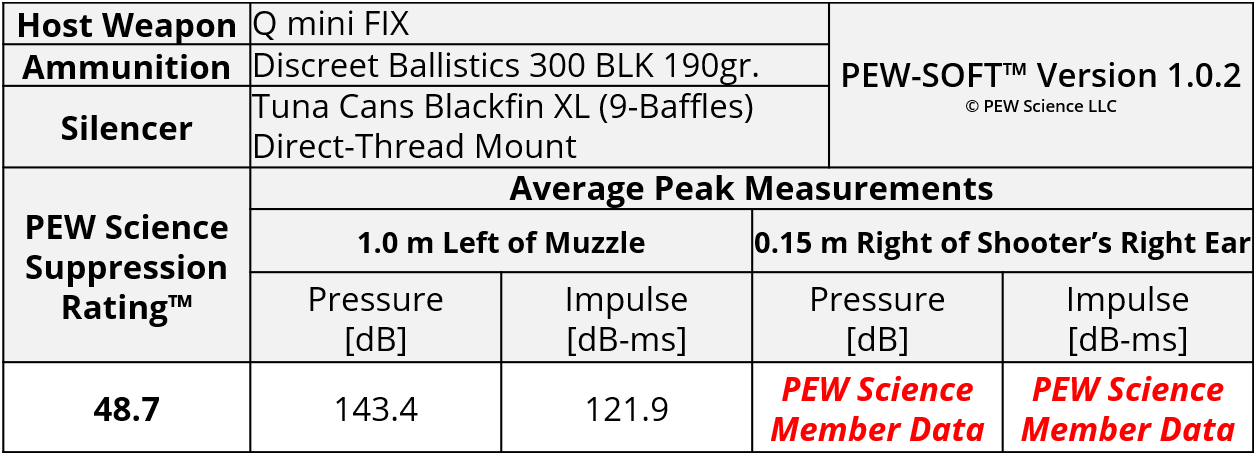
Table 2. Tuna Cans Blackfin XL 9-Baffle Configuration Sound Metric Summary
6.241.2.1 SOUND SIGNATURES AT THE MUZZLE
Real sound pressure histories from a 5-shot test acquired with PEW-SOFT™ are shown below. The waveforms are not averaged, decimated, or filtered. The data acquisition rate used in all PEW Science laboratory sound signature testing is 1.0 MS/s (1 MHz). The peaks, shape, and time phasing (when the peaks occur in relation to absolute time and to each other) of these raw waveforms are the most accurate of any firearm silencer testing publicly available. PEW-SOFT data is acquired by PEW Science independent laboratory testing; the recognized industry leader in silencer sound research. For more information, please consult the Silencer Sound Standard.
The primary sound signature pressure histories for all 5 shots are shown in Figure 5a. A zoomed-in timescale displays early time phenomena in Figure 5b, for the first two shots. The real sound impulse (momentum transfer potential) histories from the same 5-shot test are shown in Figure 6a. In Figure 6b, a shorter timescale is shown comparing the impulse of Shot 1 to that of Shot 2 and Shot 3.
Fig 5a. Tuna Cans Blackfin XL 9-Baffle Configuration Bolt Action 300 BLK Muzzle Sound Pressure Signature
Fig 5b. Tuna Cans Blackfin XL 9-Baffle Configuration Bolt Action 300 BLK Muzzle Sound Pressure Signature, Short Time Window
Fig 6a. Tuna Cans Blackfin XL 9-Baffle Configuration Bolt Action 300 BLK Muzzle Sound Impulse Signature
Fig 6b. Tuna Cans Blackfin XL 9-Baffle Configuration Bolt Action 300 BLK Muzzle Sound Impulse Signature, Short Time Window
When removing three baffles from the silencer to form the 9-baffle configuration, much of the same behavior is observed with two distinct differences:
Blowdown duration is reduced (Fig. 5)
Blast load amplitude in both pressure and impulse is elevated (Fig. 5 and Fig. 6).
PEW Science Research Note 8: Note that the FRP signature in the 9-baffle configuration is still severe and characterized by not only high amplitude but significantly high impulse accumulation rate (Fig. 6b). FRP blast propagation from the end of the 9-baffle configuration is initially violent from the subsonic pressure wave of the bullet coupled with a very intense initial jet; the rarefaction from this event shows high momentum (Fig. 5b) and that is confirmed with the impulse shown in Figure 6. The major FRP jet is suppressed significantly less than it was in the 12-baffle configuration. Nonetheless, the relative muzzle (bystander) FRP severity to subsequent shots with the 9-baffle configuration is reduced compared to that of the 12-baffle configuration because the remainder of the 9-baffle shots are more severe. Relative consistency remains with the 9-baffle configuration, post-FRP, albeit with gradually delayed momentum onset as the shot string progresses (Fig. 6b, 31 ms).
It is interesting to note that the above significant behavioral changes, dropping the muzzle Suppression Rating from 47.3 with the 12-baffle configuration to 40.2 with the 9-baffle configuration, occur with the removal of only 3 baffles. It is expected that the removal of further baffles will continue to drive up personnel risk with reduced signature suppression performance. It is important to note that the shape of the risk field changes when baffles are reduced from 12 with the Blackfin XL. Operators are exposed to significantly more risk during FRP, and in general. The operator (shooter’s ear) Suppression Rating drop from 63.5 to 47.7 reflects this, in a gross sense. The reader is encouraged to examine the Silencer Hazard Maps at the beginning of this report to view the spatial nature of the calculated risk field changes.
The Tuna Cans Blackfin XL 9-baffle shooter’s ear suppression performance is examined in the full Member Version of this report.
Direct comparisons with other silencers fired with subsonic 300 BLK from an 8-inch barrel are provided in Section 6.241.3.
6.241.3 Suppression Rating Comparison - Subsonic 300 BLK
The Tuna Cans Blackfin XL was developed with a focus on modularity, multi-caliber subsonic suppression, and economy. Figure 9 shows a performance comparison of many .30 caliber rifle silencer configurations tested with the subsonic 300 BLK cartridge shown in public PEW Science testing, to date, along with both the 12-baffle and 9-baffle configurations of the .375 caliber Blackfin XL. Unsuppressed and suppressed Suppression Ratings are shown for both the shooter and bystanders. The silencers in the figure are presented in order of total mounted system length, from shortest to longest.
Figure 9. Suppression Rating Comparisons Of the .375 Blackfin XL with .30 Rifle Silencers Using PEW-SOFT 300 BLK Subsonic Test Data
Hazards in Figure 9 are expressed with the Suppression Rating; a holistic parameter that captures human inner ear damage risk potential from a measured impulsive complex overpressure signature during the entire time regime of weapon operation, including combustion, complete blowdown, and all mechanical operation, including the carrier group returning to battery (if applicable), in the true free field. The parameter may be used with the dose chart at the beginning of this report. The PEW Science Suppression Rating is a damage risk criterion (DRC), a lower Suppression Rating indicates a higher personnel hazard in the free field - it is not a subjective quantity; it is an objective quantification of hearing damage risk potential. Due to its true free field test data origin and complete waveform analytical calculation basis, it is a universal suppressed weapon system signature comparison metric.
The following gross conclusions can be made from the subsonic 300 BLK bolt-action suppression performance metrics presented in Figure 9, above:
The 12-baffle Tuna Cans Blackfin XL produces average free field bystander hazard reduction that is similar to that of the following silencers on a 300 BLK bolt-action rifle:
The average free field operator (shooter) subsonic 300 BLK short barrel bolt-action hazard reduction of the 12-baffle Tuna Cans Blackfin XL is similar to that of the following silencers:
When removing three baffles from the Blackfin XL, suppression performance decreases:
The 9-baffle Tuna Cans Blackfin XL produces average free field bystander hazard reduction that is similar to that of the following silencers on a 300 BLK bolt-action rifle:
The average free field operator (shooter) subsonic 300 BLK short barrel bolt-action hazard reduction of the 9-baffle Tuna Cans Blackfin XL is similar to that of the following silencers:
CGS Hyperion K (6.50), again
Energetic Armament VOX-S (6.25), again
The reader is encouraged to use the sortable and filterable PEW Science Rankings table to compare the performance of the Tuna Cans Blackfin XL silencer from this test program with that of the performance on other silencers, with the reminder that the metrics are based on average personnel risk. FRP severity and risk differentials may differ based on silencer designs and combustion regimes.
PEW Science Research Note 11: As discussed in the previous Tuna Cans 5.56 XL evaluation, the technology in the Tuna Cans silencers is relatively well studied. With enough baffles and/or expansion volume, it produces significantly suppressed muzzle blast, with high back pressure, and severe FRP. It is important to note that when baffles are removed from the system, the risk field will increase in severity globally, and also potentially become more balanced. There is often a nonlinear relationship between changes in the severity of the risk field and the MIL-STD muzzle and ear measurement locations when modifying silencer configurations and designs. Comparison of the two Silencer Hazard Maps at the beginning of this report illustrate one possible outcome.
The difference in sound signature suppression performance from silencers in the subsonic 300 BLK suppression regime can be extremely significant. The user is encouraged to be mindful of the degree to which sound signature suppression, and resulting personnel hazards, can vary across designs. Small arm weapon system suppression performance is a spectrum. The PEW Science Suppression Rating and the Silencer Sound Standard help quantify this spectrum for end users and industry, objectively.
6.241.4 Review Summary: Tuna Cans Blackfin XL in 12-baffle and 9-baffle configurations on a Q mini FIX 300 BLK with 8-in Barrel
When paired with the Q mini FIX 8-in 300 BLK and fired with Discreet Ballistics 190gr Subsonic Target ammunition, the Tuna Cans Blackfin XL 12-baffle configuration with a direct-thread mount achieved a composite Suppression Rating™ of 63.7 in PEW Science testing. On the same host weapon, the Tuna Cans Blackfin XL 9-baffle configuration with a direct-thread mount achieved a composite Suppression Rating of 48.7.
As with all weapon systems, the user is encouraged to examine both muzzle and ear Suppression Ratings.
PEW Science Laboratory Staff Opinion:
The Tuna Cans Blackfin XL is a full size modular .375 caliber rifle silencer that provides various degrees of subsonic 300 BLK suppression performance based upon the number of baffles the user chooses to install. In the 12-baffle configuration, the silencer is the quietest, though it does exhibit noticeable first round pop (FRP). In the 9-baffle configuration, performance drops somewhat significantly and FRP remains severe. Nonetheless, users may find utility in the silencer due to its economy, modularity, HUB-mount compatibility, and multi-caliber applicability. Note that although the baffle technology in the Blackfin XL is relatively primitive, this program evaluates its performance in an over-bore condition, which is a performance handicap given this type of technology.
The Tuna Cans Blackfin XL is modular and tubeless in that the baffle sections connect to each other with threaded junctions. There are a total of 12 baffles; one stainless steel blast baffle and 11 aluminum primary baffles. All baffles are straight cones with single notches and stepped geometry. Similar in design to the baffles present in the Tuna Cans 5.56 XL, the baffle ridges increase surface area and turbulence which both influence heat transfer and signature suppression. It is important to note that the bore aperture of the Blackfin XL baffles is larger than .30 caliber silencers; the Blackfin XL is a .375 caliber silencer. This allows the Blackfin XL to function on 8.6 BLK (.338 caliber) systems. However, it also results in the aforementioned over-bore condition on .30 caliber hosts like the .300 BLK bolt-action test host used in this program. Note that the manufacturer states 9mm projectiles are too large for the Blackfin XL bore, despite the .375 caliber sizing.
In an unoptimized condition, silencer over-bore may result in notable signature inconsistency, compromised signature suppression, excess flash, and other inefficiencies. In the case of the Blackfin XL, a “brute force” approach in which all 12 baffles are used does mitigate many of the typical downsides of the over-bore condition. Nonetheless, FRP is not alleviated and this performance factor is shared with the 9-baffle configuration. One positive performance trait of the Tuna Cans Blackfin XL is that its post-FRP signature consistency is relatively robust.
Mounting systems are relatively easy to install in the Blackfin XL silencer due to the proximal wrench flats included on the stainless steel blast chamber assembly. Production versions of the silencer are shown to also have wrench flats on the individual baffles, which are probably paramount. Without those wrench flats, removal and installation of the baffles is somewhat challenging without a special tool or clamp. The test specimen evaluated in this program did not have baffle wrench flats and during testing, a pipe-wrench was used to reconfigure baffle count, as typical strap wrenches slipped and would not grip the unfinished smooth baffle surfaces.
As discussed in the previous Tuna Cans 5.56 XL evaluation, the technology in the Tuna Cans silencers is relatively well studied. With enough baffles and/or expansion volume, it produces significantly suppressed muzzle blast, with high back pressure, and severe FRP. It is important to note that when baffles are removed from the system, the risk field will increase in severity globally, and also potentially become more balanced. There is often a nonlinear relationship between changes in the severity of the risk field and the MIL-STD muzzle and ear measurement locations when modifying silencer configurations and designs. Comparison of the two Silencer Hazard Maps at the beginning of this report illustrate one possible outcome.
In this review, the Tuna Cans Blackfin XL performance metrics depend upon suppressing a subsonic intermediate rifle cartridge in two different baffle configurations. While the sound signature of such cartridges can be suppressed to levels that may result in the desire of the shooter and bystanders to not wear hearing protection, PEW Science encourages the reader to remain vigilant with regard to all subsonic rifle cartridge suppression claims. The gas volume and combustion products created by firing a subsonic intermediate rifle cartridge such as 300 BLK are still significant; the measured pressure and impulse magnitudes, and their durations, illustrate this fact.
The hearing damage potential of subsonic rifle use is not insignificant. PEW Science encourages the reader to consider the Suppression Rating when deciding on an appropriate silencer and host weapon combination for their desired use.