SSS.6.244 - Canik VOID-9 and the HK P30L - with Human Perception Analysis (Free Version)
/Canik VOID-9 on the HK P30L Full-Size Semiautomatic Pistol
The VOID-9 is designed and manufactured for Canik by Otter Creek Labs. It is a 9mm centerfire pistol silencer, intended to suppress the 9x19mm cartridge from semiautomatic handguns and submachine guns. The VOID-9 has a 1.38-inch primary diameter and an overall length of 6.75 inches, inclusive of the installed inertial decoupling piston assembly. While the VOID-9 is a fixed-length silencer, it is supplied with two interchangeable end caps that alter its internal gas dynamics: a Solid End Cap and a Vented End Cap. The silencer retail kit includes a 1/2-28tpi inertial decoupling piston, and the silencer is compatible with SilencerCo, Rugged Suppressors, HUXWRX, and CGS pattern pistons. For testing on the factory HK P30L 13.5x1mm LH threaded barrel in this evaluation, the VOID-9 was fielded with a Rugged Suppressors 13.5x1mm LH piston. The Rugged piston is vented, whereas the Canik pistons are not. Users should note that performance and operability differentials may occur when varying piston type. If the VOID-9 is fielded on fixed-barrel submachine guns or pistol-caliber carbines, a fixed barrel spacer or dedicated fixed mount must be installed in lieu of the inertial decoupler spring, as is typical for 9mm pistol silencers possessing inertial decoupling mechanisms. The VOID-9 is 3D-printed titanium. With the Rugged piston and Canik spring installed, the silencer weighs 9.4 ounces, as tested. The Canik VOID-9 can be obtained from Silencer Shop.
System Suppression Ratings and Silencer Hazard Maps:
This report includes two (2) different tests of the Canik VOID-9, evaluating both the Solid End Cap and Vented End Cap configurations on the standard HK P30L 9mm semiautomatic pistol. Composite and Detailed Suppression Ratings, along with the predicted personnel hazards generated by the tested configurations in this report in the free field, are shown in the below graphics and Silencer Hazard Maps. Click or tap the Maps to enlarge. Please reference Silencer Hazard Map Brief 8.1.41 for further details. The PEW-SOFT HD Blast Hazard Prediction Tool and Hazard Mapper is presented in Report 8.1.1.
Canik VOID-9 (Solid End Cap) HK P30L 9mm Pistol Free Field Hazard Map Produced by PEW-SOFT HD Blast Hazard Prediction Tool using PEW Science Test Data
Canik VOID-9 (Vented End Cap) HK P30L 9mm Pistol Free Field Hazard Map Produced by PEW-SOFT HD Blast Hazard Prediction Tool using PEW Science Test Data
PEW Science is an independent private testing laboratory and also hosts the world’s only independent public suppressed small arms research cooperative. Testing, data analysis, and reporting is generated with funding provided by PEW Science members. Any test data that is generated with any portion of private funding contains this disclosure. The testing and analysis production for this Sound Signature Review was funded in part by PEW Science Project PEW-Canik-165-001-26. Therefore, data pertaining to the VOID-9 in this Sound Signature Review is published with the express written permission of Canik USA LLC.
This Sound Signature Review contains test results and analysis for two silencer configurations in two tests. Test data was generated using the Canik VOID-9 in both its Solid End Cap and Vented End Cap configurations, fitted with a Rugged 13.5x1mm LH piston on the HK P30L full-size semiautomatic pistol, chambered in 9mm with a 5-inch factory HK threaded barrel. Speer Lawman 147gr ammunition was used in the tests.
Report Table of Contents:
Section 6.244.1 contains a Human Perception Analysis (Suppression Rating Loudness and Tone) comparing the Solid End Cap and Vented End Cap configurations of the VOID-9 at the muzzle and shooter's ear (including First-Round Pop analysis for PEW Science Members).
Section 6.244.2 contains the VOID-9 test results and analysis with the Solid End Cap.
Section 6.244.3 contains the VOID-9 test results and analysis with the Vented End Cap.
Section 6.244.4 contains Suppression Rating comparisons of the VOID-9 in both end cap configurations with the Microtech Defense R2K9, Dead Air Mojave 9, Rugged Obsidian 9, CAT SC, SilencerCo Omega 9K, Inert Haze Ti-P, AAC Ti-RANT 9M-HD, AAC Ti-RANT 9M, AAC Ti-RANT 9, HUXWRX CA$H 9K, Resilient Suppressors RSP, CGS MOD9 FS, Rugged Obsidian 45, and SWR Trident-9 silencers, fired on the Heckler and Koch P30L.
Section 6.244.5 contains the review summary and PEW Science laboratory staff opinions.
Summary: When paired with the HK P30L full-size semiautomatic pistol and fired with Speer Lawman 147gr ammunition with its Solid End Cap installed, the Canik VOID-9 achieved a Suppression Rating™ of 49.4 in PEW Science testing. With its Vented End Cap installed on the same host weapon and with the same ammunition, the VOID-9 achieved a Suppression Rating of 51.5. As with all weapon systems, the user is encouraged to examine both muzzle and ear Suppression Ratings.
Relative Suppression Rating Performance is Summarized in SSS.7 - PEW Science Rankings.
6.244.1 Canik VOID-9 Human Perception Analysis (Free Version)
While the overall PEW Science Suppression Rating quantifies the comprehensive hearing risk and severity of a suppressed gunshot on a single unified scale, human auditory response varies across frequency. Two suppressed weapon systems (or two configurations of the same silencer) may generate similar peak free field pressures while exhibiting distinctly different loudness and tonal characteristics to the operator and nearby bystanders.
PEW Science Suppression Rating calculations always consider tone mathematically, by default, as it is an inherent signature characteristic. To provide further objective engineering breakdown of how a suppressed signature is perceived across the human hearing spectrum, PEW Science has developed the PEW-SOFT HD Silencer Perception Plot (Suppression Rating Loudness and Tone Analysis). Unlike conventional microphone frequency plots that merely display raw free field pressure amplitudes, these curves are derived directly from the Suppression Rating analysis to map the true physical loudness and tonal response experienced by the human ear across four distinct regimes of perception (300 Hz to 15,000 Hz):
Low Frequency (300 Hz to 1,000 Hz | Deep / Full / Boomy): Driven primarily by late-time gas blowdown and muzzle blast expansion. Because human hearing sensitivity is naturally attenuated at low frequencies, energy in this regime is perceived as a full-bodied "thump" or "boom" rather than piercing loudness.
Mid-Range Transition (1,000 Hz to 2,500 Hz | Bark / Punchy): Marks the acoustic transition where sound couples with rapidly increasing efficiency into the human ear. On semiautomatic weapon systems, this band frequently captures the physical coalescence of forward muzzle jetting and ejection port blast propagation.
Peak Sensitivity (2,500 Hz to 5,500 Hz | Intense / Piercing): Represents the primary resonance band of human hearing sensitivity. Acoustic energy in this regime is perceived as intense, ear-ringing loudness and serves as the dominant driver of the overall PEW Science Suppression Rating.
High Frequency (5,500 Hz to 15,000 Hz | Bite / Hissing / Sharpness): Driven by phenomena that include high velocity turbulent jetting and sharp early-time events like breech gas leaks. Elevated response in this regime shifts the tonal balance upward, imparting a sharper, harsher, or sibilant edge to the signature.
The five-shot-average Human Perception Plots comparing the Canik VOID-9 equipped with the Solid End Cap and Vented End Cap on the HK P30L with Speer Lawman 9mm 147gr ammunition are presented in Figure 1a (Muzzle / Bystander) and Figure 1b (Shooter’s Ear / Operator), below. Click, tap, or zoom on the plots to enlarge.
Figure 1a. Canik VOID-9 Average Human Perception - Suppression Rating Loudness and Tone Analysis - Muzzle (Bystander) Location, Solid vs. Vented End Cap
Figure 1b. Canik VOID-9 Average Human Perception - Suppression Rating Loudness and Tone Analysis - Shooter’s Ear (Operator) Location, Solid vs. Vented End Cap
Evaluating Fig. 1a and Fig. 1b side-by-side demonstrates the physical gas flow and blast load propagation tradeoff between the two VOID-9 end-cap configurations and explains why their performance rank order reverses between the free field muzzle and the operator's ear locations:
Muzzle (Bystander) Five-Shot-Average Perception (Fig. 1a): In the free field 1.0 m left of the muzzle, the Solid End Cap (47.5 muzzle Suppression Rating) achieves slightly higher signature suppression performance than the Vented End Cap (46.6 muzzle Suppression Rating). As shown in the figure, because the Vented End Cap purposefully vents additional blast overpressure from both the silencer’s primary bore and annulus, it produces consistently higher perceived loudness across the Low Frequency (300–1,000 Hz), Mid-Range Transition (1,000–2,500 Hz), and lower Peak Sensitivity (2,500–4,600 Hz) regimes. To bystanders positioned adjacent to and forward of the firing line, this gives the Vented configuration a fuller, slightly louder low-mid "bark.” Above 5,000 Hz in the High Frequency regime, both configurations converge, attenuating high-frequency sibilance almost identically in the forward field.
Shooter's Ear (Operator) Five-Shot-Average Perception (Fig. 1b): At the operator's ear, lower amplitude ejection port blast and less mechanical shock allow the Vented End Cap configuration to outperform the Solid End Cap configuration (49.1 vs. 43.6 shooter’s ear Suppression Rating). While the Vented configuration’s loudness remains marginally higher below 1,100 Hz due to muzzle blast propagating back toward the shooter, the curves converge and cross inside the Mid-Range Transition zone (1,100–1,800 Hz). Above 1,800 Hz, the signature at the shooter's ear is governed by the aforementioned ejection port blast and mechanical shock from the piston, barrel, and pistol slide assembly. By increasing gross flow rate (reducing backpressure), the Vented End Cap drops peak perceived loudness at 4,600 Hz from 1.00 down to 0.83 (~17% lower peak loudness) and maintains a less piercing tonal profile across the entire Peak Sensitivity and High Frequency regimes (2,500–12,000 Hz).
PEW Science Research Note 1: The above plots illustrate why someone with high-frequency hearing loss from pre-existing hearing damage may interpret the Vented End Cap VOID-9 to sound “louder” on average than the Solid End Cap configuration, despite the shooter’s ear Suppression Rating indicating otherwise. This is independent of late-time muzzle blast effects in the forward field.
While five-shot-average curves characterize steady-state performance after oxygen-rich air has been purged from the silencer, the first shot fired through an atmospheric-filled silencer (first-round-pop, or “FRP”) alters both amplitude and tonal balance. The full Member Version of this report also contains First Shot (FRP) Human Perception Plots for both VOID-9 configurations.
The full report with detailed time-domain pressure and impulse waveforms for the Canik VOID-9 (Solid End Cap) is presented in Section 6.244.2 below, followed by the Vented End Cap evaluation in Section 6.244.3.
6.244.2 Canik VOID-9 (Solid End Cap) Sound Signature Test Results
A summary of the principal Silencer Sound Standard performance metrics of the Canik VOID-9 in its Solid End Cap configuration tested on the HK P30L is shown in Table 1. The data acquired 1.0 m (39.4 in) left of the muzzle is available for viewing to all. The data acquired 0.15 m (6 in) right of the shooter’s ear is only available to membership supporters of PEW Science and the Silencer Sound Standard. You can support public PEW Science testing, research, and development with a membership, here. State-of-the-art public firearm sound signature testing and research conducted by PEW Science is supported by readers like you.
Table 1. Canik VOID-9 (Solid End Cap) Sound Metric Summary
6.244.2.1 SOUND SIGNATURES AT THE MUZZLE
Real sound pressure histories from a 6-shot test acquired with PEW-SOFT™ are shown below. Six cartridges were loaded into the magazine and the weapon was fired until the magazine was empty, and the slide locked back on the slide-release lever actuated by the follower of the empty magazine. Only five shots are considered in the analysis. The signatures of Shot 6 are displayed in the data presentation but are not included in the analysis to maintain consistency with the overall PEW Science dataset. The waveforms are not averaged, decimated, or filtered. The data acquisition rate used in all PEW Science testing is 1.0 MS/s (1 MHz). The peaks, shape, and time phasing (when the peaks occur in relation to absolute time and to each other) of these raw waveforms are the most accurate of any firearm silencer testing publicly available. PEW-SOFT data is acquired by PEW Science independent testing; the industry leader in silencer sound research. For more information, please consult the Silencer Sound Standard.
The primary sound signature pressure histories for all 6 shots with the Canik VOID-9 in its Solid End Cap configuration are shown in Figure 3a. The sound signatures of Shot 1 and Shot 2 are shown in Figure 3b, in early time. The real sound impulse (momentum transfer potential) histories from the same 6-shot test are shown in Figure 4a. In Figure 4b, a shorter timescale is shown comparing the impulse of Shots 1 through 3.
Figure 3a. Canik VOID-9 (Solid End Cap) subsonic 9x19mm HK P30L Semiautomatic Pistol Muzzle Sound Pressure Signature
Figure 3b. Canik VOID-9 (Solid End Cap) subsonic 9x19mm HK P30L Semiautomatic Pistol Sound Pressure Signature
Figure 4a. Canik VOID-9 (Solid End Cap) subsonic 9x19mm HK P30L Semiautomatic Pistol Muzzle Sound Impulse Signature
Figure 4b. Canik VOID-9 (Solid End Cap) subsonic 9x19mm HK P30L Semiautomatic Pistol Muzzle Sound Impulse Signature
The Canik VOID-9 is a compact hybrid centerfire pistol silencer; as shown in Figure 11 later in this report, its overall length sits between the 6.44-inch short configuration of the Microtech Defense R2K9 (6.198) and the 6.8-inch Resilient Suppressors RSP (6.87), placing it in the "mid-size" or long-compact envelope for 9mm handgun silencers. Rather than employing removable tube extensions to alter length, the VOID-9 allows the operator to tune internal gas dynamics and distal flow rate (Omega) by swapping between a Solid End Cap (evaluated in this section) and a Vented End Cap (evaluated in Section 6.244.3).
PEW Science Research Note 2: Unlike traditional baffle pistol silencers such as the Rugged Obsidian 9 (6.172), the AAC Ti-RANT series (6.118), or the aforementioned Microtech R2K9, the Canik VOID-9 is classified as a hybrid design in the PEW Science research taxonomy. Specifically, the silencer uses Otter Creek Labs Infinity technology (see Infinity 762 and Infinity 556K technical reports). Internally, the silencer combines primary bore reflectors with an outer annular flow path designed to manage early-time stagnation and distribute combustion gases radially prior to exit. When fitted with the Solid End Cap, however, the outer annulus is sealed at the distal face of the silencer. Consequently, gas that enters the annular path must recombine and exit entirely through the single central bore aperture.
PEW Science Research Note 3: With the Solid End Cap installed, restricting distal gas exit strictly to the primary bore produces specific free field signature characteristics in the measured test data above:
Moderate gross blast pressure amplitude (Fig. 3a), with a distinct precursor wave (Fig. 3b).
High-amplitude initial coupled jetting, followed by discrete and repeating primary jetting peaks before the flow begins to normalize (Fig. 3b).
A characteristic stepped jetting profile in impulse space across all shots (Fig. 4b), where momentum transfer accumulates in discrete stages.
Moderate First-Round Pop (FRP) divergence in impulse space, before normalizing post-peak.
As revealed in the Human Perception Analysis in Section 6.244.1 (Fig. 2a), although the peak free field pressure of Shot 1 is numerically similar to Shot 2, the Solid End Cap restricts the secondary FRP combustion wave from venting directly out of the annulus. Funneling that secondary FRP combustion through the central bore aperture generates severe high-frequency jetting above 3,100 Hz in the Peak Sensitivity and High Frequency regimes.
PEW Science Research Note 4: Sealing the distal end of the annulus with the Solid End Cap limits the gross late time flow rate (Omega) of the VOID-9. While this constraint slightly improves forward bystander hazard reduction (47.5 Muzzle Suppression Rating), it increases internal impulse accumulation and backpressure on the modified Browning tilting-barrel action of the HK P30L. Even so, because the internal hybrid geometry still provides early-time annular volumetric expansion, the VOID-9 with the Solid End Cap achieves a 43.6 Shooter's Ear Suppression Rating, meeting or exceeding the operator protection of several legacy full-size K-baffle and curved-cone silencers (such as the Obsidian 9 Long, Ti-RANT 9M-HD Long, and R2K9 Long) as well as shorter conventional designs like the SilencerCo Omega 9K (6.153) and Inert Haze Ti-P (6.145).
PEW Science Research Note 5: As in most semiautomatic weapon testing, a second pressure pulse originates from the ejection-port signature of the weapon and it occurs early enough in time such that its waves coalesce with that of the muzzle signature. However, in late time (at approximately 73 ms in Figure 3a) the mechanical noise of the slide closing is observed. The pressure signature of Shot 6 does not display this event due to the slide remaining locked to the rear after the sixth and final round is fired from the magazine.
The shape, timing, and magnitudes of the early-time pressure pulses and overall shape of the impulse waveforms measured at the muzzle, from shot-to-shot, are relatively consistent (note the early chamber breech leak visible on Shot 3 at ~30.4 ms in Fig. 4b). The consistency of the waveform amplitudes highlights the silencer’s overall sound performance consistency at the muzzle after the FRP, as well as the relative consistency of the tested semiautomatic firearm configuration.
PEW Science Research Note 6: Note that the muzzle Suppression Rating of the Canik VOID-9 with its Solid End Cap used on the full-size HK P30L semiautomatic handgun test host is 47.5 and the shooter’s-ear Suppression Rating is 43.6; both reside in the same zone on the Suppression Rating Dose Chart. The gross suppression of a silencer, as well as its flow rate, influences the holistic signature on a semiautomatic host weapon. The signatures measured at the shooter’s ear with the Solid End Cap are presented and examined in the full Member Version of this report.
When the Solid End Cap is replaced with the Vented End Cap, the annulus is opened to the atmosphere at the distal end, significantly altering the gross flow rate (Omega) and changing the signature balance between the muzzle and the shooter's ear. This is demonstrated in the test results and analysis in the following section.
6.244.3 Canik VOID-9 (Vented End Cap) Sound Signature Test Results
A summary of the principal Silencer Sound Standard performance metrics of the Canik VOID-9 in its Vented End Cap configuration is shown in Table 2. The data acquired 1.0 m (39.4 in) left of the muzzle is available for viewing to all. The data acquired 0.15 m (6 in) right of the shooter’s ear is only available to membership supporters of PEW Science and the Silencer Sound Standard. You can support public PEW Science testing, research, and development with a membership, here. State-of-the-art public firearm sound signature testing and research conducted by PEW Science is supported by readers like you.
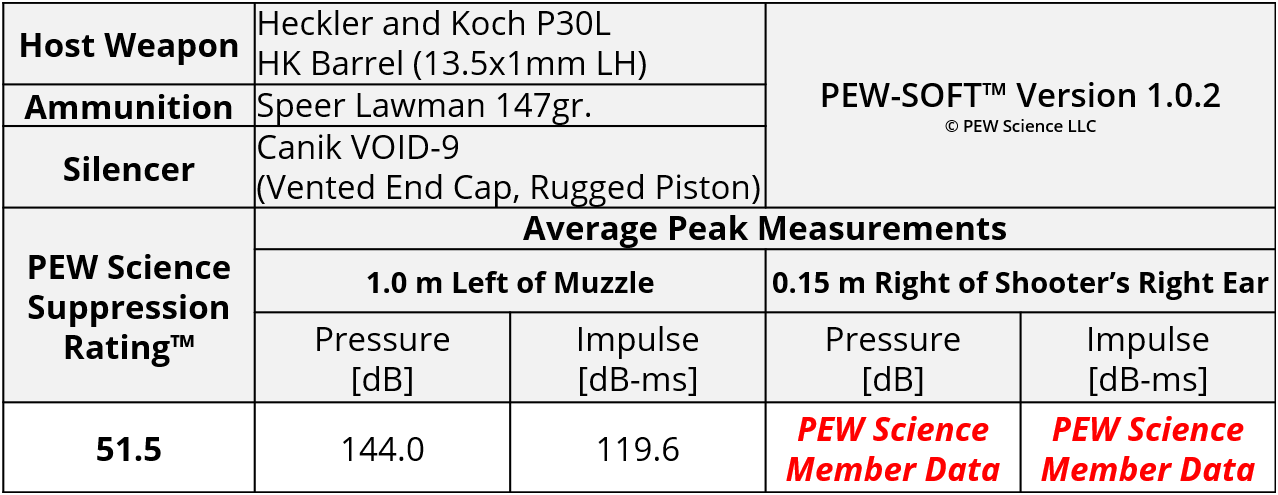
Table 2. Canik VOID-9 (Vented End Cap) Sound Metric Summary
6.244.3.1 SOUND SIGNATURES AT THE MUZZLE
Real sound pressure histories from a 6-shot test acquired with PEW-SOFT™ are shown below. The waveforms are not averaged, decimated, or filtered. The data acquisition rate used in all PEW Science testing is 1.0 MS/s (1 MHz). The peaks, shape, and time phasing (when the peaks occur in relation to absolute time and to each other) of these raw waveforms are the most accurate of any firearm silencer testing publicly available. PEW-SOFT data is acquired by PEW Science independent testing; the industry leader in silencer sound research. For more information, please consult the Silencer Sound Standard.
The primary sound signature pressure histories for all 6 shots with the Canik VOID-9 in its Vented End Cap configuration are shown in Figure 7a. The sound signatures of Shot 1 and Shot 2 are shown in a shorter time window in Figure 7b. The real sound impulse (momentum transfer potential) histories from the same 6-shot test are shown in Figure 8a. In Figure 8b, a shorter timescale is shown comparing the impulse of Shot 1 to that of Shot 2 and Shot 3.
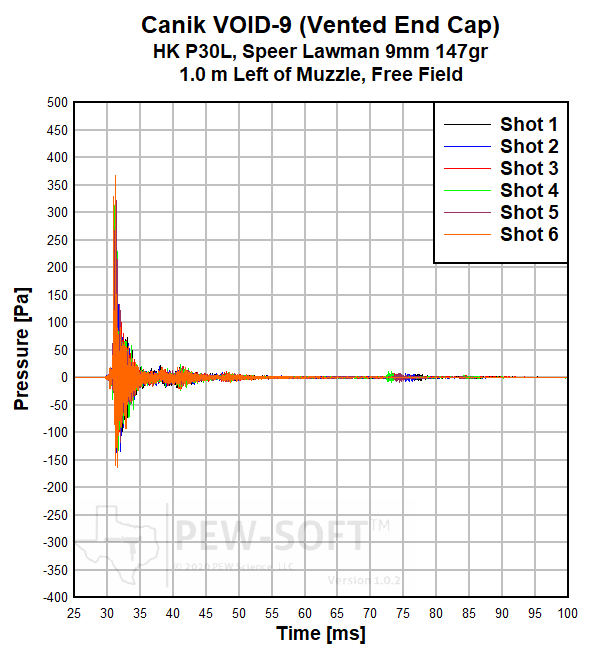
Figure 7a. Canik VOID-9 (Vented End Cap) subsonic 9x19mm HK P30L Semiautomatic Pistol Muzzle Sound Pressure Signature

Figure 7b. Canik VOID-9 (Vented End Cap) subsonic 9x19mm HK P30L Semiautomatic Pistol Muzzle Sound Pressure Signature
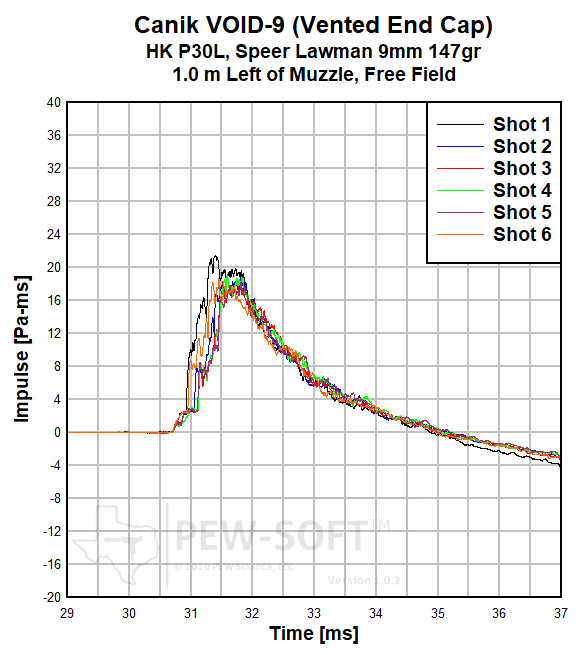
Figure 8a. Canik VOID-9 (Vented End Cap) subsonic 9x19mm HK P30L Semiautomatic Pistol Muzzle Sound Impulse Signature
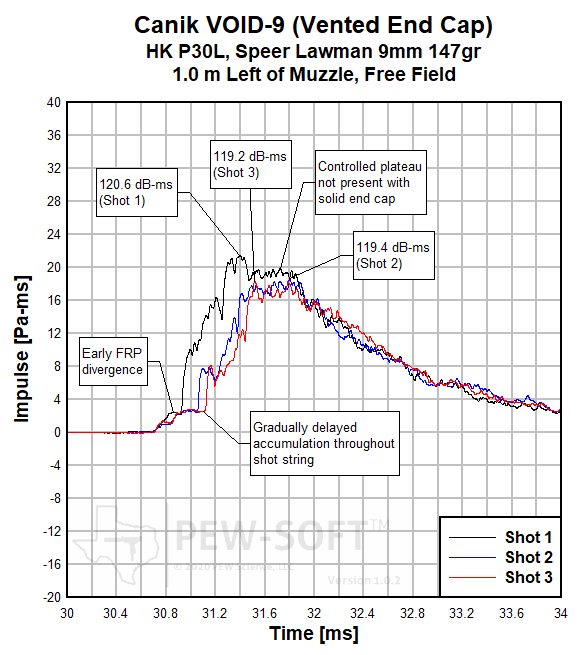
Figure 8b. Canik VOID-9 (Vented End Cap) subsonic 9x19mm HK P30L Semiautomatic Pistol Muzzle Sound Impulse Signature
Replacing the Solid End Cap with the Vented End Cap opens two sets of ports at the distal end of the VOID-9; three ports from the main bore and six ports from the annulus. This allows gas to escape and combine from both origins, combining annular and bore jetting to atmosphere. Unlike modular silencers where shortening the tube removes baffles and can significantly drop suppression efficiency, swapping the end cap on the VOID-9 keeps the physical length constant while increasing the gross distal flow rate. Comparing Figures 7 and 8 (Vented End Cap) against Figures 3 and 4 (Solid End Cap) highlights several key physical performance and behavioral differentials at the muzzle:
Identical Average Peak Pressure, Faster Blowdown, and Higher Momentum Transfer: While the five-shot-average peak muzzle pressure is identical
Slightly Higher Precursor and Deeper Rarefaction: With the distal vents open, the precursor amplitude increases slightly and the higher flow rate from the combined bore and annular vents induces somewhat more severe rarefaction (negative-phase pressure) than the Solid End Cap (Fig. 7b).
Gradually Delayed Accumulation and Controlled Impulse Plateau: In impulse space, the Vented End Cap exhibits a gradually delayed accumulation throughout the shot string followed by a distinct, flat and controlled plateau that is not present with the Solid End Cap (Fig. 8b). This plateau demonstrates active momentum throttling.
PEW Science Research Note 8: Examine Table 1 and Table 2 closely: both the Solid End Cap and Vented End Cap configurations of the Canik VOID-9 produce an identical five-shot-average peak muzzle pressure and an identical five-shot-average peak shooter's ear pressure. Furthermore, average peak impulse at both sensors is numerically higher with the Vented End Cap. Any evaluation relying on peak pressure (dB) or peak impulse (dB-ms) alone would either conclude that the Vented End Cap makes little difference or erroneously rank the Vented End Cap as more hazardous at the shooter's ear. In physical reality, as characterized by the PEW Science Suppression Rating (49.1 vs. 43.6 at the ear) and the Perception Plots (Fig. 1b and Fig. 2b in Section 6.244.1), the Vented End Cap is quieter and safer for the operator in the free field because it reduces high-frequency ejection-port blast jetting and mechanical shock above 1,800 Hz.
PEW Science Research Note 9: Adding distal bore and annular vents shifts the free field Muzzle Suppression Rating from 47.5 (Solid End Cap) to 46.6 (Vented End Cap); not a significant change. As shown in the average Muzzle Perception Plot (Fig. 1a), that point reduction is driven by the fuller, slightly more "boomy" and "barky" low-to-mid-frequency part of the signature from the higher distal flow rate exiting the vents. In exchange for sacrificing minimal bystander suppression at the muzzle, the Vented End Cap increases operator protection at the shooter's ear by half a Suppression Rating category.
PEW Science Research Note 10: It is very interesting to note that the Vented End Cap configuration of the VOID-9 is functionally analogous to the “Fully Vented” Infinity 556K or “5.56 Vented” Infinity configurations in function; moving from Solid to Vented VOID-9 skips the “partially vented” end cap step where only annular venting would be provided (no additional bore venting is present in the “partially vented” Infinity end caps). For the VOID-9 to lose minimal muzzle suppression performance when jumping to fully combined axial bore and annular venting is notable. On the whole, transitioning from the Solid to Vented End Cap keeps early-time proximal flow (alpha) constant while increasing late time flow rate (dropping Omega). This is further reflected in the jet stability index dropping between the configurations as shown in the Hazard Maps at the beginning of this report. The signatures measured at the shooter’s ear with the Vented End Cap are presented and examined in the full Member Version of this report.
The following section presents overall comparisons of centerfire pistol silencer configurations on the HK P30L semiautomatic pistol.
6.244.4 Suppression Rating Comparison (Subsonic 9x19mm from the HK P30L)
Figure 11 presents a comparison of the PEW Science Suppression Ratings of the Canik VOID-9 in both its Solid End Cap and Vented End Cap configurations with other silencers on the full-size HK P30L semiautomatic pistol using subsonic Speer Lawman 147gr 9mm ammunition. Note that Figure 11 presents all silencers in order of overall length, inclusive of the installed piston.
Figure 11. Suppression Rating Comparisons of the Canik VOID-9 Solid and Vented with the Microtech Defense R2K9, Dead Air Mojave 9, Rugged Obsidian 9, CAT SC, SilencerCo Omega 9K, AAC Ti-RANT 9 Series, the HUXWRX CA$H 9K, Resilient Suppressors RSP, Rugged Obsidian 45, CGS MOD9 FS, and SWR Trident-9 on the HK P30L, Using PEW-SOFT 9x19mm Subsonic Test Data and PEW Science Analysis
Figure 11 presents an overall summary of the postulated hazards to the operator and bystanders when fielding a variety of different silencers on the standard HK P30L 9x19mm semiautomatic pistol weapon system. The two configurations of the Canik VOID-9 from this test program are shown in red. Data is also presented for the fielding cases of the Microtech Defense R2K9 (6.198), Dead Air Mojave 9 (6.177), Rugged Obsidian 9 (6.172), CAT/SC/B1 (6.162), SilencerCo Omega 9K (6.153), Inert Haze Ti-P (6.145), AAC Ti-RANT 9 series (6.118), HUXWRX CA$H 9K (6.96), Resilient Suppressors RSP (6.87), SWR Trident-9 (6.8), Rugged Obsidian 45 (6.7), and CGS MOD9 FS (6.6). Hazards are expressed with the Suppression Rating; a holistic parameter that captures human inner ear damage risk potential from a measured impulsive complex blast overpressure signature during the entire time regime of weapon operation, including combustion, complete blowdown, and all mechanical operation, including the slide returning to battery, in the true free field. The parameter may be used with the dose chart and Hazard Maps at the beginning of this report. The PEW Science Suppression Rating is a damage risk criterion (DRC); a lower Suppression Rating indicates a higher personnel hazard in the free field - it is not a subjective quantity; it is an objective quantification of hearing damage risk potential. Due to its true free field test data origin and complete waveform analytical calculation basis, it is the only known universal suppressed weapon system signature comparison metric available. Analytically computed metrics are color-coded in the Rankings Table, in all Silencer Hazard Maps, and keyed to the dose chart for user interpretation.
The following gross conclusions can be made from the metrics presented above and the test data in this report:
The solid and vented end cap configurations of the Canik VOID-9 provide relatively balanced performance on the standard HK P30L, and are highly competitive in overall suppression performance throughout the risk field for their mid-size 6.75-inch length.
The vented end cap configuration is the more balanced of the two configurations of the VOID-9 on a reciprocating semiautomatic handgun, providing extreme operator protection while minimally sacrificing free-field bystander protection.
Changing the end cap to the solid variant restricts distal flow from both the primary bore and the outer annulus compared with the vented end cap, and therefore slightly increases forward bystander hazard reduction in the free field while elevating weapon backpressure, ejection port blast, and piston/slide mechanical shock at the operator's ear. User impressions of signature loudness and tonal severity across both configurations will vary based upon the physical factors highlighted in the Human Perception and Tone Analysis in Section 6.244.1 of this report.
The vented end cap configuration of the VOID-9 produces less ejection port blast and mechanical shock to the weapon operator during firing. Personnel in the forward field will perceive the vented configuration as having a fuller, slightly louder low-to-mid-frequency "bark" (as quantified in Section 6.244.1), and nearby reflecting surfaces may increase operator hazard more so than in the true free field, though to a lesser extent than with lower-performing compact silencers that exhibit more severe muzzle blast.
Specific performance comparisons of each Canik VOID-9 configuration with the rest of the HK P30L dataset are presented below:
Solid End Cap Configuration
The Canik VOID-9 with solid end cap (47.5 Muzzle Suppression Rating) produces free field bystander hazard reduction on par with or exceeding the following silencers on the HK P30L weapon system:
Canik VOID-9 (Vented End Cap, this report)
The free field operator (shooter) hazard reduction of the Canik VOID-9 with solid end cap (43.6 Ear Suppression Rating) on the standard HK P30L weapon system is higher than that of all tested legacy full-size traditional baffle silencers. The operator protection is on par with or exceeding that of the:
Microtech Defense R2K9 (Short) (6.198), again
Inert Haze Ti-P (6.145), again
Vented End Cap Configuration
The Canik VOID-9 with vented end cap (46.6 Muzzle Suppression Rating) produces free field bystander hazard reduction on par with or exceeding the following silencers on the HK P30L weapon system:
Canik VOID-9 (Solid End Cap, this report)
Inert Haze Ti-P (6.145), again
The free field operator (shooter) hazard reduction of the Canik VOID-9 with vented end cap (49.1 Ear Suppression Rating) on the standard HK P30L weapon system is among the highest evaluated by PEW Science to date, trailing only the short configuration of the CAT/SC/B1 (6.162). The HK P30L operator protection is on par with or exceeding that of the:
PEW Science Research Note 13: The shooter’s ear Suppression Rating of the Canik VOID-9 with vented end cap is tied for #2 overall in the PEW Science laboratory HK P30L Rankings, and its Composite Suppression Rating is the highest of any pistol silencer configuration under 7.5 inches in length on this platform. Meanwhile, both the Solid End Cap and Vented End Cap configurations rank inside the Top 2 of all sub-7-inch pistol silencers in muzzle (bystander) Suppression Rating, exceeded in that size bracket only by the higher-backpressure R2K9 Short. Please note that similar Suppression Ratings between different silencers do not mean that the weapon systems will sound identical to the shooter or bystanders in the free field. What an operator hears through the entire time regime of a gunshot event and subsequent environmental reflections, and which acute hazards and tonal characteristics manifest, may differ significantly. The reader is strongly encouraged to review the published Human Perception Plots in Section 6.244.1 as well as the Silencer Hazard Maps at the top of this report and in Silencer Hazard Map Brief 8.1.41. For further context regarding performance, size, and weight balance, the reader is encouraged to use the Suppression Rating Parametric Visualization Tool (Members Only) for independent study.
Hybrid designs, as classified in the PEW Science research taxonomy, continue to demonstrate the most significant holistic performance potentials in centerfire combat handgun suppression. While traditional K-baffle, curved-cone baffle, and similar legacy designs are capable of high pure muzzle signature suppression through length and volume, balanced protection for both the operator and bystanders is demonstrated to have the greatest chance of success with modern hybrid design solutions that manage early-time and distal flow rates. Silencers like the CAT SC, Dead Air Mojave 9, and now the Canik VOID-9 show that high operator hazard reduction and competitive bystander protection can be achieved simultaneously in practical design envelopes.
As detailed in this report, the signature at the operator’s head is a function of both muzzle and ejection port signatures from the semiautomatic pistol weapon system. When the silencer’s end cap is in closer proximity to the shooter, the severity is increased. The coalescing of the ejection port overpressure with the primary muzzle blast exacerbates the severity of the signature at the shooter’s head position. Specific weapon system parameters and end cap selection will dictate hazard reduction efficacy.
Small arm weapon system suppression performance is a spectrum. The PEW Science Suppression Rating and the Silencer Sound Standard help quantify this spectrum for end users and industry, objectively.
6.244.5 Review Summary: Canik VOID-9 on the HK P30L Full-Size Semiautomatic Pistol
When paired with the HK P30L full-size semiautomatic pistol and fired with Speer Lawman 147gr ammunition with its Solid End Cap installed, the Canik VOID-9 achieved a Suppression Rating™ of 49.4 in PEW Science testing. With its Vented End Cap installed on the same host weapon and with the same ammunition, the VOID-9 achieved a Suppression Rating of 51.5.
As with all weapon systems, the user is encouraged to examine both muzzle and ear Suppression Ratings.
PEW Science Laboratory Staff Opinion:
The Canik VOID-9 is a mid-size, 3D-printed titanium hybrid design 9mm centerfire pistol silencer that offers the user adjustable back pressure with interchangeable Solid and Vented end caps. At 6.75 inches in overall length and 9.4 ounces as tested, the VOID-9 sits between compact "K" silencers and longer full-size models, achieving an impressive balance of bystander and operator hazard reduction. When fielded with its Vented End Cap, the VOID-9 delivers free-field operator protection on par with the highest performing pistol silencers evaluated by PEW Science on the HK P30L semiautomatic combat handgun, to date.
Unlike traditional baffle pistol silencers such as the Rugged Obsidian 9, the AAC Ti-RANT series, or the Microtech R2K9, the Canik VOID-9 is classified as a hybrid design in the PEW Science research taxonomy and utilizes Otter Creek Labs Infinity technology. Internally, the silencer combines primary bore reflectors with an outer annular flow path designed to manage early-time pressure stagnation and distribute combustion gases radially prior to exit. Rather than employing removable tube extensions to alter length and internal volume, the VOID-9 allows the operator to tune internal gas dynamics and gross distal flow rate (adjust back pressure) by swapping between the included Solid and Vented end caps.
When fitted with the Solid End Cap, the outer annulus is sealed at the distal face of the silencer, forcing gas that enters the annular path to recombine and exit entirely through the single central bore aperture. While this constraint slightly improves forward bystander hazard reduction in the free field, it increases internal impulse accumulation and weapon backpressure on the modified Browning tilting-barrel action of the HK P30L. Even so, because the internal hybrid geometry still provides early-time annular volumetric expansion, the VOID-9 with the Solid End Cap meets or exceeds the operator protection of all tested legacy full-size K-baffle and curved-cone silencers, as well as shorter conventional designs like the SilencerCo Omega 9K.
Replacing the Solid End Cap with the Vented End Cap opens two sets of ports at the distal end of the VOID-9; three ports from the main bore and six ports from the annulus, allowing gas to escape from both origins to the atmosphere. In exchange for sacrificing minimal bystander suppression at the muzzle, the Vented End Cap increases operator protection at the shooter's ear by half a Suppression Rating category. With the Vented End Cap installed, the Canik VOID-9 ties the long configuration of the CAT SC for the second highest shooter's ear Suppression Rating in the HK P30L Rankings, and its Composite Suppression Rating is currently the highest of any pistol silencer configuration under 7.5 inches in length on this platform.
As demonstrated in the PEW-SOFT HD Silencer Perception Plots introduced in this report, the slight reduction in free-field muzzle Suppression Rating with the Vented End Cap is driven by a fuller, more "boomy" and "barky" low-to-mid-frequency signature resulting from the higher distal flow rate exiting the vents. At the operator's ear, however, increasing gross flow rate with the Vented End Cap significantly reduces ejection port blast and mechanical shock from the piston, barrel, and slide assembly, substantially lowering perceived loudness across the critical Peak Sensitivity and High Frequency hearing regimes. Notably, both end cap configurations of the VOID-9 produce identical average peak pressures at the muzzle and shooter's ear, and average peak impulse is numerically higher with the Vented End Cap, illustrating why simplistic evaluations relying on peak pressure or peak impulse alone fail to characterize the physical hazards and human perception of silencer signatures.
The Canik VOID-9 retail kit includes a 1/2-28tpi inertial decoupling piston and both end caps, and the silencer is compatible with SilencerCo, Rugged Suppressors, HUXWRX, and CGS pattern pistons. For testing on the factory HK P30L 13.5x1mm LH threaded barrel in this evaluation, the VOID-9 was fielded with a Rugged Suppressors 13.5x1mm LH piston and the Canik booster spring. Users should note that the Rugged piston is vented, whereas the factory Canik pistons are not; performance and operability differentials may occur when varying piston type. If the VOID-9 is fielded on fixed-barrel submachine guns or pistol-caliber carbines, a fixed barrel spacer or dedicated fixed mount must be installed in lieu of the inertial decoupler spring. Users should contact the manufacturer for guidance on firing schedules and mounting configurations for their desired application.
In this review, the Canik VOID-9 performance metrics depend upon suppressing a full-size combat handgun firing a full-power subsonic centerfire pistol cartridge. This type of evaluation provides a potential upper-bound for typical real handgun silencer performance due to the barrel length and action dynamics of the host weapon. PEW Science encourages the reader to carefully consider action dynamics, barrel lengths, and other characteristics in the selection of centerfire pistol silencer hosts.
The hearing damage potential of centerfire pistol use is significant. PEW Science encourages the reader to consider the Suppression Rating when deciding on an appropriate silencer and host weapon combination for their desired use. Note that the presence of nearby reflecting surfaces, as well as ammunition choice, can influence the sound signature to which both the shooter and bystanders are subjected.